
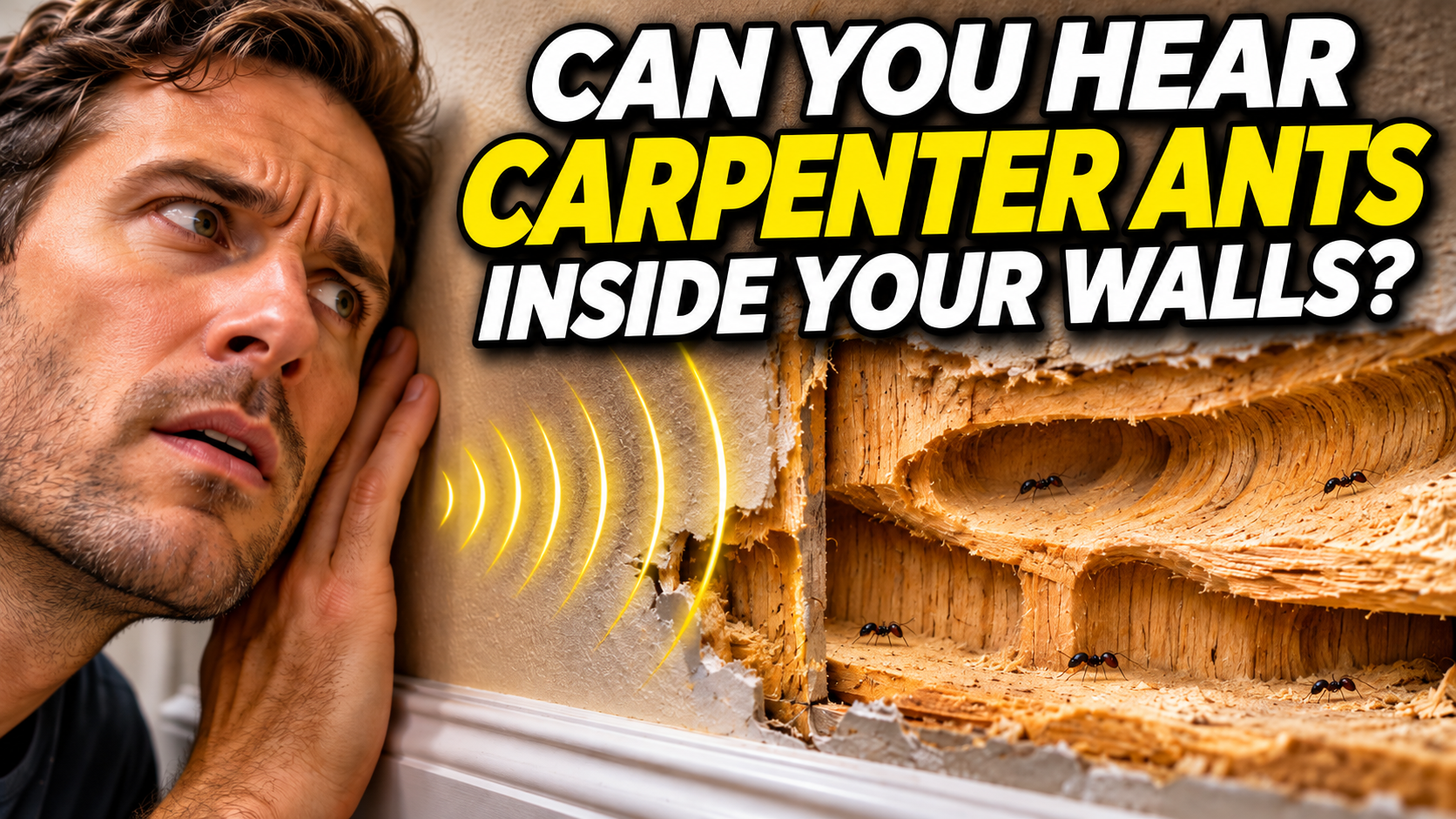
Can You Hear Carpenter Ants Inside Your Walls? The answer is yes, under certain conditions. A well-established carpenter ant colony can create faint rustling or scratching-like sounds within a wall, ceiling, door, or wooden structural cavity. These noises are not necessarily loud enough to notice while a television, fan, or air conditioner is running. Sometimes a homeowner hears something only after pressing an ear close to a suspected area, and a pest professional may use a stethoscope. That makes the phenomenon real, but not a reliable do-it-yourself diagnosis on its own. Other insects, rodents, expanding materials, and plumbing can create sounds that seem similar.
Why Carpenter Ants Can Make Noise Inside Walls
Carpenter ants are social insects that establish nests in wood or sheltered voids, including spaces inside buildings. Workers travel through these cavities, maintain their nests, move nesting material, and react when the colony is disturbed. When enough individuals are active in the same place, their movement can generate a dry, intermittent rustling sound. The University of Minnesota Extension specifically describes active colonies making such noises, sometimes more clearly after disturbance. Noise does not mean that ants are deliberately calling to a person outside the wall. It means their activity can become detectable through materials separating the nest from the listener. The volume depends on colony activity, distance, surrounding construction, and background sound.
What Does a Carpenter Ant Nest Actually Sound Like?
Descriptions from university extension specialists repeatedly use the word rustling, not a steady buzz, chirp, or human-like voice. Some people compare the sound to crinkling dry material or faint movement behind a surface. NC State Extension also describes rustling or gnawing sounds associated with mature colonies. The noise may be intermittent rather than continuous and may become more noticeable when the nesting area is disturbed. None of those descriptions gives a sound signature that can conclusively distinguish carpenter ants from every other source. If a wall makes noise only when heating equipment cycles or water flows, the homeowner needs to investigate those possibilities too instead of assuming that an insect nest is present.
Can You Hear Carpenter Ants Inside Your Walls Without Equipment?
Sometimes, but the circumstances matter. A quiet room, activity close to a wall surface, and a sufficiently busy nest make listening more practical. University guidance mentions pressing an ear against suspected surfaces, while some specialists use a stethoscope for better detection. Listening late in the evening may help because surrounding household noise can be lower, and carpenter ants often forage after dark. Yet a silent wall proves little. An infestation may be too small, too far from the surface, or simply inactive during the brief period someone listens. Similarly, hearing a faint sound is a reason to inspect other evidence, not proof that carpenter ants caused it.
Do Carpenter Ants Chew and Eat the Wood?
The common idea that carpenter ants eat wood in the same way termites do is wrong. Carpenter ants excavate wood to build galleries and move the material out of the nest. Their food sources include insects and sweet substances, not the wood they remove. Penn State Extension explains that workers may nest in existing hollow spaces, softened timber, or insulation, and that displaced wood particles can collect near openings. This distinction matters when interpreting the sound: activity can involve movement through cavities as well as excavation, and not every noise must be the sound of wood being chewed. Severe or prolonged nesting in important structural members can still require repairs, especially where water damage already exists.
Where Hidden Carpenter Ant Nests Are Most Likely
Moisture problems provide important clues. Look around leaking windows, damp bathroom framing, areas below sinks, damaged rooflines, and spots where condensation or drainage has repeatedly wetted building materials. Satellite nests can also occupy relatively dry interior voids, while a parent nest may be outdoors in a tree or stump. That means seeing carpenter ants in a kitchen does not by itself establish that the main colony is in the kitchen wall. Follow repeated ant trails and note where workers disappear. For a practical first inspection checklist, the PestMarket ant control guide covers signs of recurring ant activity, entry points, and moisture reduction.
What Other Signs Should You Check?
Look for coarse, fibrous sawdust-like material, discarded insect parts, repeated trails of relatively large ants, and workers emerging from gaps in trim or wood. Excavated debris is especially useful because carpenter ants do not consume the wood; they push unwanted material outside their galleries. NC State Extension describes such debris as a clue to the location of a nest. Also inspect for past leaks or soft, damaged wood, remembering that some nests occupy existing cavities without causing dramatic visible timber destruction. One ant wandering across a countertop, or one unusual noise from a wall, should not trigger an expensive demolition project. A pattern of several signs is far more informative.
Could the Noise Come From Something Else?
Absolutely. Buildings contain many potential sources of tapping, squeaking, scraping, or rustling, including pipes, ventilation systems, small vertebrates, other insects, and ordinary movement in construction materials. Sound alone cannot determine the insect species, colony size, exact nest location, or amount of damage. It also cannot tell homeowners whether the source is a carpenter ant nest versus foraging ants temporarily moving through an existing opening. Professionals combine observations, inspection of moisture conditions, insect identification, evidence of excavated debris, and sometimes targeted listening. The most defensible conclusion is that acoustic clues are useful supporting evidence, not an independent identification test.
What Should Homeowners Do Before Opening a Wall?
Start with non-destructive steps. Record where and when sounds occur, photograph ants if they appear, look for recurring trails, check nearby moisture sources, and inspect accessible areas for coarse wood debris. Do not open electrical cabinets, probe wiring, or drill into unknown cavities to investigate a noise. Seal obvious entry points and repair moisture problems, but avoid indiscriminate spraying that could scatter ants or make it harder to locate the actual nest. If signs persist or the suspected area contains important structural wood, request an inspection from a qualified professional. The PestMarket professional pest control directory provides a starting point for locating help.
What University Experts Say About Listening for Ants
The University of Minnesota Extension notes that an active colony can create dry rustling sounds and that pest professionals may use a stethoscope. Penn State Extension similarly discusses listening for wall or ceiling nests with a stethoscope or an inverted glass. NC State Extension reports that mature indoor colonies can produce audible rustling or gnawing sounds. These independently published extension resources agree about the possibility of detectable nest activity. They do not establish an exact universal sound level, detection distance, or a guarantee that every nest will be audible.
The PestMarket Verdict
Yes, carpenter ants really can be heard inside walls, particularly when an established colony is active near the surface and the environment is quiet. A dry rustling sound is one possible clue, but it is not a unique carpenter ant fingerprint and silence does not rule out a nest. The better approach is to combine listening with ant identification, visible trails, debris, moisture inspection, and professional assessment when warranted. It is also essential to remember that carpenter ants excavate wood for shelter rather than eating it as food. A suspicious sound should prompt careful investigation, not a claim that the wall is certainly filled with ants.
Evidence Grade
STRONG EVIDENCE that active carpenter ant colonies can produce faint rustling sounds detectable through walls or nearby surfaces in favorable conditions. This conclusion is directly supported by multiple university extension publications. MODERATE, CONDITION-DEPENDENT EVIDENCE for reliably detecting a particular nest by ear alone, because audibility varies with colony activity, construction, background noise, and listener conditions, and sound can have other causes. INSUFFICIENT EVIDENCE to diagnose carpenter ants or estimate structural damage from sound alone. A full diagnosis requires additional physical signs and an appropriate inspection.