
Spider control starts with identifying where spiders are hiding and reducing the conditions that attract them to your home. Learn how to remove spiders and webs, reduce hiding places and insect prey, prevent entry, and know when professional pest control may be appropriate. Explore our Pest Control Guides for identification, prevention, and treatment information on other common household pests.
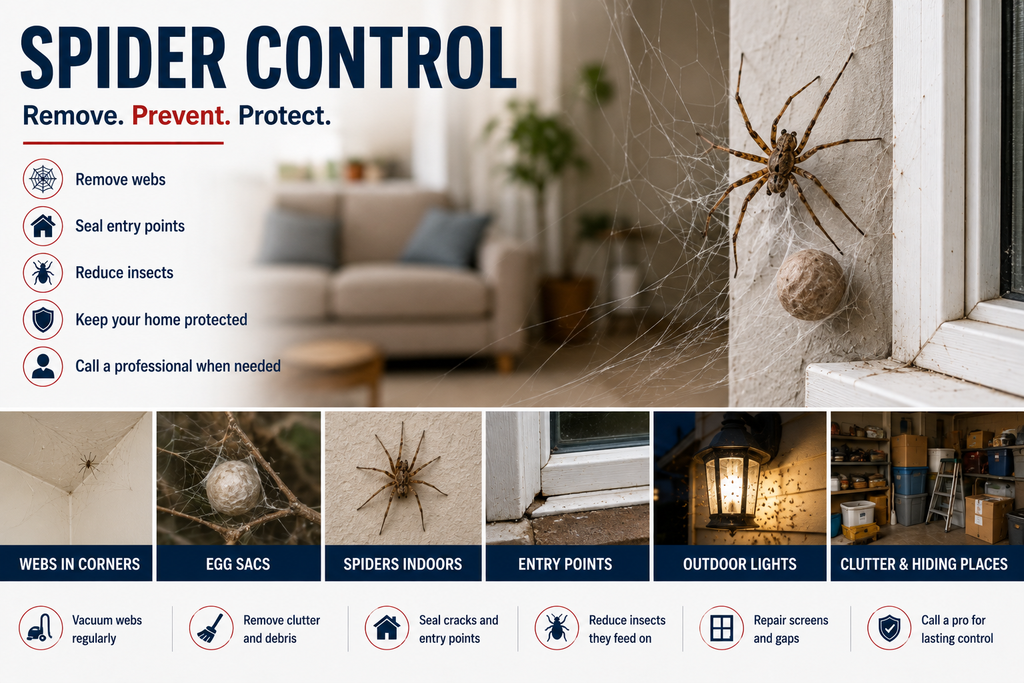
How to Identify a Spider Problem
Finding an occasional spider does not necessarily mean you have a serious pest problem. Many spiders are beneficial predators that feed on insects and other pests. However, recurring indoor sightings, numerous webs, egg sacs, or spiders repeatedly appearing in garages, basements, storage areas, and other protected spaces may indicate conditions that are supporting spider activity. UC IPM notes that most spiders are beneficial and recommends focusing control on webs and hiding places rather than automatically using pesticides.
Common Signs of Spider Activity
- Spiders repeatedly appearing indoors
- New webs appearing around windows, ceilings, corners, garages, or exterior structures
- Egg sacs attached to webs or protected surfaces
- Spiders hiding behind stored items or clutter
- Activity around outdoor lights where insects gather
- Spiders entering through gaps around doors, windows, or foundations
- Large numbers of insects around the property that provide spider prey
Why Are Spiders Around My Home?
Spiders are often present where they can find insects to eat and protected places to build webs or hide. Outdoor lighting can attract insects, which may in turn attract spiders. Clutter, vegetation near the structure, cracks, storage areas, and undisturbed spaces can also provide suitable spider habitat.
This means effective spider control often involves addressing both the spiders and the conditions attracting their insect prey.
DIY Spider Control
1. Remove Spiders and Webs
Vacuum or sweep spiders, webs, and accessible egg sacs from corners, windows, storage areas, garages, basements, and other locations where activity occurs.
Regular removal can reduce existing spider activity while also making it easier to notice when new webs appear. UC IPM specifically recommends regular sweeping, mopping, and vacuuming as spider-management methods.
2. Reduce Hiding Places
Remove unnecessary clutter and organize storage areas. Keep boxes off floors and away from walls when practical, and reduce debris, leaf litter, wood piles, and dense vegetation close to the foundation.
3. Seal Entry Points
Inspect cracks around foundations, windows, doors, utility penetrations, and other openings. Repair damaged screens and seal accessible gaps that may allow spiders and the insects they feed on to enter.
4. Reduce Insects That Attract Spiders
Spiders feed on insects and other small prey. Reducing insect activity around doors, windows, exterior lighting, and other areas can make the property less attractive to spiders.
When practical, position outdoor lighting away from doors and windows or reduce unnecessary lighting that attracts insects near the structure. UC IPM specifically notes the relationship between outdoor lights, insects, and spiders.
5. Use Spider Treatments Carefully
Pesticides are not always necessary for spider control, and spraying alone may provide only temporary results if webs, hiding places, entry points, and insect prey remain.
If using a pesticide, select a product labeled for the intended spider-control application and follow all label directions. UC IPM notes that insecticides generally do not provide long-term spider control without accompanying housekeeping and exclusion measures.
What About Venomous Spiders?
Most spiders encountered around homes are not considered medically significant. However, some species can cause more serious bites.
Correct identification matters before assuming a spider is dangerous. Avoid handling an unfamiliar spider with bare hands, particularly when cleaning garages, wood piles, storage areas, or other protected spaces.
If you believe you have been bitten by a medically significant spider or develop concerning symptoms, seek appropriate medical advice.
When to Call a Professional for Spider Control
Consider professional spider control when spiders repeatedly return despite cleaning and exclusion, numerous spiders or webs are appearing throughout the property, you suspect a medically significant species, or spider activity is associated with a larger insect problem.
A professional can inspect hiding areas and entry points, identify the spider when possible, evaluate insect activity that may be attracting spiders, and determine whether additional treatment is appropriate.
How to Help Prevent Spiders
- Vacuum and remove indoor webs regularly.
- Remove webs from exterior walls and structures.
- Reduce clutter in garages, basements, attics, and storage areas.
- Seal cracks and gaps around windows, doors, and foundations.
- Repair damaged window and door screens.
- Keep vegetation and debris away from the foundation.
- Store firewood away from the house.
- Reduce unnecessary outdoor lighting near doors and windows.
- Address insect problems that provide spiders with food.
- Inspect boxes, plants, and firewood before bringing them indoors.
These measures align closely with UC IPM’s current spider-management guidance.
Explore more DIY Pest Control Solutions for practical ways to prevent and manage common pest problems around your home.
Spider Control FAQ
Are all spiders dangerous?
No. Most spiders found around homes are not considered dangerous to people, and many are beneficial because they prey on pest insects. Correct identification is important before assuming a spider poses a significant risk.
Why do spiders keep coming into my house?
Spiders may enter through cracks and other openings or be carried inside on boxes, plants, firewood, and other objects. Indoor insects can also provide spiders with a continuing food source.
Does removing spider webs help?
Yes. Regularly vacuuming or sweeping spiders and webs is one of the primary nonchemical spider-management methods recommended by UC IPM.
Does spraying spiders prevent them from returning?
Not necessarily. Insecticides generally do not provide long-term control when hiding places, entry points, webs, and insect prey remain. Prevention and habitat reduction are important parts of lasting spider management.
When should I hire a professional for spiders?
Consider professional help when spider activity is widespread or persistent, you cannot identify a potentially concerning spider, spiders repeatedly return despite prevention measures, or another pest infestation appears to be supporting the spider population.