
Bee control starts with identifying what kind of bee activity you are seeing and whether removal is actually necessary. Many bees are valuable pollinators and should be left alone when they pose little risk. Learn how to recognize swarms and established colonies, prevent bees from nesting inside structures, and know when to call a beekeeper or pest professional. Explore our Pest Control Guides for identification, prevention, and treatment information on other common household pests.
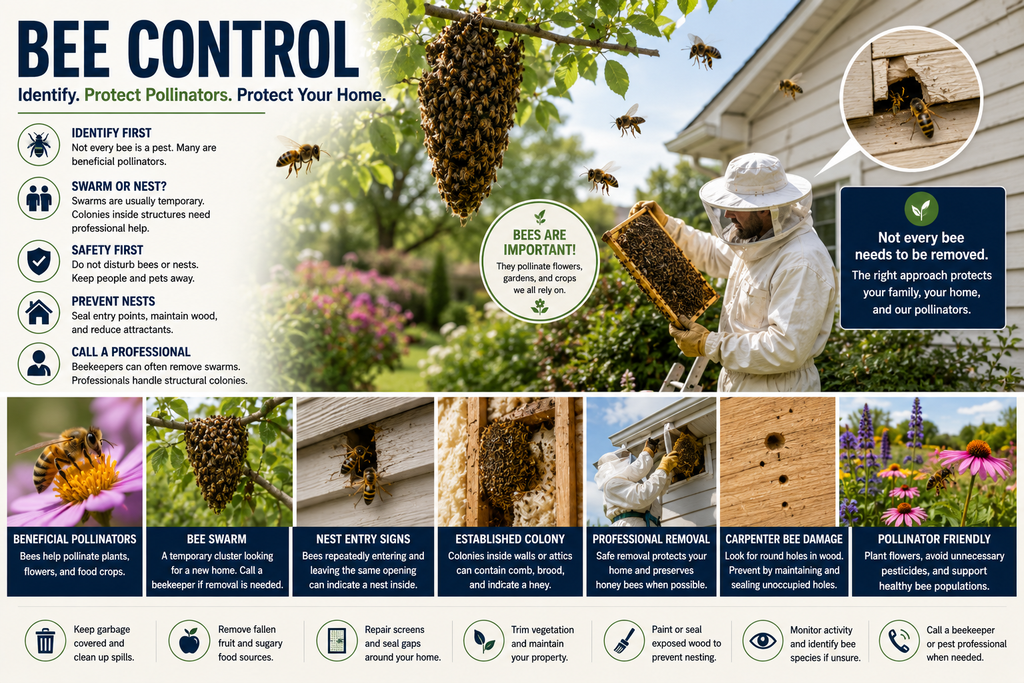
Do Bees Actually Need to Be Removed?
Not every bee around your property is a pest. Many bees provide important pollination benefits, and simply seeing bees visiting flowers is generally not a reason for control.
The situation becomes more important when large numbers of bees cluster near people, repeatedly enter and leave an opening in a building, establish a colony inside a wall or attic, or create a significant sting risk.
Correct identification should come before treatment. UC IPM emphasizes that many bees and wasps are beneficial pollinators or natural enemies of other pests.
Common Signs of Bee Activity
- A large cluster of bees on a tree, fence, wall, or other surface
- Bees repeatedly entering and leaving one structural opening
- Buzzing or humming coming from a wall, attic, chimney, or soffit
- Visible comb or hive material
- Increasing bee traffic around one part of the home
- Carpenter bee holes in exposed wood
- Bees regularly visiting flowers without any nearby nest problem
Bee Swarm vs. Established Colony
Understanding the difference between a swarm and an established colony is especially important.
Honey Bee Swarm
Swarming is a natural part of honey bee colony reproduction. Thousands of bees may temporarily cluster together while scout bees search for a new nesting location.
Although a swarm can look alarming, UC IPM reports that swarm clusters are generally temporary and often move away once a suitable new home is found.
Do not spray, hit, hose, or otherwise disturb a swarm.
If it must be removed because of its location, contact an experienced beekeeper.
Established Bee Colony
The situation changes once honey bees establish themselves inside a wall, attic, chimney, soffit, tree cavity, or other protected location.
An established colony may contain bees, comb, brood, wax, and stored honey. Removal can therefore be considerably more complicated than simply killing visible bees.
What to Do About Bees Around Your Home
1. Identify the Bee First
Don’t assume every yellow-and-black flying insect is a honey bee.
Honey bees, carpenter bees, bumble bees, yellowjackets, paper wasps, and other insects can require very different management strategies.
2. Leave Beneficial Bees Alone When Possible
Bees feeding on flowers away from frequently occupied areas generally don’t require control.
Avoid unnecessary pesticide applications around flowering plants and active pollinators. UC IPM’s current pesticide-stewardship guidance recommends identifying the bee species and minimizing pesticide risks to bees.
3. Don’t Disturb a Honey Bee Swarm
If thousands of bees suddenly form a cluster on a branch, fence, wall, or similar surface, keep people and pets away and observe from a safe distance.
Many swarm clusters leave on their own. If removal is necessary, an experienced beekeeper may be able to collect the swarm without killing the bees.
4. Don’t Seal Bees Inside a Wall
If bees are repeatedly entering and leaving an opening in your house, do not simply seal the entrance while the colony is active.
Trapped bees can search for another way out and may enter the living space. An established colony can also contain substantial amounts of comb and honey that need to be properly addressed.
5. Address Carpenter Bee Damage Differently
Carpenter bees can create nesting tunnels in exposed wood, so their management differs from honey bees.
UC IPM recommends prevention as the primary strategy: maintaining painted or varnished wood surfaces, repairing cracks and depressions, and sealing unoccupied holes after bees have emerged.
Why Killing Bees Inside a Wall Can Create Another Problem
Simply killing an established honey bee colony inside a structure may leave behind bees, brood, beeswax, and stored honey.
UC IPM warns that abandoned honey can ferment or leak through walls and ceilings, while dead bees and brood can create odors and additional cleanup problems.
That means proper colony removal may require opening the cavity, removing the bees and comb, cleaning the area, and sealing potential future entrances.
When to Call a Beekeeper or Pest Professional
Consider professional assistance when:
- A swarm is located where people or pets cannot safely avoid it.
- Bees have established a colony inside a wall, attic, chimney, soffit, or other structure.
- You cannot confidently identify the insect.
- Bee activity occurs near a doorway, playground, patio, or heavily used area.
- The colony cannot be safely accessed.
- Someone nearby has a known severe sting allergy.
- Carpenter bee activity is causing recurring structural damage.
For a removable honey bee swarm, a beekeeper may be the best first call.
For an established structural colony, especially one inside a wall or inaccessible cavity, look for a beekeeper or pest-control professional experienced specifically in bee and comb removal. UC IPM recommends professional help rather than attempting established colony removal without experience and proper equipment.
How to Help Prevent Bee Problems
- Repair appropriate gaps and openings before bees establish a colony.
- Maintain window and door screens.
- Inspect rooflines, soffits, siding, vents, and utility penetrations.
- Do not seal an opening while an active colony is inside.
- Maintain exposed wood to discourage carpenter bee nesting.
- Fill abandoned carpenter bee holes after confirming they are unoccupied.
- Avoid unnecessary pesticide use around flowering plants.
- Leave harmless foraging bees alone whenever practical.
- Monitor repeated bee traffic entering a structural opening.
- Contact an experienced professional before attempting difficult colony removal.
Explore more DIY Pest Control Solutions for practical ways to prevent and manage common pest problems around your home.
Bee Control FAQ
Should I remove a swarm of bees?
Not necessarily. Honey bee swarms are often temporary and may leave once scout bees find a suitable nesting location. If a swarm is in a dangerous or inconvenient location, contact an experienced beekeeper rather than disturbing it yourself.
What’s the difference between a bee swarm and a hive?
A swarm is typically a temporary cluster of honey bees searching for a new nesting location. An established colony has occupied a location and begun maintaining comb, brood, and stored food.
Can I seal the hole bees are entering?
Not while an active colony is inside. Bees may seek another exit and enter the living space, while comb and honey can remain inside the structure. Proper removal should occur before permanent exclusion.
Should I call a beekeeper or pest control company?
For an accessible honey bee swarm, a beekeeper is often an excellent first option. An established colony inside a building may require someone experienced with structural bee removal, potentially involving both a beekeeper and a contractor or pest professional.
Are carpenter bees treated the same as honey bees?
No. Carpenter bees nest by creating tunnels in wood rather than forming honey bee colonies. Prevention focuses heavily on maintaining exposed wood and sealing unused nesting holes appropriately.