
Mite control starts with identifying which type of mite is causing the problem. Different mites can come from bedding, stored foods, plants, birds, rodents, or outdoor areas, and the right solution depends on the source. Learn how to recognize common household mites, eliminate conditions that support them, prevent future problems, and know when professional pest control may be appropriate. Explore our Pest Control Guides for identification, prevention, and treatment information on other common household pests.
What Are Mites?
Mites are tiny arthropods related to ticks and spiders. Thousands of mite species exist, and their behavior varies considerably.
Some live primarily outdoors. Others feed on plants, stored products, fungi, birds, rodents, or other animals. Dust mites can live in household environments and feed largely on shed skin particles.
Because mites have very different sources and behaviors, simply finding a tiny crawling organism does not tell you which treatment will work.
Identification comes first.
Common Types of Mites Around Homes
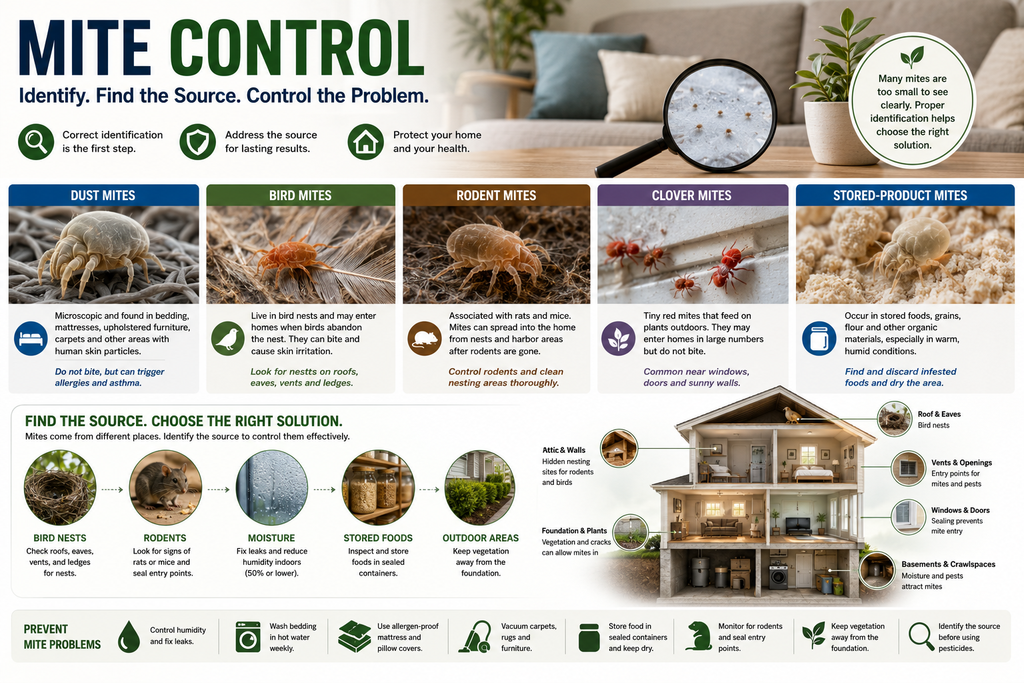
Dust Mites
Dust mites are microscopic and commonly associated with mattresses, bedding, upholstered furniture, carpeting, and other locations where skin particles accumulate.
They do not bite people, but their body fragments and waste can contribute to indoor allergens.
Bird Mites
Some mites normally associated with birds can enter homes when birds nest on or inside structures.
Problems may appear after birds abandon a nest and the mites begin searching for another host.
Rodent Mites
Rodent-associated mites can become a household problem when rats or mice are present.
If rodents are eliminated but their nests remain, mites may disperse from the nesting area and enter occupied rooms.
Clover Mites
Clover mites are tiny plant-feeding mites that can sometimes enter buildings in large numbers.
They do not feed on people or pets, but their presence indoors can become a nuisance.
Stored-Product Mites
Certain mites may occur in stored foods or other organic materials, especially where moisture and humidity are high.
Locating and eliminating the infested material is generally more important than simply treating visible mites.
Common Signs of a Mite Problem
- Extremely small crawling organisms on walls, windows, or surfaces
- Activity near bird or rodent nesting areas
- Mites appearing after a bird nest has been abandoned
- Mite activity following a rodent infestation
- Large numbers of tiny mites near windows or exterior walls
- Problems associated with damp stored food or organic material
- Persistent unexplained indoor pest activity despite routine cleaning
Because mites can be difficult to identify with the naked eye, professional identification may be useful when the source is unclear.
DIY Mite Control and Prevention
1. Identify the Source
This is the most important step.
Look for patterns that may explain where the mites originated:
- Bird nests near windows, roofs, vents, or attics
- Evidence of rats or mice
- Damp or contaminated stored food
- Heavy vegetation touching the structure
- Indoor humidity problems
- Bedding or upholstered areas associated with dust-mite concerns
Treating mites without addressing their source may provide only temporary relief.
2. Address Bird and Rodent Problems
If bird or rodent mites are suspected, the underlying host problem must be addressed.
For rodents, that means eliminating the infestation, removing nesting materials safely, and sealing entry points.
For birds, nests should not be disturbed while they are active. Bird nests and wildlife may also be protected by federal, state, or local laws depending on the species and circumstances.
Once a nest is legally and safely abandoned or removed, appropriate openings can be sealed to help prevent future nesting.
3. Reduce Indoor Humidity
Moisture can contribute to conditions favorable to certain mites.
Repair leaks, improve ventilation, and use appropriate humidity control where necessary.
For dust mites specifically, reducing indoor humidity is an important part of environmental control.
4. Manage Dust Mites Differently
Dust mites require a different strategy from bird, rodent, or clover mites.
Common environmental measures include:
- Washing bedding regularly
- Using allergen-resistant mattress and pillow covers
- Controlling indoor humidity
- Cleaning dust-collecting surfaces
- Vacuuming carpets and upholstered furniture appropriately
Because dust mites are microscopic, attempting to eliminate them with ordinary household insect sprays is generally not the right approach.
5. Inspect Stored Food
If mites appear around pantries or food-storage areas, inspect flour, grains, cereals, pet food, and other stored products.
Discard clearly infested products and clean the surrounding storage area.
Store replacement foods in tightly sealed containers and correct excess moisture conditions.
6. Reduce Outdoor Entry
For nuisance mites such as clover mites, prevention can include reducing vegetation directly against the foundation and sealing cracks and openings around windows, doors, siding, and other potential entry points.
Avoid crushing clover mites on walls or furnishings because some can leave reddish stains.
Why Identification Matters for Mite Control
One of the biggest mistakes in mite control is treating every tiny pest the same way.
For example:
Bird mites → find the bird/nesting source
Rodent mites → find and eliminate the rodent source
Dust mites → humidity and allergen management
Clover mites → exterior habitat and exclusion
Stored-product mites → locate contaminated material and moisture
The visible mites may be the symptom.
The source is often the real problem.
When to Call a Professional for Mite Control
Consider professional pest control when:
- You cannot identify the mite.
- Large numbers continue appearing indoors.
- Bird or rodent mites are suspected.
- The source appears to be inside a wall, attic, crawlspace, or other inaccessible area.
- A rodent infestation is also present.
- The infestation continues after sanitation and exclusion measures.
- You are considering pesticide treatment but do not know which mite is present.
A professional can inspect the property, identify likely sources, determine whether the organism is actually a mite, and recommend treatment based on the specific pest.
How to Help Prevent Mites
- Repair moisture problems and leaks.
- Keep indoor humidity under control.
- Store food in sealed containers.
- Monitor for rats and mice.
- Seal rodent entry points.
- Inspect structures for problematic bird nesting locations.
- Do not disturb active bird nests without determining whether removal is lawful.
- Keep vegetation from growing directly against the foundation where practical.
- Seal appropriate exterior cracks and gaps.
- Wash bedding regularly for dust-mite management.
- Identify tiny pests before applying pesticides.
Explore more DIY Pest Control Solutions for practical ways to prevent and manage common pest problems around your home.
Mite Control FAQ
Can you see mites?
Some mites can be seen as extremely small moving dots, while others such as dust mites are microscopic and cannot normally be identified with the naked eye.
Do dust mites bite people?
No. Dust mites do not bite people. Their primary household concern is allergens associated with their waste and body particles.
Why did mites suddenly appear after birds left a nest?
Some bird-associated mites normally feed on birds. When their hosts leave an abandoned nest, mites may disperse and enter nearby parts of a building while searching for another host.
Can rats or mice cause a mite problem?
Yes. Certain mites are associated with rodents. If rodents or their nesting areas are present in or around a structure, identifying and eliminating that source can be an important part of controlling the mites.
Should I spray my house if I find mites?
Not automatically. The correct approach depends on the species and source. Spraying visible mites without correcting an underlying bird nest, rodent infestation, moisture problem, stored-product infestation, or other source may not solve the problem.
When should I call a pest professional?
If mites continue appearing, the source cannot be located, bird or rodent mites are suspected, or identification is uncertain, professional inspection is appropriate.
Learn more about dust mite prevention from the National Institute of Environmental Health Sciences.