
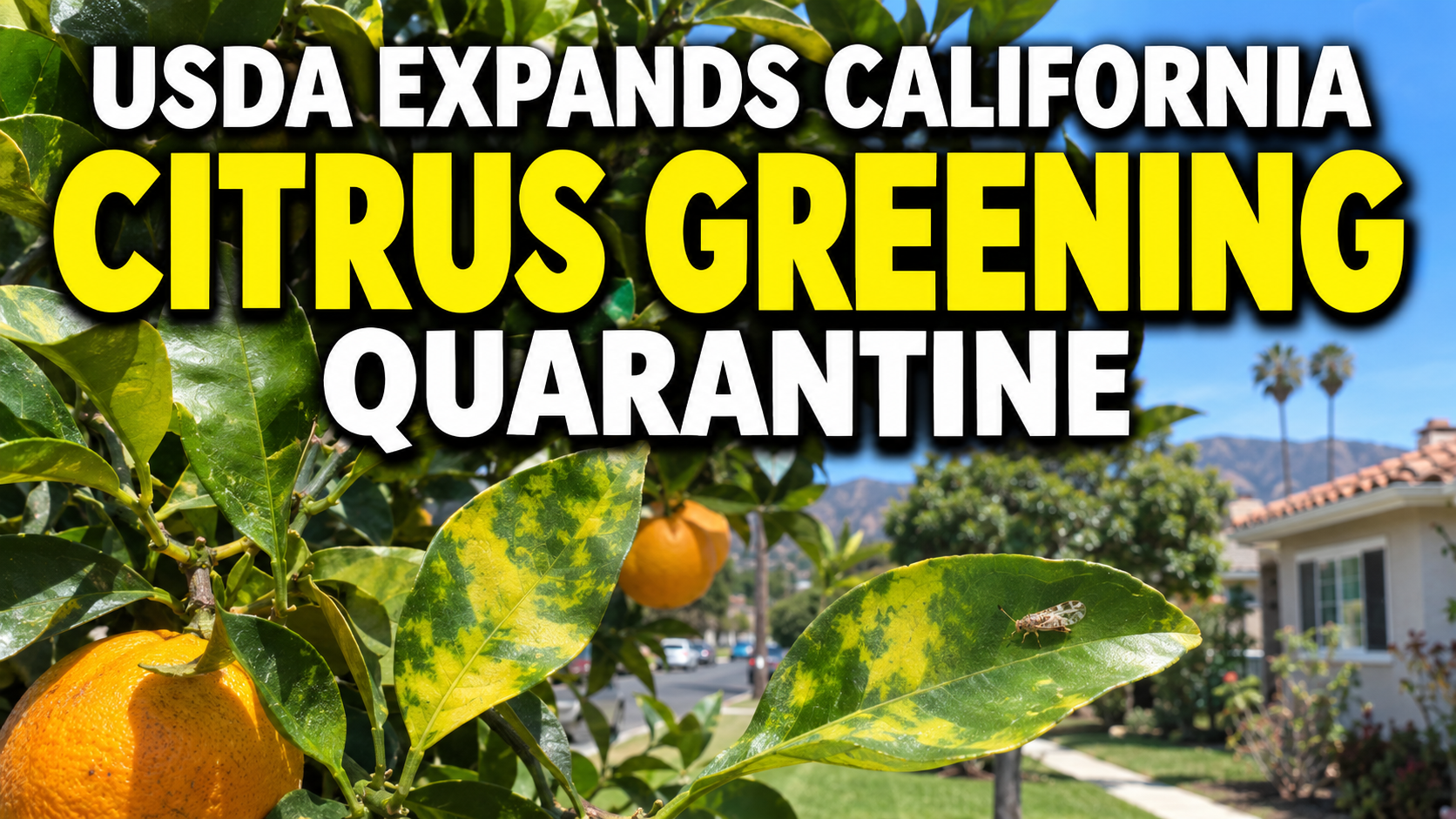
USDA Expands California Citrus Greening Quarantine is the latest federal response to a serious bacterial disease threatening California’s citrus trees. On November 16, 2026, the U.S. Department of Agriculture’s Animal and Plant Health Inspection Service (APHIS) announced an immediate expansion of the federal huanglongbing, or HLB, quarantine covering portions of Corona, Lake Elsinore, and Wildomar in Riverside County. The change adds 64 square miles to the quarantined area and affects 16.8 acres of commercial citrus. The action followed a positive test involving plant tissue collected from a residential property. Those figures describe the additional quarantine boundary, not 64 square miles of infected orchards, and not a newly discovered outbreak at every property inside it.
What USDA Announced on November 16
According to the November 16 USDA APHIS announcement, the 64-square-mile expansion took effect immediately in cooperation with the California Department of Food and Agriculture. The announcement identifies the Corona, Lake Elsinore, and Wildomar areas of Riverside County and states that 16.8 acres of commercial citrus fall within the newly affected territory. Federal officials did not announce that all citrus trees across those communities had tested positive. A quarantine is a geographic tool intended to reduce further movement of plant material that could spread the disease. Affected growers, nurseries, haulers, and residents should check their precise address against current quarantine maps instead of assuming their entire city is subject to identical rules.
Why a Residential Plant Sample Triggered the Expansion
The federal notice links the expansion to plant tissue from a residential property that tested positive for Candidatus Liberibacter asiaticus, the bacterium associated with HLB. This matters because backyard citrus trees are part of California’s citrus disease surveillance system, not just large commercial orchards. One confirmed residential sample can prompt authorities to redraw boundaries designed to protect surrounding plantings. The announcement does not identify the homeowner, establish how the bacterium reached that property, or quantify how many additional trees may be infected. It would be inaccurate to claim the November 16 action followed dozens of new detections or a sudden explosion of disease without additional supporting surveillance records.
USDA Expands California Citrus Greening Quarantine Under Federal Rules
The expansion has a specific regulatory purpose. USDA uses federal plant health rules to govern interstate movement of regulated citrus-related articles from quarantine areas. The November action follows a California intrastate quarantine established on September 17, 2026. That timing is important: the state boundary change predates the new federal announcement by roughly two months. The fresh news is federal recognition and the corresponding safeguards, not the assertion that the disease first entered Riverside County this week. The relevant requirements vary by commodity and transaction, so movement of nursery stock, cuttings, plant parts, and commercial shipments should be evaluated against current official guidance rather than an assumption that every piece of fruit is automatically prohibited.
What Is Citrus Greening and Why Is It Serious?
Citrus greening, also called huanglongbing or HLB, is a destructive disease affecting citrus trees. The pathogen is spread by an insect known as the Asian citrus psyllid, which can acquire and transmit the bacterium while feeding. Infected trees may develop irregular yellow mottling on leaves, misshapen or poorly colored fruit, declining productivity, and eventual deterioration. The USDA citrus greening and Asian citrus psyllid resource explains the disease, its insect vector, and federal regulatory framework. Yellow leaves alone are not proof of HLB; nutrient issues, watering stress, and other disorders can produce similar-looking symptoms. Suspected infections should be assessed using official reporting and diagnostic procedures.
Why Homeowners With Citrus Trees Should Pay Attention
The detection came from a residential property, underscoring why homeowners with orange, lemon, lime, or other citrus trees should not dismiss this as a problem limited to commercial agriculture. Backyard trees can provide habitat for the psyllid and may be involved in disease transmission. Residents should examine trees periodically for unusual blotchy leaf yellowing and irregular fruit development, avoid moving citrus plants or cuttings out of regulated areas without authorization, and follow instructions from agricultural authorities when sampling or treatment is requested. A suspected diseased tree should not be moved elsewhere to try to save it, because that can undermine containment efforts. Residents also should not apply pesticides indiscriminately simply because a quarantine expanded nearby.
How to Find the Exact California Quarantine Boundary
For property-level decisions, use the CDFA HLB quarantine maps and regulatory information. CDFA provides state boundary maps, an active quarantine application, and the California pest reporting hotline at 1-800-491-1899. The federal program also maintains current citrus quarantine information. Because county and city names describe broad geographic areas, a Corona mailing address does not by itself establish precisely which restrictions apply to a particular lot, business, or shipment. Farmers and nursery operators should verify current maps and applicable shipping requirements before moving regulated citrus material. Homeowners who notice suspicious symptoms can seek instructions from agricultural regulators rather than relying on social-media photographs for diagnosis.
What the 16.8 Acres Figure Actually Means
The 16.8 acres cited by APHIS refers to commercial citrus acreage affected by the newly added quarantine area. It does not represent the total commercial citrus acreage already quarantined throughout Southern California, nor does it measure the amount of land where laboratory-confirmed infected trees were found. Similarly, 64 square miles measures the additional geographic area placed under federal quarantine, not acreage sprayed or trees removed. Keeping those units separate is essential for understanding the scale of the news. The federal release does not provide a new estimate of crop losses, a count of infected residences inside the new perimeter, or projected eradication costs. Such figures should not be invented or inferred from the boundary expansion.
How This Differs From Recent California Fruit Fly Alerts
California is handling several different pest threats at the same time, but their biology and control measures are not interchangeable. Earlier PestMarket reporting on Oriental fruit fly threats in Los Angeles County concerned an invasive insect that damages fruit, whereas this Riverside County announcement concerns a bacterial citrus disease spread by the Asian citrus psyllid. The term “fruit fly” should not be used as a substitute for the psyllid, and an HLB quarantine should not be described as an emergency fruit fly spray zone. More general information on flies and identification can be found in PestMarket’s fly control guide, but HLB requires the specific citrus disease and agricultural regulatory guidance cited here.
What Happens Next for Riverside County
The USDA notice states that the change takes effect immediately and that a corresponding notice will appear in the Federal Register. It also points stakeholders to updated citrus quarantine information and safeguarding rules for interstate movement. The document does not announce a fixed date when the newly added area will be released from quarantine, and it does not direct residents to destroy healthy citrus trees. The most useful next steps are to check current boundary maps, avoid unauthorized movement of regulated citrus material, monitor backyard citrus for concerning symptoms, and report potential problems to CDFA. PestMarket will treat any later changes in acreage or enforcement rules as new developments only when they are documented by regulators.