
DIY pest control starts with correctly identifying the pest and understanding why it is present. Many common household pest problems can be reduced by removing food and water sources, eliminating hiding places, sealing entry points, using traps or other targeted methods, and applying pesticides only when appropriate. Use these guides to find practical ways to manage pests around your home and recognize when professional help may be the better option.
Start With the Pest You’re Dealing With
Different pests require different control strategies. Choose the pest you’re dealing with to learn what attracts it, which DIY methods may help, and when the problem may require professional treatment.
Common Household Pests
Ants
Find the colony source, reduce food and water, seal entry points, and compare practical ant-control methods.
Cockroaches
Learn how sanitation, moisture control, monitoring, exclusion, and targeted treatments work together.
Mice
Learn how to identify mouse activity, seal entry points, use traps appropriately, and prevent recurring problems.
Rats
Explore practical rodent-control methods including sanitation, exclusion, trapping, and prevention.
Spiders
Reduce hiding places and insect prey while learning practical ways to manage spiders around your home.
Biting & Outdoor Pests
Mosquitoes
Reduce standing water and learn practical ways to limit mosquito activity around outdoor living areas.
Fleas
Learn how to address fleas on pets, inside the home, and in areas where animals spend time.
Ticks
Explore practical ways to reduce tick exposure around your home, yard, pets, and family.
Occasional & Moisture-Related Pests
Silverfish
Reduce moisture, hiding places, and accessible food sources that can support silverfish activity.
Earwigs
Manage moisture and outdoor hiding places while sealing common routes earwigs use to enter homes.
Centipedes
Reduce moisture and investigate the other insects that may be providing food for house centipedes.
The DIY Pest Control Process
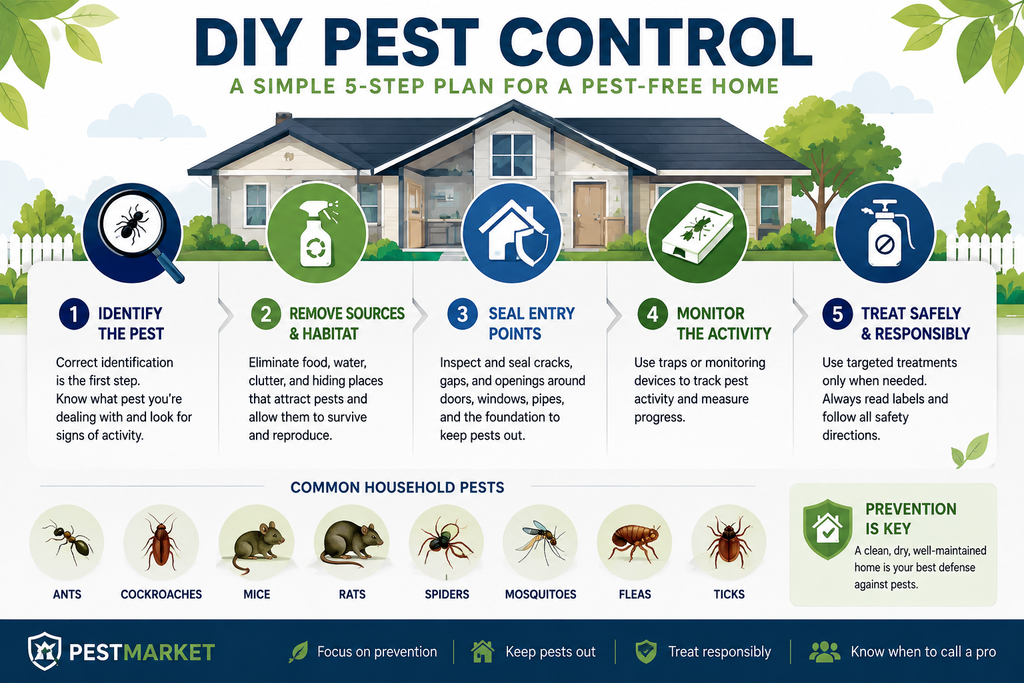
1. Identify the Pest
Correct identification should come before treatment. Different pests can look similar while requiring very different control methods. Look at the insect or animal itself, where it appears, signs it leaves behind, and the conditions surrounding the activity.
2. Find Out Why It’s There
Look for food, water, moisture, shelter, breeding material, entry points, or other conditions that may be supporting the pest. Treating visible pests without addressing the source often leads to recurring problems.
3. Remove Food, Water, and Hiding Places
Sanitation and habitat modification can be among the most effective pest-control tools. Clean food residue, repair leaks, reduce clutter, manage garbage, remove unnecessary debris, and correct moisture problems where appropriate.
4. Seal Entry Points
Inspect doors, windows, screens, utility penetrations, foundation gaps, and other openings. Exclusion can help prevent rodents, insects, and other pests from repeatedly entering the home.
5. Monitor and Use Targeted Control
Traps, monitoring devices, physical removal, and other targeted methods can help determine whether activity is declining. When a pesticide is appropriate, use only products labeled for the intended pest and location and follow all label directions.
When DIY Pest Control May Not Be Enough
Some pest problems carry greater risks, involve difficult-to-reach areas, or are particularly difficult to eliminate without specialized equipment or experience.
Termites
Suspected termite activity can involve hidden structural areas. A professional inspection may be appropriate when termites or termite damage are suspected.
Bed Bugs
Small or early infestations can still be difficult to eliminate completely. Persistent, widespread, or uncertain bed bug problems may benefit from professional inspection and treatment.
Bees and Wasps
Avoid disturbing active colonies or nests when access is difficult, large numbers are present, or stings could create a safety risk.
Persistent or Unidentified Infestations
If pests continue returning after you’ve addressed likely sources, or you cannot confidently identify what you’re dealing with, a professional inspection can help locate the underlying problem.
DIY Pest Control Safety
DIY does not mean using more pesticide. Start with identification, sanitation, moisture management, exclusion, and other nonchemical methods when practical. If you use a pesticide, read the entire label, use the product only for labeled pests and locations, follow application directions, and store products securely away from children and pets.
Learn more about safe pesticide use from the U.S. Environmental Protection Agency.
Explore More Pest Control Guides
Not sure which DIY method fits your problem? Browse our complete pest control library to identify the pest, understand what may be attracting it, and compare prevention, DIY, and professional treatment options.
Need Professional Help?
DIY pest control can work well for many minor or localized problems, but recurring infestations, structural pests, inaccessible nests, or difficult-to-identify activity may require professional help.