
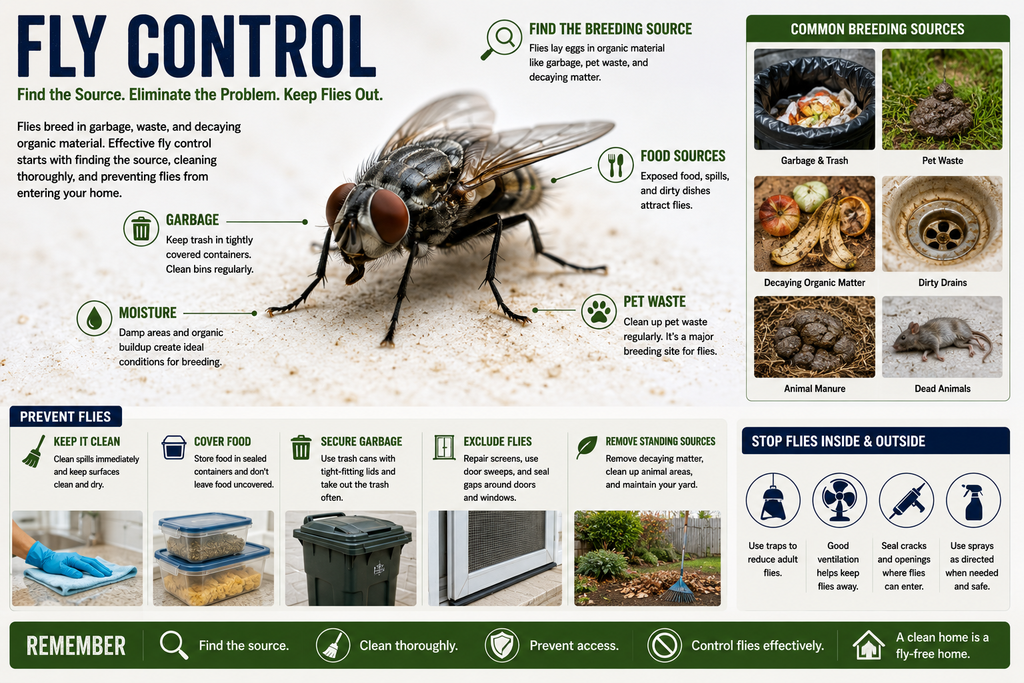
Fly control starts with finding out where flies are coming from and what is allowing them to reproduce. Garbage, food waste, pet waste, decaying organic material, and other breeding sources can turn a few flies into a persistent problem. Learn how to identify common fly activity, eliminate breeding sources, keep flies out of your home, and know when professional pest control may be appropriate. Explore our Pest Control Guides for identification, prevention, and treatment information on other common household pests.
How to Identify a Fly Problem
An occasional fly entering through an open door does not necessarily indicate an infestation.
Repeated fly activity, however, can mean there is a breeding source somewhere inside or close to the property.
House flies are commonly found around garbage, animal waste, decaying organic material, and other areas where suitable food and breeding material are available.
The most effective fly control usually begins by finding why the flies are there, rather than simply killing the adults you can see.
Common Signs of a Fly Infestation
- Numerous flies repeatedly appearing indoors
- Flies gathering around windows and doors
- Activity around garbage cans or dumpsters
- Flies around pet food or animal waste
- Flies repeatedly appearing in kitchens
- Maggots in garbage or decaying organic material
- Persistent activity despite killing visible adult flies
- Flies emerging from one particular area of the property
Large or sudden increases in flies deserve closer investigation because the breeding source may not always be obvious.
Why Are There So Many Flies in My House?
Flies generally become established when they have access to suitable food and breeding material.
Common sources can include:
- Uncovered garbage
- Food scraps
- Dirty garbage containers
- Pet waste
- Animal manure
- Decaying organic matter
- Spilled food or beverages
- Rotting material
- Dead animals
- Poorly maintained waste areas
Adult flies may travel away from where they developed, so the place where you see them is not necessarily the breeding site.
DIY Fly Control
1. Find the Breeding Source
This is the most important step in long-term fly control.
Inspect areas where organic material can accumulate, including:
- Garbage cans
- Trash storage areas
- Pet areas
- Garages
- Outdoor waste containers
- Compost areas
- Areas beneath appliances
- Locations where food has spilled
- Areas where an animal may have died
If flies continue appearing after adults are killed, assume there may still be a breeding source.
2. Clean Garbage and Waste Areas
Keep garbage in containers with tight-fitting lids.
Remove household trash regularly and clean residue from the inside and outside of garbage containers when needed.
Food waste should not be allowed to accumulate for extended periods.
Outdoor garbage areas should also be kept as clean and dry as practical.
3. Remove Pet Waste
Pet waste can provide suitable material for certain flies.
Clean yards, kennels, litter areas, and other pet spaces regularly.
Pet food should also be stored properly, and leftover wet food should not remain exposed unnecessarily.
4. Keep Flies Outside
Preventing adult flies from entering the building can substantially reduce indoor activity.
Check:
- Window screens
- Screen doors
- Door sweeps
- Weather stripping
- Gaps around doors
- Openings around windows
- Other exterior entry points
Repair damaged screens and avoid leaving doors open unnecessarily.
5. Protect Food
Store food in covered containers and clean spills promptly.
Do not leave dirty dishes, food scraps, or uncovered food sitting out longer than necessary.
Keep countertops and food-preparation areas clean.
6. Use Traps as a Supplement
Fly traps can help reduce adult populations and may also help identify areas with particularly heavy activity.
However, traps alone usually do not solve an infestation when an active breeding source remains.
Think of traps as population reduction and monitoring, not a substitute for sanitation and source removal.
7. Use Insecticides Carefully
Insecticides can sometimes help control adult flies, but they generally work best as part of a broader management program.
Always use a pesticide specifically labeled for the intended location and application and follow all label directions.
Repeatedly spraying visible flies without removing breeding material can lead to temporary improvement followed by another wave of flies.
What If Flies Suddenly Appear in Large Numbers?
A sudden increase in flies can sometimes indicate a hidden source.
For example, certain flies may develop in animal remains inside a wall, attic, crawlspace, chimney, or another inaccessible area.
If many flies suddenly appear without an obvious garbage or food source, inspect for unusual odors, animal activity, or other clues.
Persistent unexplained activity may justify professional inspection.
House Flies vs. Fruit Flies vs. Drain Flies
Not every small flying pest requires the same treatment.
House Flies
Often associated with garbage, animal waste, and decaying organic material.
Fruit Flies
Frequently associated with fermenting fruits, vegetables, beverages, and food residues.
Drain Flies
Can develop in organic buildup associated with drains and other wet environments.
Correct identification matters because treating the wrong source can allow the infestation to continue.
Why Fly Control Matters
Flies are more than an annoyance.
House flies frequently contact garbage, waste, decaying material, and other contaminated environments before landing on household surfaces or food.
Sanitation and food protection are therefore important components of fly management.
The goal is not simply to kill flies—it is to remove the conditions producing them and prevent additional flies from entering the home.
When to Call a Professional for Fly Control
Consider professional pest control when:
- Large numbers of flies continue appearing.
- You cannot locate the breeding source.
- Flies return despite improved sanitation.
- Activity appears to originate inside a wall, attic, crawlspace, or other inaccessible area.
- A dead animal or hidden organic source may be present.
- Fly activity is occurring throughout multiple areas of the property.
- DIY measures are not substantially reducing the problem.
A professional can help identify the fly species, locate likely breeding sources, inspect inaccessible areas, and determine whether targeted treatment is appropriate.
How to Help Prevent Flies
- Keep garbage containers tightly covered.
- Remove household garbage regularly.
- Clean food spills promptly.
- Do not leave food uncovered.
- Clean pet waste regularly.
- Store pet food properly.
- Repair damaged window and door screens.
- Keep exterior doors closed when practical.
- Clean garbage containers when residue accumulates.
- Remove decaying organic material around the property.
- Monitor for animal activity that could create hidden breeding sources.
- Investigate repeated fly activity rather than relying only on sprays.
Explore more DIY Pest Control Solutions for practical ways to prevent and manage common pest problems around your home.
Fly Control FAQ
Why do I suddenly have so many flies?
A sudden increase can indicate a nearby breeding source such as garbage, animal waste, decaying organic material, or occasionally a dead animal. Finding the source is usually more important than killing individual adult flies.
Where are flies coming from if my house is clean?
The source may be outdoors, inside a garbage container, in a garage, beneath an appliance, around pet areas, or in an inaccessible location such as an attic or wall cavity. Flies can travel away from their breeding site.
Will fly traps get rid of an infestation?
Traps can reduce adult flies but may not eliminate an infestation if breeding material remains. Source removal, sanitation, and exclusion are usually the foundation of long-term control.
Why do flies gather around windows?
Adult flies inside a building are often attracted toward light and may gather around windows while attempting to escape.
Are house flies and fruit flies the same?
No. They differ in appearance, biology, and common breeding sources. Fruit flies are particularly associated with fermenting fruits, vegetables, beverages, and food residues and require a somewhat different control strategy.
When should I call a pest professional?
Professional inspection is useful when fly numbers remain high, the breeding source cannot be located, flies repeatedly return after sanitation, or activity appears to originate from an inaccessible area.
Learn more about safer pest prevention and integrated pest management from the U.S. Environmental Protection Agency.