
Centipede control starts with understanding why these fast-moving predators are entering your home. House centipedes often appear in damp, protected areas where other small insects and arthropods provide food. Learn how to identify centipedes, reduce moisture and hiding places, control the pests they feed on, prevent indoor entry, and know when professional pest control may be appropriate. Explore our Pest Control Guides for identification, prevention, and treatment information on other common household pests.
How to Identify House Centipedes
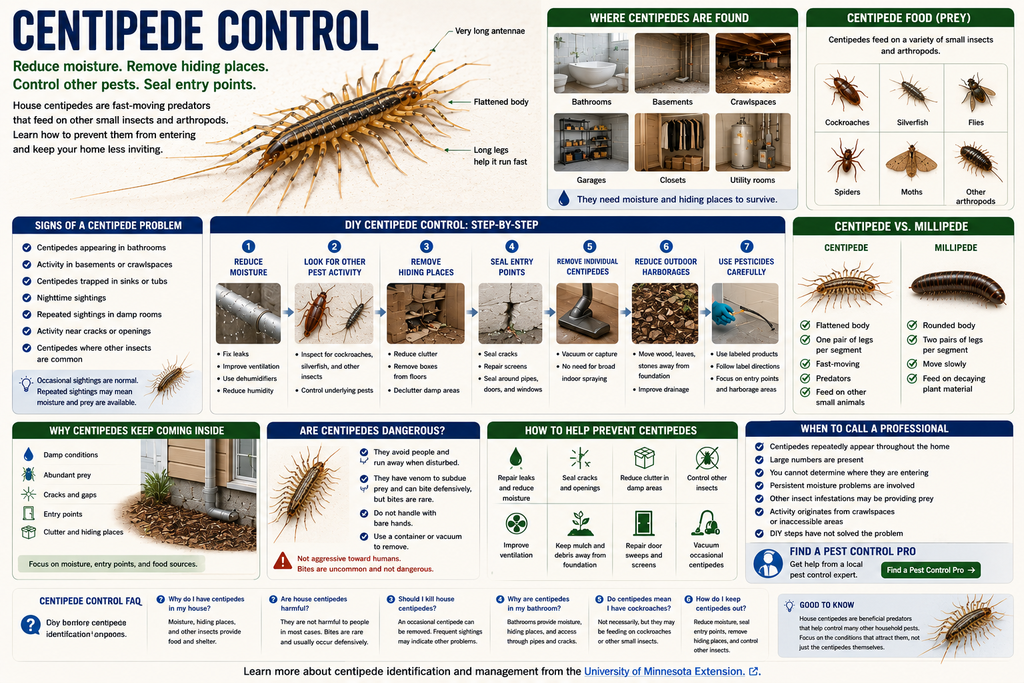
House centipedes have long, flattened bodies with numerous pairs of legs extending from their sides.
Their extremely long legs and rapid movement make them easy to recognize.
House centipedes are commonly yellowish-gray to brown and may have darker markings along the body.
They are often found in:
- Basements
- Bathrooms
- Crawlspaces
- Garages
- Closets
- Utility rooms
- Other cool or damp areas
They are primarily active at night and may quickly run for cover when lights are turned on.
Common Signs of a Centipede Problem
Look for:
- Centipedes appearing in bathrooms
- Activity in basements or crawlspaces
- Centipedes trapped in sinks or bathtubs
- Nighttime sightings
- Repeated sightings in damp rooms
- Activity near cracks or foundation openings
- Centipedes appearing where other insects are common
An occasional house centipede does not necessarily indicate an infestation.
Repeated sightings, however, may suggest that the environment is providing both moisture and prey.
Why Are Centipedes in My House?
Centipedes are predators.
House centipedes feed on various small insects and arthropods that may occur indoors.
Potential prey can include:
- Cockroaches
- Silverfish
- Flies
- Moths
- Spiders
- Other small arthropods
That makes centipedes different from many household pests.
If you repeatedly see centipedes, the real question may not simply be:
“How do I kill the centipedes?”
It may be:
“What are the centipedes finding to eat in my house?”
DIY Centipede Control
1. Reduce Moisture
House centipedes favor damp environments.
Inspect for:
- Plumbing leaks
- Damp basements
- Crawlspace moisture
- Condensation
- Poor ventilation
- Water collecting near the foundation
- Excess indoor humidity
Repair leaks and improve moisture control where appropriate.
A dehumidifier may help in persistently humid areas.
2. Look for Other Pest Activity
Because centipedes are predators, repeated sightings can sometimes indicate that other insects are available as prey.
Inspect for signs of:
- Cockroaches
- Silverfish
- Flies
- Pantry pests
- Other small insects
Addressing those underlying pests may make the home less attractive to centipedes.
3. Remove Hiding Places
Reduce clutter and protected harborages in areas where centipedes appear.
Pay particular attention to:
- Basements
- Garages
- Storage rooms
- Crawlspaces
- Utility areas
- Boxes stored directly on floors
Outdoors, reduce unnecessary debris immediately adjacent to the foundation.
4. Seal Entry Points
Inspect possible entry routes around:
- Foundation cracks
- Doors
- Windows
- Utility penetrations
- Pipes
- Siding
- Garage doors
- Crawlspace openings
Seal appropriate gaps and repair damaged screens or door sweeps.
5. Remove Individual Centipedes
An occasional centipede indoors can usually be vacuumed or physically removed.
For isolated sightings, widespread indoor pesticide application is generally unnecessary.
Instead, monitor the area to determine whether additional centipedes—or other pests—continue appearing.
6. Reduce Outdoor Harborages
Centipedes can also live outdoors beneath protected materials.
Where practical, reduce excessive:
- Leaf litter
- Boards
- Stones
- Wood piles
- Damp debris
- Heavy organic material immediately against the foundation
Correct drainage problems that keep areas next to the home continuously wet.
7. Use Pesticides Carefully
Targeted pesticide treatment may sometimes be appropriate for persistent centipede problems.
Always use a product labeled for the intended pest and location and follow all label directions.
However, pesticide treatment alone may provide only temporary results if moisture, entry points, and abundant insect prey remain.
Are House Centipedes Actually Beneficial?
In one sense, yes.
House centipedes are predators that consume other household arthropods, including some species people generally consider pests.
That does not mean you need to tolerate large numbers inside your home.
But it does mean that repeatedly seeing centipedes can provide useful information about the environment.
Instead of focusing only on killing the visible centipede, look for the conditions supporting it.
Are Centipedes Dangerous?
House centipedes generally avoid people and attempt to escape when disturbed.
They have venom used to subdue prey and are capable of biting defensively, but bites to people are uncommon.
Avoid handling centipedes with bare hands.
If you need to remove one, use a container, vacuum, or another method that avoids direct handling.
Centipede vs. Millipede
These two pests are commonly confused.
Centipedes
- Flattened body
- One pair of legs per body segment
- Fast-moving
- Predators
- Feed on other small animals
Millipedes
- More rounded or cylindrical body
- Two pairs of legs on most body segments
- Generally move more slowly
- Primarily feed on decaying plant material
Correct identification matters because the conditions attracting them can differ.
Why Do Centipedes Keep Appearing in My Bathroom?
Bathrooms can provide several conditions house centipedes prefer:
- Moisture
- Plumbing penetrations
- Cracks and hiding spaces
- Small insects or other prey
Repeated bathroom sightings are a good reason to inspect for leaks, excess humidity, entry points, and other pest activity.
Simply removing each centipede may not address the underlying reason they keep appearing.
When to Call a Professional for Centipede Control
Consider professional pest control when:
- Centipedes repeatedly appear throughout the home.
- Large numbers are present.
- You cannot determine where they are entering.
- Persistent moisture problems are involved.
- Other insect infestations may be providing prey.
- Activity appears to originate from a crawlspace or inaccessible area.
- Moisture reduction and exclusion have not solved the problem.
A professional can inspect for centipede harborages while also looking for the other pests and environmental conditions that may be supporting them.
How to Help Prevent Centipedes
- Repair plumbing leaks.
- Reduce excessive indoor humidity.
- Improve ventilation in damp areas.
- Correct drainage problems near the foundation.
- Reduce clutter in basements and garages.
- Seal appropriate foundation cracks and openings.
- Repair damaged door sweeps and screens.
- Inspect utility and plumbing penetrations.
- Reduce damp debris immediately around the structure.
- Monitor for cockroaches, silverfish, and other potential prey.
- Address underlying insect infestations.
- Vacuum occasional indoor centipedes rather than automatically spraying.
Explore more DIY Pest Control Solutions for practical ways to prevent and manage common pest problems around your home.
Centipede Control FAQ
Why do I have centipedes in my house?
Your home may be providing moisture, hiding places, and other small insects for centipedes to eat. Repeated sightings are a reason to investigate all three.
Are house centipedes harmful?
House centipedes generally avoid people. They can bite defensively, but bites are uncommon. Avoid handling them directly.
Should I kill house centipedes?
An occasional house centipede can simply be removed. Because they prey on other household arthropods, repeated sightings may be more useful as a clue that moisture or another pest problem exists.
Why are centipedes in my bathroom?
Bathrooms can provide humidity, water, hiding places, and access through plumbing penetrations. Other small insects may also provide food.
Do centipedes mean I have cockroaches?
Not necessarily. Centipedes eat many kinds of small arthropods. However, frequent centipede activity is a good reason to inspect for cockroaches, silverfish, flies, and other potential prey.
How do I keep centipedes out of my house?
Reduce moisture, seal appropriate entry points, remove hiding places, and control other insects that provide food.
Learn more about centipede identification and management from the University of Minnesota Extension.