
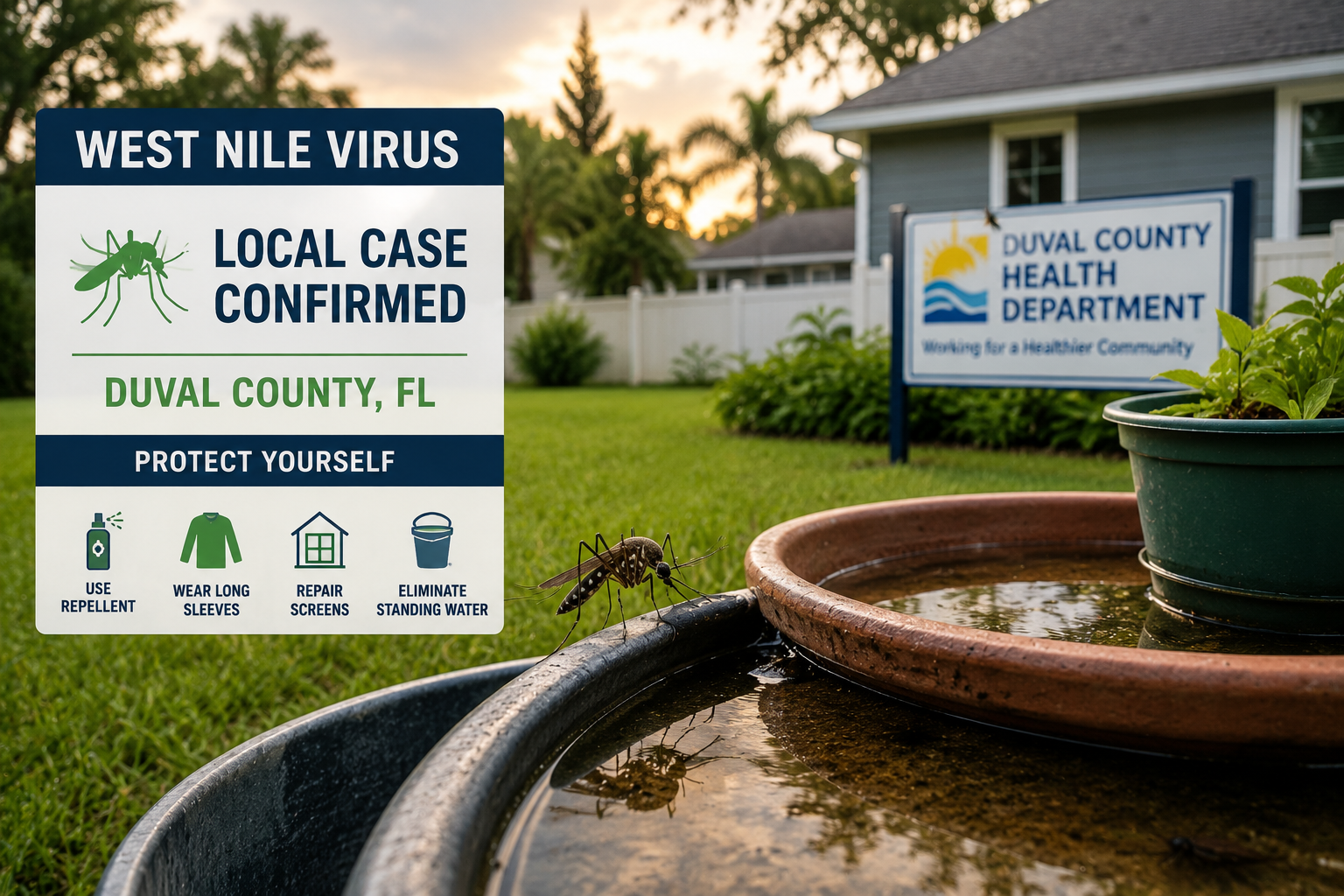
Health officials are stepping up mosquito-control efforts after a locally acquired case of West Nile in Jacksonville was confirmed in Duval County.
The Florida Department of Health in Duval County announced the case on August 31. The department said it is working with Jacksonville Mosquito Control on increased surveillance and prevention efforts, including ground spraying.
For residents, the timing is worth paying attention to. Late summer is already one of the most active periods of the year for West Nile virus in the United States.
West Nile in Jacksonville: What Health Officials Confirmed
The case was locally acquired, according to the Florida Department of Health. That means the infection was acquired in the area rather than associated with travel elsewhere.
Officials did not identify the patient or provide details about the person’s condition in the public advisory.
Jacksonville Mosquito Control and the county health department are now coordinating their response. Ground spraying is part of that effort, along with continued surveillance for mosquito-borne disease activity.
Florida routinely monitors several illnesses transmitted by mosquitoes, including West Nile virus, dengue, Eastern equine encephalitis, St. Louis encephalitis, chikungunya and malaria.
The state also uses reports involving animals as part of its broader surveillance system.
The Case Comes at the Height of West Nile Season
An August 31 case is notable because it falls almost exactly within the period when West Nile activity typically reaches its seasonal high.
The Centers for Disease Control and Prevention says West Nile infections occur during mosquito season, generally from summer through fall. The number of diagnosed human cases typically peaks in late August through early September.
West Nile virus circulates primarily between mosquitoes and birds. Mosquitoes can become infected after feeding on an infected bird and later transmit the virus when they bite people or other animals.
A confirmed local case does not mean every mosquito in Jacksonville carries West Nile virus. It does show that local transmission has occurred, which is why mosquito surveillance and control efforts become important.
Most West Nile Infections Don’t Cause Symptoms
West Nile can sound alarming, but the risk needs to be kept in perspective.
Most people infected with the virus do not develop symptoms, according to the CDC.
People who do become sick may experience fever, headache, body aches, joint pain, vomiting, diarrhea or a rash. A smaller number develop severe illness involving the central nervous system.
Anyone concerned about possible West Nile illness should contact a healthcare provider rather than trying to diagnose an illness based on a mosquito bite alone.
There is currently no licensed human vaccine to prevent West Nile virus disease. Prevention therefore centers largely on reducing mosquito bites.
What Jacksonville Residents Can Do Now
Health officials are asking residents to take familiar mosquito precautions, but those steps matter more when local disease transmission has been documented.
The CDC recommends using an EPA-registered insect repellent when mosquitoes are active. Long, loose-fitting clothing can provide additional protection, while intact window and door screens help keep mosquitoes outside.
Around the home, standing water deserves particular attention.
Buckets, plant saucers, toys, containers and other objects that collect rainwater can become mosquito breeding sites. Water that cannot simply be dumped may require a mosquito-control product specifically intended for that use.
The mosquitoes involved in West Nile transmission are especially active from dusk to dawn, according to the CDC, making protection during those hours particularly important.
Mosquito Control Goes Beyond Killing Adult Mosquitoes
Ground spraying can reduce adult mosquito populations, but community mosquito control also targets the earlier stages of the mosquito life cycle.
Larvicides can be used in appropriate standing-water habitats to kill mosquito larvae before they become flying adults. Adulticides are used to reduce adult mosquito populations when conditions warrant it.
Homeowners have a role as well.
Removing unnecessary standing water, maintaining screens and reducing mosquito breeding areas around a property can complement larger community-control programs.
PestMarket’s mosquito control guide explains how to identify common mosquito problems around a home, reduce breeding areas and decide when additional control may be necessary.
The Duval County case is a reminder that mosquitoes are more than a late-summer nuisance. In some places, they are also part of an active public-health surveillance and control effort.