
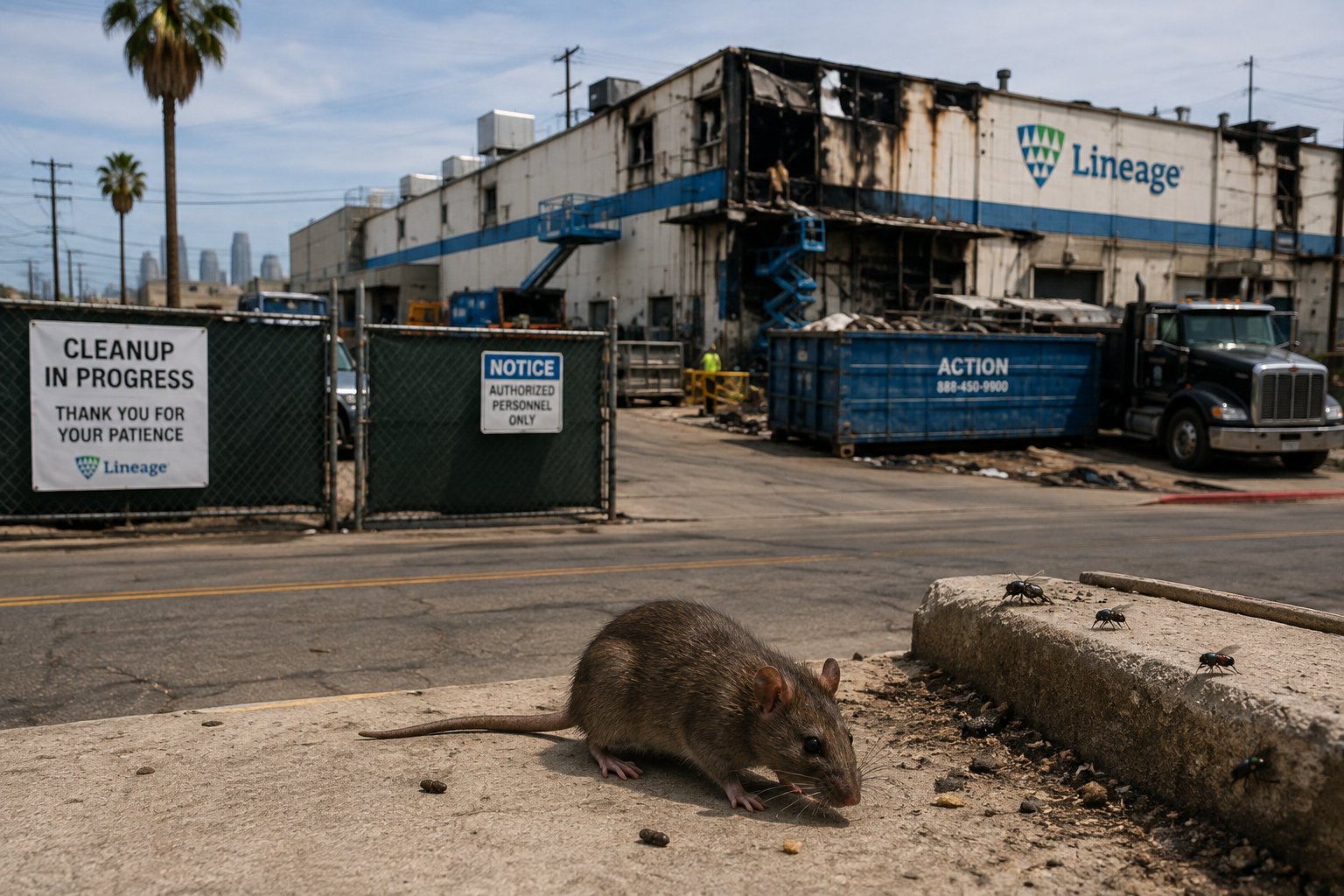
Boyle Heights rats and flies remain a concern for some residents even after crews removed the rotting food from a fire-damaged cold-storage warehouse that has disrupted the Los Angeles neighborhood for more than two months.
The bulk food removal was completed on August 29 at the Lineage facility, according to the company and local regulators. But that milestone does not mean the cleanup is finished. Disinfecting and cleaning the property are continuing, while some neighbors say pests and odors have not disappeared.
The situation dates back to a June 17 fire at the warehouse, where approximately 85 million pounds of food debris were left behind. As the material decomposed, the problem spread beyond the damaged building and into the surrounding community.
Boyle Heights Rats and Flies Became a Neighborhood Problem
Pest complaints around the warehouse have been documented for weeks.
In July, the Los Angeles County Department of Public Health surveyed 240 households near the facility. Eighty-four percent of respondents reported an increase in pests during the previous week. Flies were the most commonly reported problem at 76%, while 35% reported an increase in rodents. Mosquitoes were also reported by 40% of respondents.
Those numbers represent what residents reported in the county survey, not independent counts of pest populations. But county inspectors separately documented pest-related conditions at the warehouse itself.
Following inspections, Public Health cited Lineage for unsanitary conditions and rodent and pest-control violations. Inspectors documented decaying organic material capable of supporting fly breeding, along with live flies, dead flies and fly larvae at and around the facility.
The county required corrective measures that included removing decomposing material, eliminating potential fly-breeding sources, cleaning and sanitizing affected areas, and using a licensed pest-control operator to treat active breeding areas.
Food Removal Is Finished. The Cleanup Isn’t.
Removing the remaining food was a major step.
Lineage says 100% of the food material had been removed by August 29 and that workers are now focused on power washing, cleaning and disinfecting the property. The company says additional cleanup and recovery work remains underway.
Residents interviewed by FOX 11 the following day, however, said they were still dealing with odors and pests. One resident told the station that her family had encountered roughly a dozen rats over the previous two months and said her son had recently caught another one. That is a resident’s account rather than a government-confirmed count, but it shows why some neighbors do not consider the problem over yet.
Air-quality regulators have also continued to deal with complaints related to the site. FOX 11 reported that regulators had received nearly 5,000 odor complaints since mid-July.
Why Rotting Food Can Create a Serious Pest Problem
A large amount of decomposing food can provide exactly what many pests need: an abundant food source, moisture and places to breed.
Flies can develop rapidly when suitable decaying organic material remains accessible. That’s why simply killing adult flies doesn’t necessarily solve the underlying problem. The breeding material itself has to be removed or treated.
Rodents present a different challenge. Rats and mice are mobile and can move beyond the original food source while searching for food, water and shelter.
That matters when a large pest-producing condition occurs close to homes and businesses. Removing the source is essential, but pest activity that has already spread into surrounding properties may not disappear immediately.
What Nearby Homeowners Should Watch For
People living near a major pest source can watch for the same signs that would matter anywhere else.
With rats and mice, that can include droppings, gnawed food packaging, scratching sounds inside walls or ceilings, burrows and activity around garbage or pet food.
Flies appearing repeatedly indoors may point to an accessible breeding source nearby. Trash containers, decaying organic material, pet waste and other moist organic matter are worth checking around a property.
Homeowners should also look for entry points rather than relying only on traps or pesticides. Gaps around utility lines, doors, vents and other openings can give rodents a way inside even after an outside food source has been removed.
PestMarket’s rat control guide, mouse control guide and fly control guide cover common warning signs, prevention and treatment options in more detail.
For Boyle Heights residents, the removal of the warehouse’s rotting food is an important milestone. Whether the neighborhood’s pest problems decline with it will be the next thing to watch.