
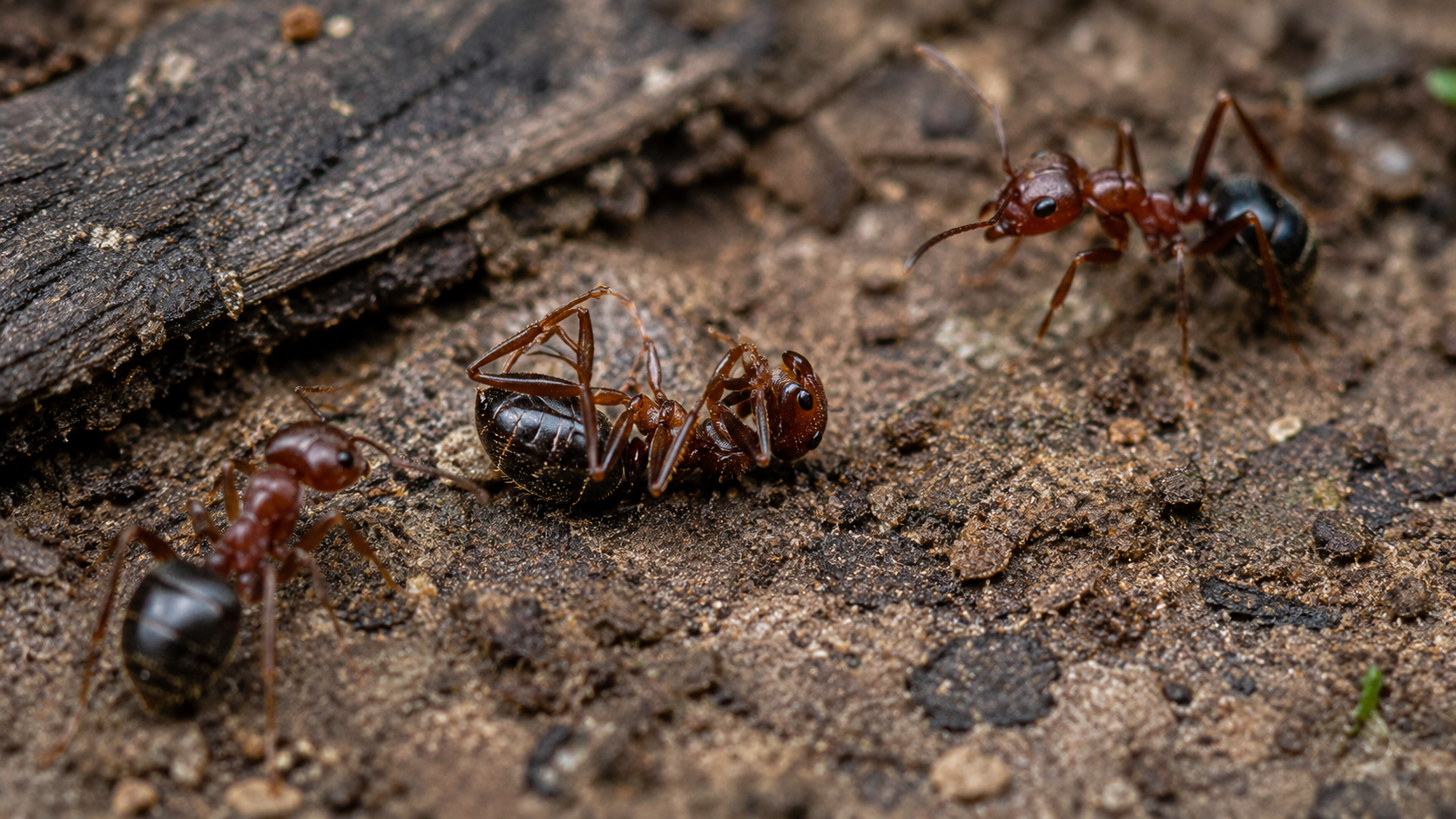
You touch an ant and, instead of running away, it suddenly curls up and stops moving. For a moment, it looks dead. Then, a short time later, it gets up and walks away.
I recently watched an ant do something very similar. After I lightly disturbed it with a fingernail, the ant pulled its legs inward and became motionless. It eventually started moving again, and when disturbed once more, it appeared to repeat the behavior.
That raised a simple question: Do ants really play dead?
It turns out that some ants play dead when threatened, and scientists have been studying the behavior for years. Researchers call it death-feigning, and a newly published 2026 study gives us an unusually detailed look at what can trigger it.
Ant Death-Feigning is a Real Behavior
“Playing dead” sounds almost too human, but the behavior behind the phrase is well documented.
A 2024 scientific review of death-feigning in ants examined previous reports across numerous ant species. Researchers have observed ants becoming motionless after disturbances and during encounters involving aggressive ants from other species.
The behavior can include freezing and curling the body or appendages inward. After some time has passed, the ant may resume normal activity.
There is an important distinction here. Calling the behavior “playing dead” doesn’t mean the ant understands what death is and consciously decides to impersonate a corpse. Scientists can observe what the ant does, but they can’t assume human-like reasoning behind it.
What they can study is the pattern: a threat occurs, the ant becomes motionless, and later it may become active again.
A New Study Put Ants Through 5,880 Threat Tests
The story became even more interesting this summer.
A study published online August 20, 2026, in Integrative Zoology examined death-feigning in 10 species of fungus-farming ants. Researchers conducted 5,880 behavioral trials, exposing ants to standardized mechanical disturbances and measuring how they responded.
The 2026 study indexed by PubMed found that the ants didn’t respond identically to every disturbance. Stronger stimuli increased both the likelihood that an ant would enter a death-feigning state and the amount of time it remained motionless.
Forceps produced the strongest response among the tested stimuli.
That’s an intriguing result because it suggests the reaction can vary with the intensity of the threat. An ant experiencing a more serious disturbance may be more likely to freeze and stay that way longer.
Not Every Ant Plays Dead the Same Way
The researchers also found substantial differences among species, colonies and individual ants.
Physical characteristics appeared to matter too. In the fungus-farming ants studied, smaller workers and ants with less substantial defensive structures tended to show stronger death-feigning behavior. Nest characteristics were also associated with differences in the response.
That gives us a more nuanced picture than simply saying all ants play dead.
Ants have evolved many ways of dealing with danger. Depending on the species, they may run, bite, sting, use chemical defenses or rely on physical protection. Becoming motionless appears to be one option in a much larger defensive toolkit.
If you’re trying to identify ants around a home rather than study their defensive behavior, PestMarket’s Ant Control Guide covers common signs, prevention and control options.
Why Would an Ant Play Dead?
The obvious explanation is survival.
Movement can make prey easier for a predator to detect, track or continue attacking. Becoming completely still could potentially interrupt that process or cause an attacker to lose interest.
Ants also have another problem: other ants.
The 2024 review found that death-feigning has been observed in situations involving aggressive ants from other species. Territorial encounters can become dangerous, so becoming motionless may have value during conflicts as well as encounters with predators.
Exactly why the strategy works, and how often it succeeds, is harder to establish.
Is It the Same as Tonic Immobility?
You’ll see several terms used when scientists and science writers discuss animals becoming motionless under threat. These include death-feigning, thanatosis, tonic immobility and apparent death.
They’re related concepts, but researchers don’t always use the terms in exactly the same way. A Myrmecological News discussion of ant death-feigning notes that multiple terms have been used for the behavior and that death-feigning in ants remains relatively understudied.
For someone watching an ant suddenly curl up after being touched, the terminology isn’t really the interesting part. The important point is that temporary immobility in response to danger is a recognized behavior in ants.
Does Playing Dead Actually Save the Ant?
This is where the answer becomes less certain.
There is strong evidence that death-feigning happens. Researchers have observed it, triggered it experimentally and measured differences in how ants respond. The new 2026 research adds evidence that the response changes with threat intensity and varies among species, colonies and individuals.
What scientists know much less about is what happens afterward in the wild.
The authors of the 2024 review noted that information about death-feigning under natural conditions is limited, including how successfully it protects ants from predators or territorial intruders.
That’s an important distinction. An ant freezing after a researcher disturbs it demonstrates the behavior, but it doesn’t tell us how often a spider, bird, lizard or rival ant actually abandons an attack because its target stopped moving.
Answering that question will require more observations under natural conditions.
So, Do Ants Really Play Dead?
Yes. At least some ants respond to threats by becoming motionless in a behavior scientists describe as death-feigning.
The evidence goes beyond casual backyard observations. Scientists have documented the behavior in multiple ant species, reproduced it experimentally and found that the intensity of a disturbance can affect both whether an ant freezes and how long it remains still.
What we shouldn’t do is give the ant more human-like intention than the evidence supports. An ant doesn’t need to understand death or consciously decide to trick an attacker for the behavior to provide a survival advantage.
So if you lightly disturb an ant and it suddenly curls up and appears dead, don’t immediately assume you’ve killed it.
Give it a little time. It might get up and walk away.
The PestMarket Verdict
The surprising part of this story isn’t whether ants can become motionless when threatened. They can, and scientists have documented it repeatedly.
The bigger unanswered question is how useful the strategy actually is when ants encounter real predators and competitors in nature.
Evidence Grade: PROVEN
What the evidence supports: Death-feigning is a documented defensive behavior in multiple ant species. Experimental research shows that threats can trigger it, and recent evidence indicates that stronger disturbances can produce stronger responses.
What remains uncertain: Scientists still don’t have enough field evidence to say how often playing dead actually saves an ant from a predator or rival ant in the wild.
So the answer to our original question is yes.
Some ants really do play dead.