
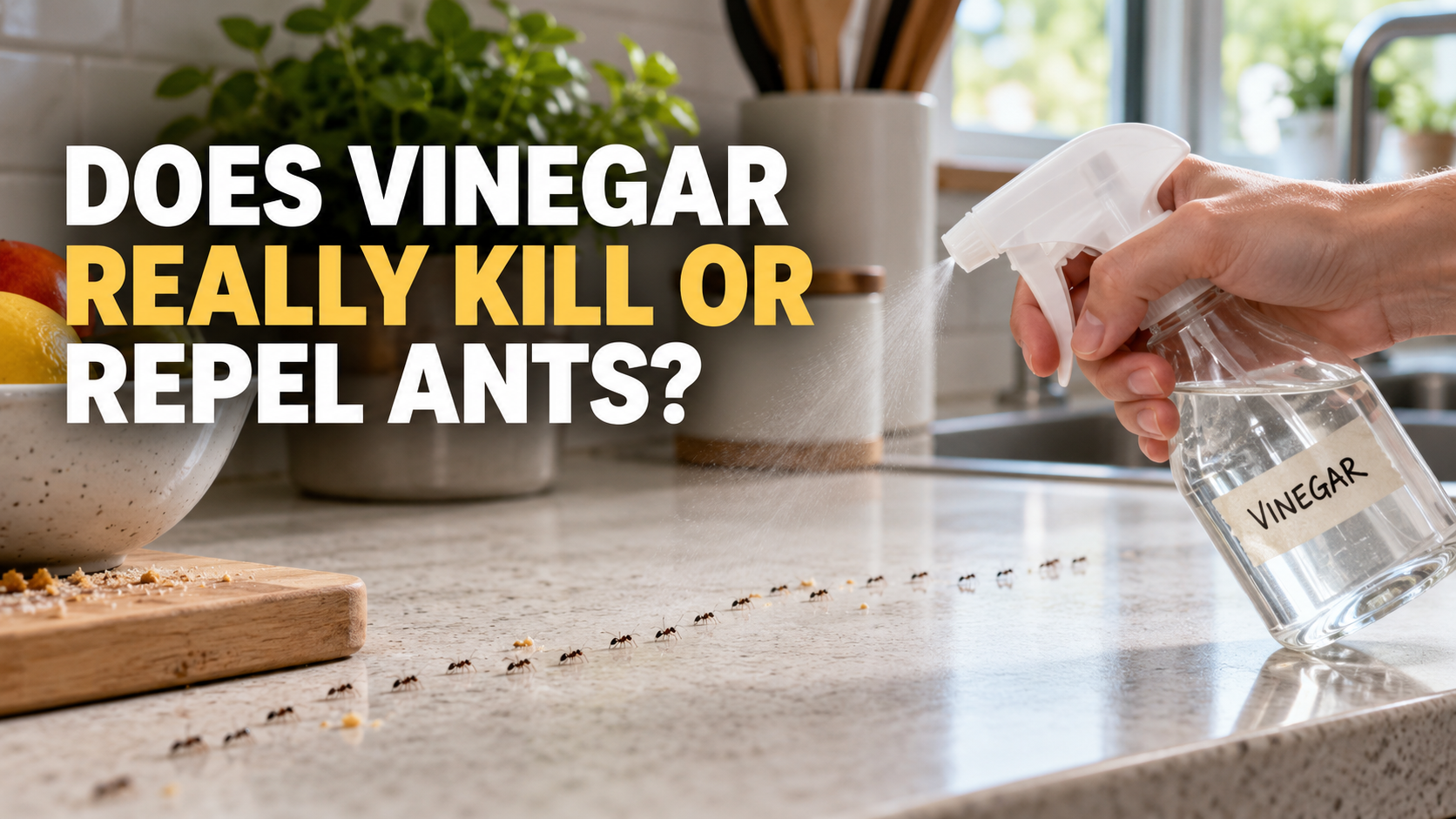
If you’ve ever searched for a quick way to get rid of ants, you’ve probably seen vinegar recommended almost immediately. Mix it with water, spray the ants, wipe down the counter, and supposedly the problem disappears.
But Does Vinegar Really Kill or Repel Ants? The answer is more complicated than most home-remedy posts make it sound. Vinegar can help disrupt ant trails and clean surfaces, but that is very different from eliminating the colony that keeps sending ants back.
Vinegar Can Disrupt the Trail Ants Are Following
Ants rely heavily on chemical trails to help workers move between the nest and food or water sources. Wiping those trails away can make it harder for other workers to follow the same path, at least temporarily.
That part of the vinegar advice has some support. The University of Minnesota Extension specifically recommends using a mild vinegar-and-water solution to wipe ant trails as a way to temporarily disrupt ant activity. The key word is temporarily. The ants may simply establish another route if the food source or entry point is still there.
Does Vinegar Actually Repel Ants?
For a short time, it can appear that way. If you wipe down the path ants have been using, you may see the trail disappear or become less organized. That’s likely because you’ve removed or disturbed the chemical cues the ants were following rather than creating a long-lasting barrier they refuse to cross.
UC Integrated Pest Management takes a similar approach. Its household-pest guidance includes diluted vinegar as an indoor spot treatment for removing ant trails, but its broader ant-control recommendations focus on sanitation, sealing entry points and using bait when colony control is needed. (UC IPM)
What About Spraying Vinegar Directly on Ants?
Directly soaking ants with a household liquid can kill some individual workers, especially if they are thoroughly coated. But that does not make vinegar a dependable ant-control treatment. The bigger problem is that the ants you see walking across the counter are usually only a small part of the colony.
The University of Minnesota Extension explains that killing foraging workers has little effect on the overall infestation because only a small percentage of the colony is outside the nest at any given time. Effective control usually requires reaching the nest and queen, either directly or through bait.
Why Do the Ants Keep Coming Back?
Because the thing that brought them inside may still be there. Food residue, pet food, moisture and easy entry points can keep attracting ants even after you clean up the visible trail.
UC IPM’s household ant guidance recommends first removing food and water sources, cleaning trails, finding where ants are entering and sealing those openings. It also notes that spraying foraging ants alone generally does not provide permanent control because the colony and queens remain intact.
Vinegar Is Better as a Cleanup Tool Than a Colony Treatment
This is where the home remedy gets oversold. Vinegar can be useful for wiping up ant trails and cleaning surfaces after ants have been active. That can absolutely be part of a larger ant-control plan.
But if ants keep returning day after day, the goal should shift from killing or confusing the workers you can see to addressing the colony. UC IPM recommends bait-based approaches for many common household ants because workers carry slow-acting bait back toward the nest, where it has a better chance of affecting the colony rather than just the ants on the counter. (UC IPM)
Species Matters More Than Most People Realize
Not every household ant behaves the same way. Different species can nest in different places, prefer different foods and respond differently to treatment. That is one reason a method that seems to work in one home may fail badly in another.
For example, UC IPM’s Argentine ant guidance recommends sanitation, sealing entry points and baiting rather than relying on indoor sprays. Argentine ants are especially relevant in California because UC IPM identifies them as the most common household ant in the state.
The PestMarket Verdict
Vinegar is not useless. It can help clean up food residue and temporarily disrupt ant trails, which may reduce visible activity for a while.
But Does Vinegar Really Kill or Repel Ants? Not in the way most people hope. It may affect or kill some individual ants on contact and temporarily disrupt trails, but it is not a reliable colony-control method. If ants keep coming back, focus on sanitation, sealing entry points and using an appropriate bait strategy. For more help, see the PestMarket Ant Control Guide.
Evidence Grade: MODERATE EVIDENCE FOR TRAIL DISRUPTION, WEAK FOR COLONY CONTROL