
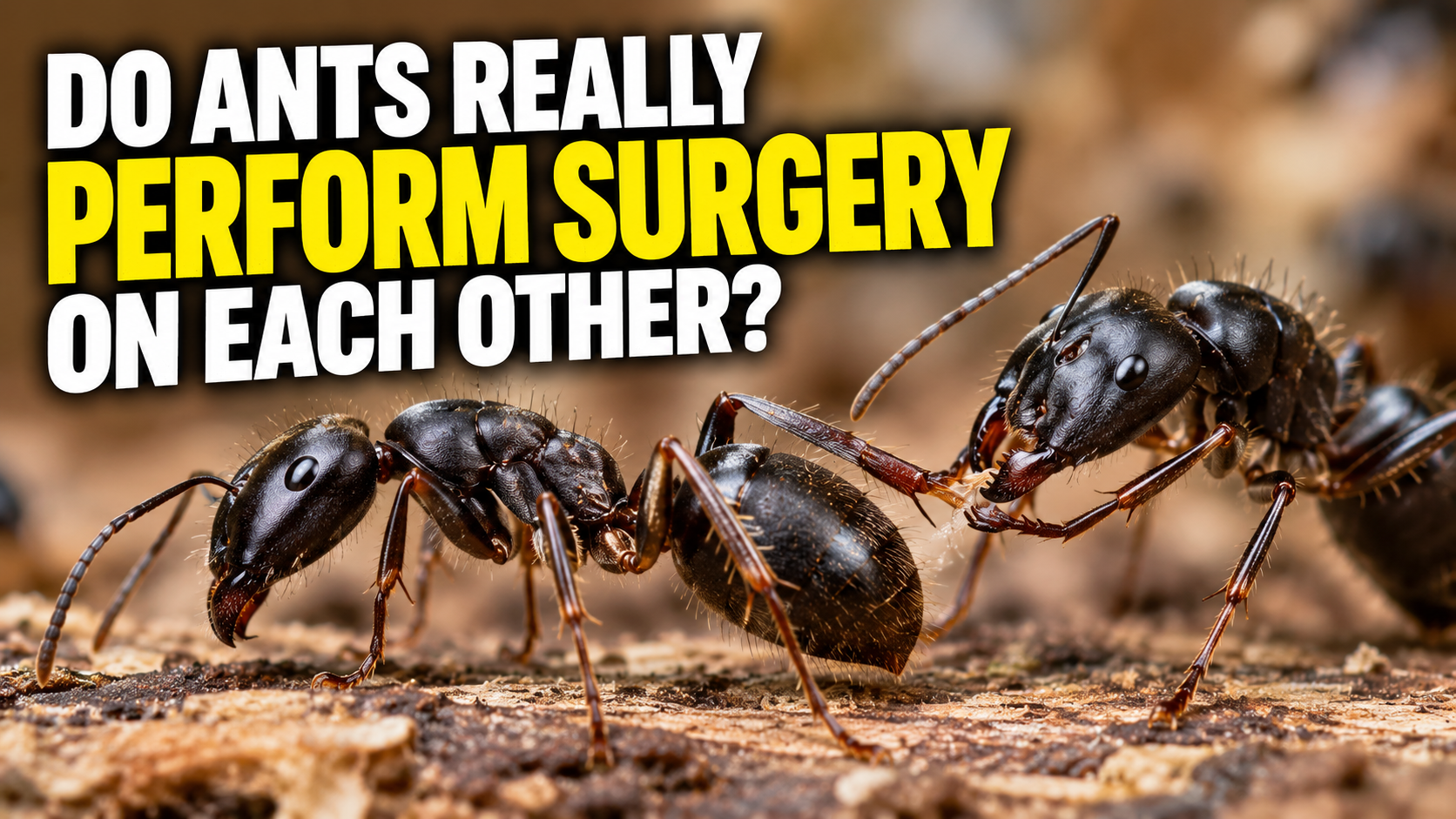
Do Ants Really Perform Surgery on Each Other? In at least one species, the answer is remarkably close to yes. Researchers studying Florida carpenter ants found that workers sometimes amputate an injured nestmate’s leg by repeatedly biting through it. Even stranger, the ants do not treat every wound the same way. They appear to respond differently depending on where the leg is injured, using amputation in some cases and intensive wound care in others. Controlled experiments showed that the right treatment can dramatically improve the injured ant’s chance of survival. Researchers described the behavior as the first known example of an animal amputating another member of its species to treat an injury.
The Ants Actually Remove the Injured Leg
The Current Biology study examined Florida carpenter ants, Camponotus floridanus. Researchers experimentally injured workers at different points on a hind leg and then returned them to their nestmates. When the injury was on the femur, other workers first cleaned the wound and then repeatedly bit the leg near its base until the entire injured limb was removed. This was not random aggression. Ants that received the appropriate amputation were much more likely to survive an infected femur injury than ants that did not receive treatment.
They Do Not Amputate Every Injury
The most surprising part may be what happened when the injury was lower on the leg. When researchers injured the tibia, the ants generally did not amputate. Instead, nestmates concentrated on cleaning the wound. That means the colony was not simply reacting to any damaged leg by removing it. The response changed with the location of the injury. Researchers concluded that the ants can differentiate between wound types and adjust treatment in a way that gives the injured worker the best chance of surviving.
Why Does the Injury Location Matter?
The difference appears to involve how infection spreads through the leg. Micro-CT imaging showed that muscles involved in circulating hemolymph, the insect equivalent of blood, are concentrated in the femur. A femur injury slows circulation enough that infection may spread more slowly, giving nestmates time to complete an amputation before pathogens reach the rest of the body. A lower tibia injury does not provide the same delay. By the time an amputation could be completed, pathogens may already have moved farther through the ant, making intensive wound cleaning a better strategy.
Ant Surgery Is Not Fast
The ants are not making a single quick bite and instantly removing a leg. Researchers observed nestmates repeatedly working around the injured limb and biting at its base until it was severed. The procedure can take a considerable amount of time. That makes the decision not to amputate tibia injuries especially interesting. If amputation were just an automatic response to seeing an injured nestmate, researchers would expect the ants to try it regardless of wound location. Instead, the behavior changes depending on the injury.
Other Ants Have Their Own Form of Medicine
Florida carpenter ants are not the only ants known to care for injured colony members. Researchers studying the African ant Megaponera analis found that workers can recognize infected wounds and apply antimicrobial secretions produced by specialized glands. The Nature Communications study found that these treatments reduced mortality in infected ants by roughly 90 percent. Chemical changes associated with infection appear to help nestmates distinguish an infected wound from a cleaner injury. That means different ant species have evolved very different ways of dealing with the same fundamental problem: keeping an injured colony member alive.
Is It Fair to Call This Surgery?
The word “surgery” sounds very human, but scientists themselves have used it to describe the behavior. A Nature research highlight described the ants as amputating nestmates’ legs to save lives and emphasized that the location of the injury determines whether the ants remove or preserve the limb. The ants almost certainly do not understand anatomy, infection or medicine the way humans do. Their behavior is probably an evolved response triggered by chemical and physical cues. Functionally, though, an injured body part is being deliberately removed because doing so improves survival.
Why Would Ants Save an Injured Worker?
Ant colonies depend on cooperation. A worker that survives an injury can continue foraging, caring for young, defending the nest and performing other jobs. Helping an injured ant can therefore benefit the colony as a whole. Social insects already use grooming, sanitation and antimicrobial defenses to limit disease. Selective wound treatment appears to be another surprisingly sophisticated part of that collective defense system. PestMarket’s Pest Control Guide covers the more familiar problems ants can cause around homes, but behavior like this shows that an ant colony is far more complex than a line of workers crossing a kitchen counter.
The PestMarket Verdict
Do Ants Really Perform Surgery on Each Other? Yes. Florida carpenter ants have been experimentally observed amputating the injured legs of nestmates, and they change their treatment depending on where the injury occurs. Femur injuries may trigger amputation, while lower-leg injuries receive more direct wound care. The treatment can dramatically improve survival.
Evidence Grade: STRONG EVIDENCE
This is not an internet myth or an anecdotal observation. The behavior was demonstrated in controlled experiments, supported by microbiological testing, anatomical imaging and survival data. Other ant species have independently been shown to identify infected wounds and apply antimicrobial treatments. Ants are not surgeons in the human sense, but some colonies have evolved remarkably sophisticated ways to keep injured nestmates alive.