
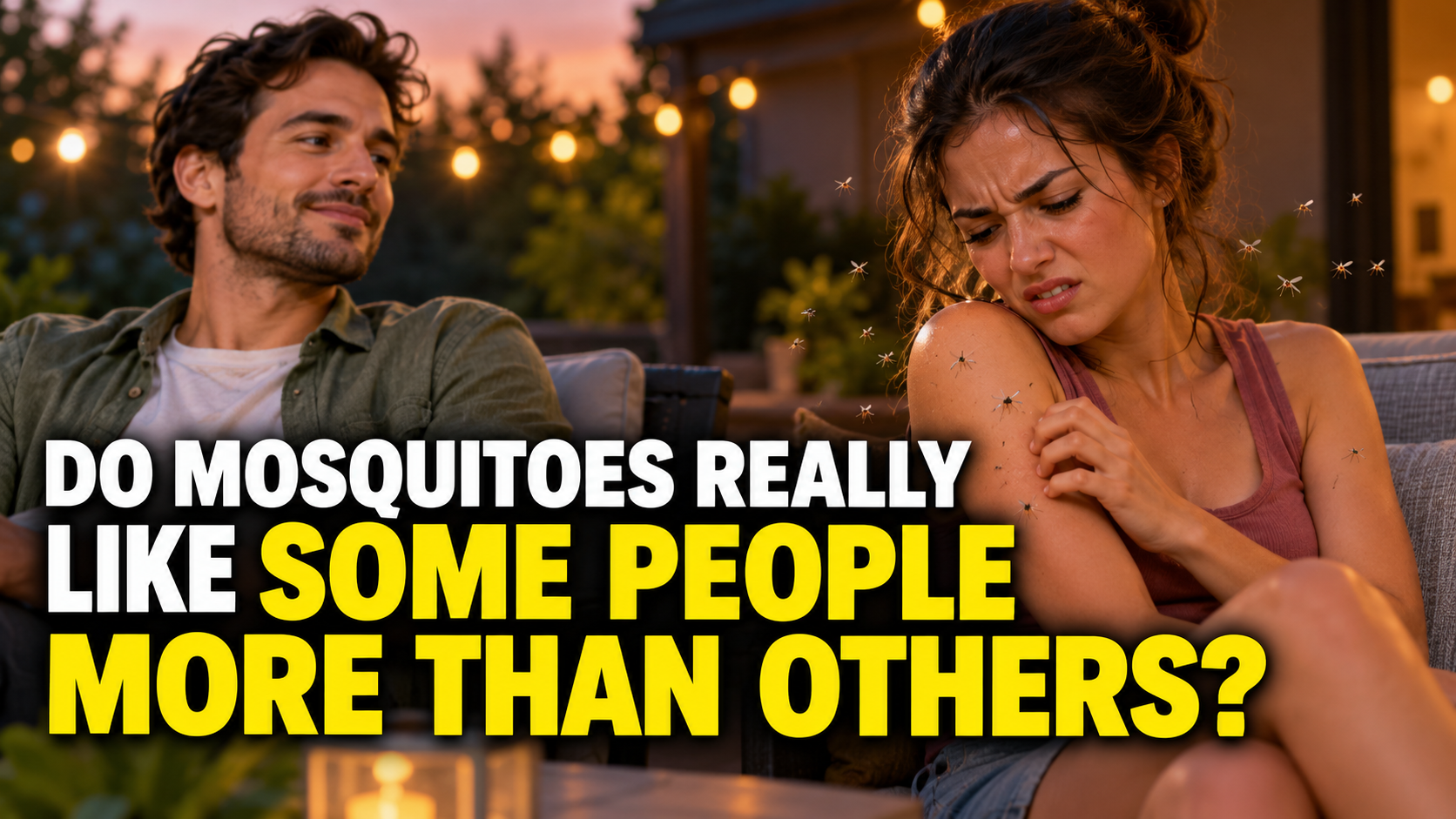
Do Mosquitoes Really Like Some People More Than Others? Yes. If two people sit outside together and one comes home covered in bites while the other barely gets touched, the difference may not be imagination. Controlled experiments have repeatedly shown that mosquitoes can strongly prefer the odor of certain people over others. Scientists are still working out exactly why, but skin chemistry, body odor, the microbes living on our skin, carbon dioxide, heat and even the species of mosquito all appear to influence who becomes the preferred target.
Some People Really Are Mosquito Magnets
One of the clearest demonstrations came from researchers at Rockefeller University, who repeatedly compared human odor samples using Aedes aegypti mosquitoes. In the Rockefeller University mosquito-magnet study, one participant was about four times more attractive than the next most attractive person and roughly 100 times more attractive than the least attractive participant. Even more striking, people who ranked as mosquito magnets tended to remain highly attractive over years of repeated testing. That suggests mosquito attractiveness can be a relatively stable feature of an individual’s skin chemistry rather than something that changes completely from day to day.
Your Skin Chemistry Appears to Matter
The Rockefeller researchers found that highly attractive participants produced higher levels of certain carboxylic acids on their skin. These naturally occurring fatty-acid-related compounds are part of the chemical environment on human skin and contribute to the odors mosquitoes use when selecting a host. This does not mean one specific acid determines whether someone gets bitten. Human odor is a complex mixture of many chemicals, and mosquitoes evaluate those signals together with other cues.
A New Study Shows Different Mosquitoes Prefer Different People
A 2026 study made the picture even more interesting. Researchers tested the odors of 119 people against three common mosquito species: Aedes aegypti, Aedes albopictus and Culex quinquefasciatus. The 2026 human-attractiveness study found that the mosquito species did not rank people in exactly the same way. Each species preferred a somewhat different subset of participants. In other words, a person who is especially attractive to one mosquito species may not be equally irresistible to another.
Your Skin Microbiome May Help Create the Smell
Human skin is covered with communities of bacteria that transform sweat, oils and other compounds into volatile chemicals. Those chemicals contribute to body odor, and mosquitoes can detect some of them. Research has found differences in skin microbiome composition between people who are highly attractive and poorly attractive to mosquitoes. A Scientific Reports study on skin microbiome odorants found that compounds produced by common skin bacteria could alter mosquito landing behavior, reinforcing the idea that the microorganisms living on our skin help shape the odor signature mosquitoes encounter.
Mosquitoes Are Not Following Smell Alone
Odor is important, but a mosquito does not use just one sense. Host-seeking females combine several clues. Carbon dioxide from breathing can alert mosquitoes that a potential host is nearby. As they approach, body odor, heat, humidity and visual cues help guide them toward exposed skin. This is why simply covering up one scent does not necessarily make a person invisible to mosquitoes. Their sensory system is designed to combine multiple pieces of information.
What About Blood Type?
Blood type is one of the most repeated explanations for why some people get bitten more often. There have been studies suggesting differences in mosquito attraction related to blood type under certain experimental conditions, but it does not explain the enormous differences seen between individuals. Current odor research provides much stronger evidence that skin chemistry plays an important role. So saying “mosquitoes always prefer Type O blood” is far too simple.
Do Bananas, Garlic or Beer Make You More Attractive?
Popular explanations are everywhere. Bananas supposedly make mosquitoes love you. Garlic supposedly repels them. Some people blame sugar consumption or sweet blood. Others say mosquitoes prefer women or children. Evidence for many of these claims is weak, inconsistent or too limited to explain persistent differences between mosquito magnets and people who rarely get bitten. Alcohol consumption has shown effects in some small studies, but it still does not replace the much broader role of odor chemistry, carbon dioxide and other host cues.
Why Does Carbon Dioxide Matter?
Female mosquitoes looking for a blood meal can detect carbon dioxide released when humans and other animals breathe. CO2 acts like a long-range signal that tells a mosquito a living host may be nearby. Once it moves closer, additional cues such as skin odor and heat become increasingly important. Larger people may emit more carbon dioxide simply because of body size and metabolism, but that alone does not determine who mosquitoes prefer.
Can You Change How Attractive You Are?
Probably not in a simple or reliable way. Because researchers found that highly attractive individuals can remain mosquito magnets for years, the underlying chemical signature may be relatively stable. Showering can temporarily alter skin odor, and cosmetics, soaps or other products can change the compounds mosquitoes encounter, but there is no proven routine that permanently turns a mosquito magnet into someone mosquitoes ignore.
Repellent Still Matters More Than Trying to Change Your Smell
Even if you happen to be highly attractive to mosquitoes, proven bite-prevention methods remain far more useful than trying to manipulate body chemistry. EPA-registered repellents, protective clothing, window screens and eliminating standing water remain the practical tools for reducing bites. PestMarket’s Mosquito Control Guide covers additional ways to reduce mosquito activity around homes and yards.
The PestMarket Verdict
Do Mosquitoes Really Like Some People More Than Others? Yes. Controlled studies show that some people consistently attract far more mosquitoes than others. Skin-derived carboxylic acids, body odor, the skin microbiome, carbon dioxide, heat and other sensory cues all appear to contribute. The newest research also shows that different mosquito species may prefer different people, making the answer more complicated than any single blood type, food or household myth.
Evidence Grade: STRONG EVIDENCE
The basic phenomenon is well established experimentally. What scientists are still working out is exactly how the many chemical and sensory signals combine to make one person dramatically more attractive than another. So if mosquitoes always seem to find you first, there may actually be a biological reason.