
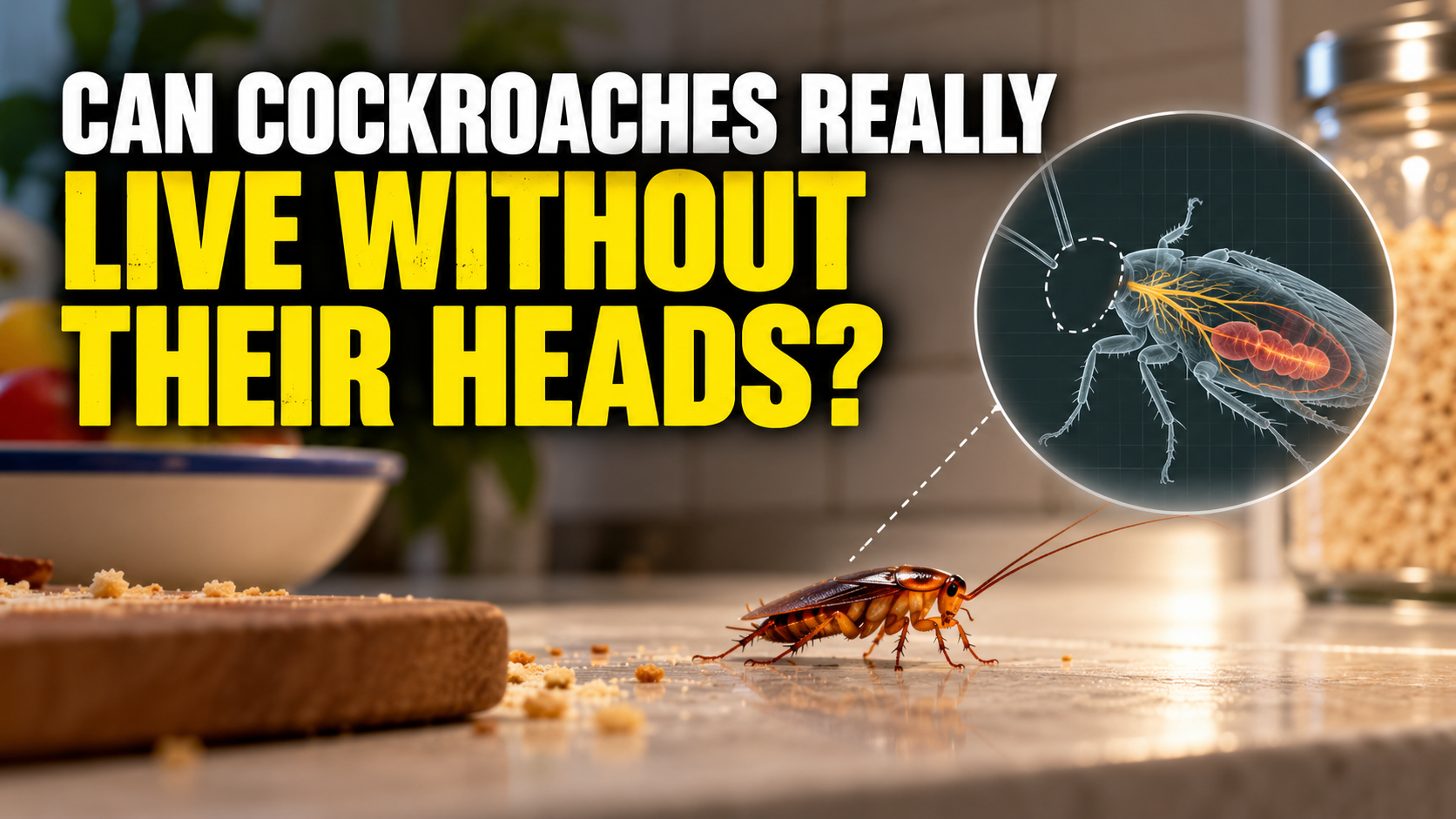
Can Cockroaches Really Live Without Their Heads? Surprisingly, yes. A cockroach that loses its head can remain alive for days and, under favorable laboratory conditions, even several weeks. That does not mean the insect is functioning normally or that it can survive indefinitely. The remarkable part is that several systems humans depend on the brain to control work very differently in a cockroach. Its breathing does not depend on its mouth, its circulation does not rely on high blood pressure, and many basic reflexes are controlled by nerve centers distributed throughout the body.
Cockroaches Do Not Breathe Through Their Heads
Humans need the brain, mouth, nose and lungs working together to breathe. Cockroaches do not. They take in air through small openings along their bodies called spiracles. Oxygen moves through a branching network of tubes called the tracheal system and reaches tissues directly. The brain does not have to continuously command this process. That means removing a cockroach’s head does not immediately stop its oxygen supply, one of the main reasons decapitation is not instantly fatal.
They Also Do Not Bleed Like Humans
Another major difference is circulation. Humans have a closed circulatory system under relatively high pressure, so a severe injury can cause catastrophic blood loss. Cockroaches have an open circulatory system with much lower pressure. As entomologists explained in a Scientific American examination of headless cockroach survival, the neck opening can seal through clotting after decapitation instead of continuously losing body fluid. Researchers have even kept experimentally decapitated American cockroaches alive for several weeks when the wound was carefully sealed to reduce water loss.
A Headless Cockroach Can Still Move
Removing the head also does not eliminate every part of the nervous system. Cockroaches have clusters of nerve cells called ganglia distributed through their body segments. These local nerve centers can control basic actions and reflexes without constant instructions from the brain. A headless cockroach may still stand, move its legs and react when touched. Those movements do not mean the animal is consciously navigating its environment normally. More complex sensory processing and behavior depend heavily on the brain and the information it receives from the head.
So What Eventually Kills It?
Usually, dehydration becomes the critical problem. A headless cockroach cannot intentionally drink. Cockroaches are extraordinarily resistant to starvation, but water is much harder for them to go without. The University of Florida’s cockroach management guidance notes that German cockroaches supplied with food but no water survive only about 12 days, while individuals with access to water but no food can survive roughly 42 days. Those numbers vary by species and conditions, but they show why losing the ability to drink is more immediately important than losing the ability to eat.
Cockroaches Can Survive a Surprisingly Long Time Without Food
Their low energy requirements add to the effect. Cockroaches are ectothermic, meaning they do not spend large amounts of energy maintaining a constant internal body temperature the way mammals do. That allows them to survive extended periods with little or no food. American cockroaches, for example, can survive two or three months without food when water remains available, according to Penn State Extension. Without water, their survival period drops dramatically. A headless cockroach therefore has stored energy available, but no practical way to replace lost moisture.
Does the Head Stay Alive Too?
Strangely, the separated head does not necessarily stop functioning immediately either. Experiments and entomological observations have shown that antennae and other structures can continue responding for a period after separation. The head contains nervous tissue capable of continuing limited activity while its remaining energy lasts. It is not an independent organism, of course, and both the body and head ultimately fail.
Is Every Cockroach Capable of This?
The basic physiology applies broadly to cockroaches and many other insects, but survival time is not fixed. Species, temperature, humidity, injury severity, infection and how much water the insect loses can all change the outcome. A cockroach in a humid laboratory with a carefully sealed wound may survive much longer than one injured inside a dry home. Claims such as “a cockroach always lives exactly one week without its head” are therefore misleading.
Why Are Cockroaches So Difficult to Kill?
The headless survival story highlights why cockroaches have such a reputation for resilience. Their decentralized nervous system, low-pressure circulation, spiracle-based breathing and low energy requirements allow them to tolerate injuries that would immediately kill many vertebrates. But resilience does not make them immortal. Removing food and especially water, eliminating hiding places and blocking movement between wall voids and plumbing penetrations are still central parts of cockroach management. PestMarket’s Cockroach Control Guide covers the practical side of controlling them around homes.
The PestMarket Verdict
Can Cockroaches Really Live Without Their Heads? Yes. Cockroaches can remain alive after decapitation because they breathe through spiracles, have a low-pressure open circulatory system and use distributed nerve centers for many basic reflexes. Under controlled conditions, some have survived for several weeks. They eventually die because the body can no longer drink and maintain hydration, along with other complications from the injury.
Evidence Grade: STRONG EVIDENCE
Headless cockroach survival has been demonstrated experimentally and is well explained by established insect physiology. The myth is not that they can survive without a head. The exaggeration is assuming they can survive that way indefinitely.