
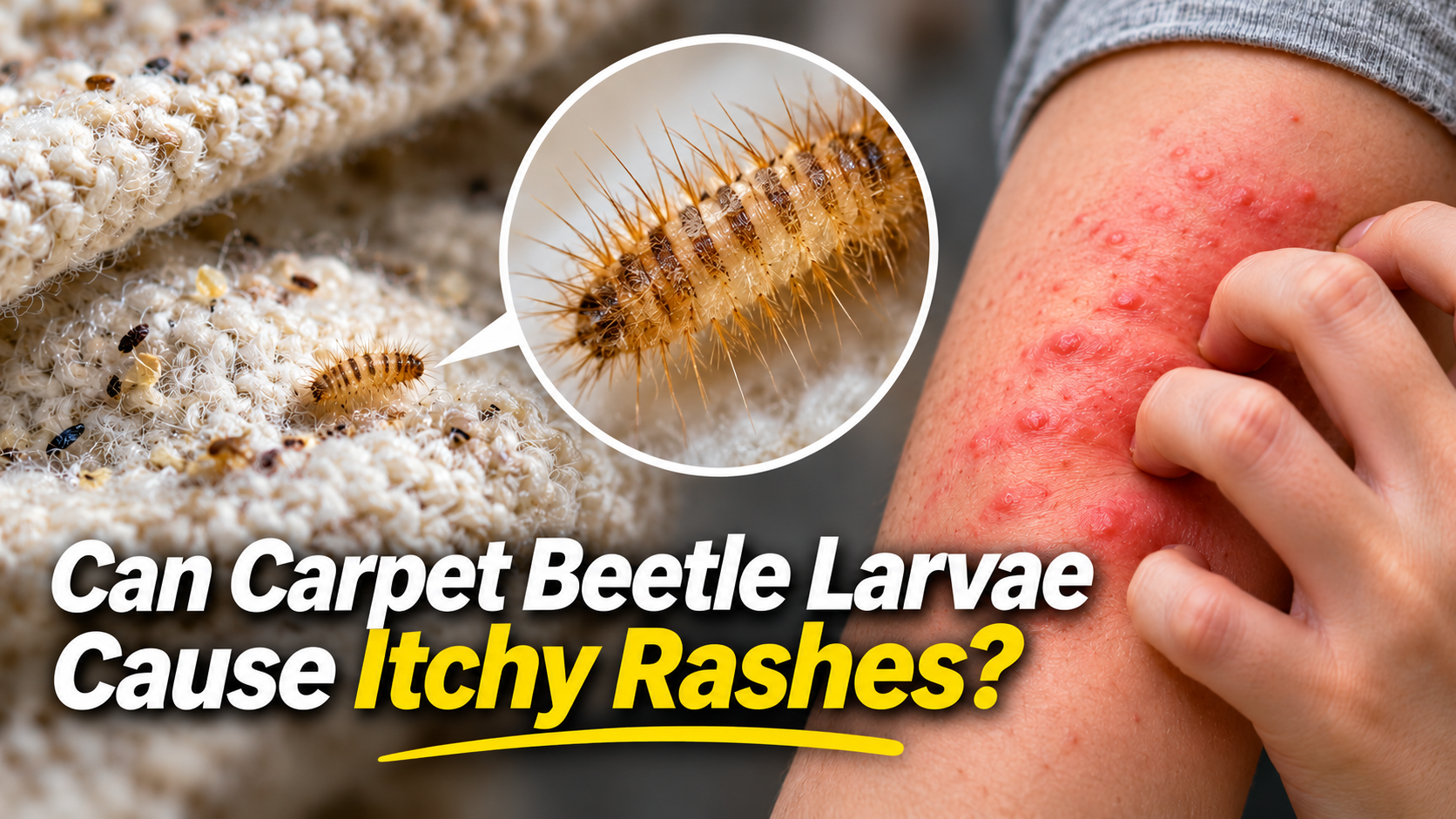
Can Carpet Beetle Larvae Cause Itchy Rashes? Yes. In some people, contact with microscopic hairs released by carpet beetle larvae can trigger itchy, red skin reactions even though the larvae do not bite or feed on human blood. Published medical cases describe larvae-associated dermatitis that can resemble bed bug bites, but this is not a diagnosis based on rash appearance alone. The distinction matters because the adults commonly seen near windows are not the source of these irritating larval hairs, and many people exposed to the insects have no skin symptoms at all. A careful search for larvae, their shed skins, and other possible causes is more informative than treating every itchy spot as an insect bite.
What Actually Causes the Skin Reaction?
The relevant stage is the larva, not the adult carpet beetle. Some dermestid larvae, especially Anthrenus species, carry specialized detachable hairs called hastisetae. These tiny, sometimes spear-shaped hairs can become embedded in fabrics, dust, or skin and provoke irritation or allergic hypersensitivity in susceptible people. A 2024 dermatology review describes both immediate and delayed reactions associated with these hairs. Larvae do not bite, sting, inject venom, or drink blood, so a red, bite-like bump is not evidence of a puncture wound. Adults may appear near sunny windows, while larvae and shed larval skins are more often found in dark, undisturbed areas where they feed on animal-derived materials.
Can Carpet Beetle Larvae Cause Itchy Rashes?
The answer is supported by documented cases, but it requires precise wording. A carpet beetle-related rash is a possible response to exposure, not an inevitable symptom in every home containing the insects. In affected people, dermatologists have described itchy red bumps, sometimes with small fluid-filled lesions, that resemble arthropod bites. Some reactions may be delayed, so the precise moment of contact might not be obvious. The offending hairs can remain in dust, fabrics, or shed larval skins even when no live larva is crawling on the person. That helps explain why an individual might blame invisible nighttime insects while an overlooked source remains behind furniture or near textile storage.
Why the Rash Can Be Mistaken for Bed Bug Bites
A cluster of itchy bumps discovered in the morning naturally raises concern about bed bugs. But appearances overlap. Bed bugs are blood-feeding insects that bite with specialized mouthparts, while carpet beetles are fabric and debris-associated scavengers whose larvae can trigger reactions through their hairs. The Penn State Extension review of carpet beetle dermatitis specifically notes complaints that feel like being bitten, with intense itching and rashes. Where the rash occurs, how many bumps appear, or whether someone saw an adult beetle is not enough to identify a cause. The safest approach is to examine bedding and furnishings for actual insects and physical evidence rather than diagnose either pest from photographs of skin alone.
Why One Person Itches and Another Feels Nothing
The same bedroom can expose multiple people to the same dust without producing identical symptoms. People vary in their sensitivity to irritating hairs and in the way inflammatory skin conditions manifest. In the CDC-reported cluster, family members differed in whether they developed lesions, even when sharing the same living environment. Thus, one symptomatic person and one symptom-free person do not rule the possibility in or out. Nor does a new rash prove that a home is heavily infested. Exposure level, personal sensitivity, and other skin or health conditions all influence what a person notices. Avoid making broad claims that every carpet beetle species or every larva will cause dermatitis; medical evidence comes from particular exposures and affected individuals, not from universal reactions.
Where Irritating Larval Hairs May Accumulate
Carpet beetle larvae prefer quiet places with suitable food such as wool, fur, feathers, lint, human or pet hair, dead insects, and some stored materials. Look beneath seldom-moved furniture, along rug edges, inside closets, around upholstered furniture, and near vents where dust and debris collect. Shed skins can be especially useful clues because they remain after a larva moves or molts. The University of California IPM identification and control guide describes hairy larvae and bristly cast skins as evidence of feeding activity. In a bedroom, the significant finding may be larvae or their skins in a fabric fold or under furniture rather than adult beetles resting on a windowpane. Air movement and handling of contaminated fabrics can also move loose hairs around a room.
How to Distinguish Carpet Beetles From Other Pests
Identify the life stage before drawing conclusions. A varied carpet beetle adult is a very small, roundish beetle with mottled black, white, and brown or yellowish scales. Its larva looks entirely different: a short, elongated, segmented, brownish and densely hairy insect, often broader toward the rear with distinct tufts of hairs. Other carpet beetle species differ, so one exact appearance does not represent them all. Larvae feed on wool, fur, feathers, hair, dead insects, and similar materials, not on humans. Bed bugs, by contrast, are flattened, oval, blood-feeding insects without dense larval bristles. Finding a fuzzy larva or cast skin supports investigating carpet beetles, but a skin lesion by itself cannot identify either pest.
Does Finding a Carpet Beetle Prove It Caused the Rash?
No. Adults can enter through windows or arrive on flowers, and an isolated adult may never establish a damaging indoor population. Even confirmed larvae do not automatically establish the cause of a particular person’s symptoms. A clinician should evaluate persistent or unexplained dermatitis, especially when there are other plausible explanations such as eczema, contact allergy, mites, or genuine insect bites. A useful investigation begins with photographing or preserving the actual insect for identification, documenting where larvae and cast skins were found, and noting whether symptoms change after thorough environmental cleaning. This is more dependable than guessing from a rash pattern or spraying an entire room before the pest has been identified.
What Medical Research Actually Demonstrates
Published medical evidence documents real cases, not merely online anecdotes. A 2021 report in CDC’s Emerging Infectious Diseases journal investigated a household cluster of skin lesions associated with Anthrenus carpet beetle larvae and their specialized hairs. Some family members were affected while others were not, underscoring the role of individual sensitivity. A 2024 dermatology review describes acute and delayed hypersensitivity reactions in susceptible individuals, and reports that larval hairs can detach and travel with dust or textiles. These are clinical and entomological observations, not proof that carpet beetles are a common cause of every unexplained rash. The evidence supports the possibility of dermatitis following exposure, not an automatic diagnosis without examining the home and patient.
How to Remove the Exposure Source Safely
The first task is to find and remove larvae, cast skins, and the material supporting their development. Vacuum rug edges, baseboards, upholstered seams, the spaces beneath beds and furniture, and locations where pet hair or dead insects accumulate. Launder washable clothing and bedding according to care labels; dry cleaning can be appropriate for vulnerable fabrics. Empty vacuum contents promptly, and clean accessible vents or dust-trapping areas. Inspect woolens and stored natural materials before putting them into clean, closed storage. Because the source may be in a closet, attic, or concealed animal nesting material, persistent activity sometimes requires professional identification and a more thorough search. PestMarket’s pest identification and prevention guides can help organize the inspection, but they cannot diagnose a skin condition.
What Not to Do When Skin Symptoms Appear
Do not apply insecticides to your skin or spray mattresses, clothes, or indoor air indiscriminately in response to unexplained itching. A pesticide is not a treatment for dermatitis, and using it where the label does not permit can create a separate exposure risk. Avoid assuming every tiny beetle is the cause or treating all itchy bumps as proof of bed bugs. If symptoms persist, spread, become painful, show signs of infection, or involve substantial swelling, consult a qualified health professional. Seek urgent medical attention for breathing difficulty or a severe allergic reaction. When a pest inspection finds no larval activity, pursue a medical assessment and other explanations rather than repeating unnecessary pesticide applications.
The PestMarket Verdict
Yes. Carpet beetle larvae can cause itchy rashes in susceptible people without biting them. The trigger is contact with irritating or allergenic larval hairs, sometimes including hairs left in shed skins or contaminated fabrics, rather than a bite from the insect. Adults are not responsible for the characteristic hair-associated reaction. If unexplained rashes appear, inspect for larvae and cast skins, remove likely food sources, and clean exposed textiles. Do not diagnose the cause from red bumps alone; persistent, worsening, or severe symptoms deserve medical evaluation.
Evidence Grade
STRONG EVIDENCE that certain carpet beetle larval hairs can cause dermatitis and bite-like lesions in susceptible people, supported by medical case reports and an entomological review. STRONG EVIDENCE that carpet beetle larvae do not bite or feed on people and that finding and removing larvae, shed skins, and food sources is central to management. MODERATE, CONTEXT-DEPENDENT EVIDENCE for connecting an individual person’s rash to carpet beetle hairs without clinical assessment and environmental confirmation. INSUFFICIENT EVIDENCE to identify carpet beetle dermatitis from the appearance or distribution of a rash alone.