
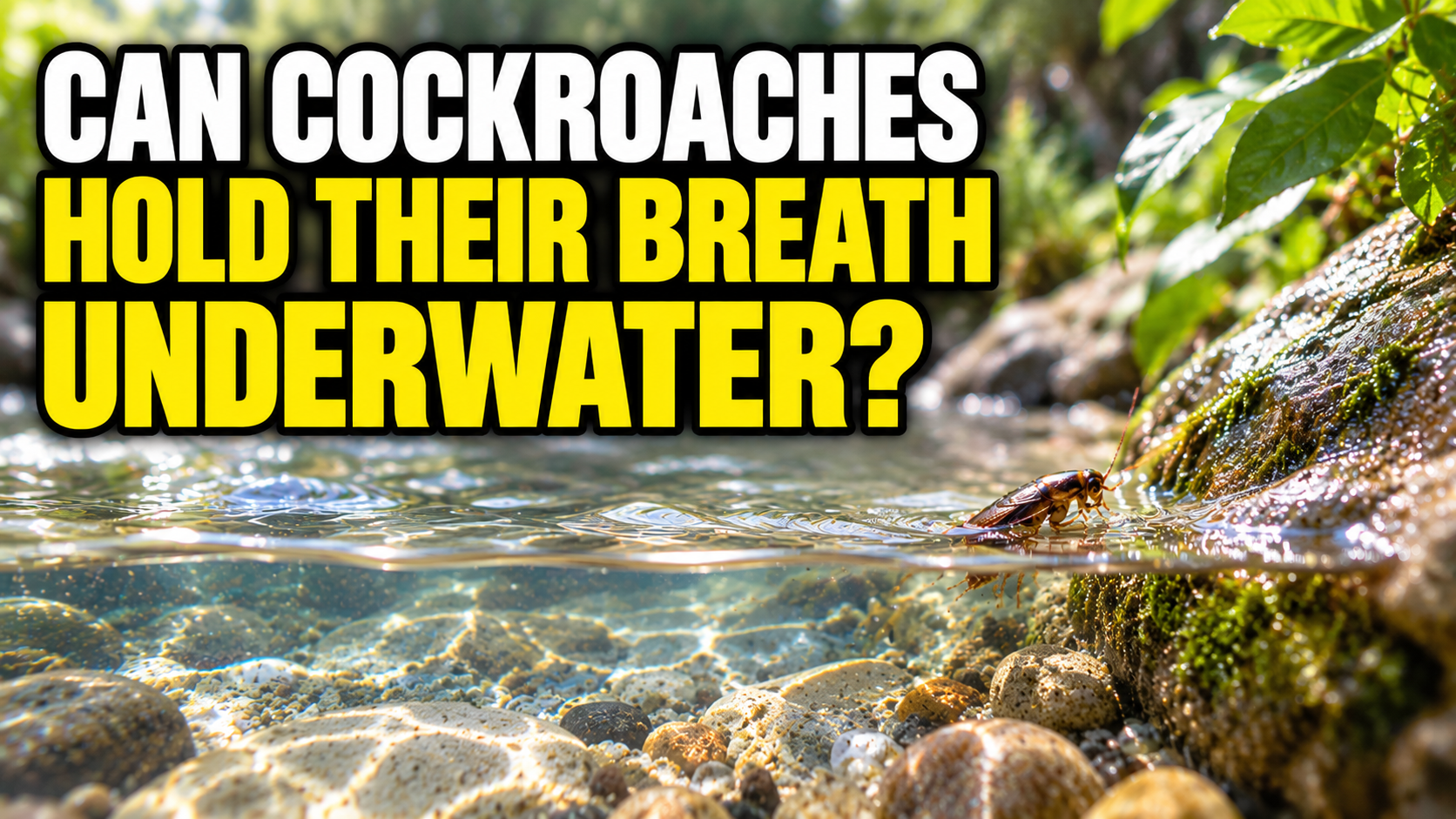
Can Cockroaches Hold Their Breath Underwater? Cockroaches are famous for surviving in harsh conditions, and a widely repeated claim says they can hold their breath for 40 minutes. But the real science is more complicated. These insects do not breathe through a nose or mouth. They control openings along their bodies, and those openings can temporarily close. That helps explain their reputation for resilience, but it does not establish that a submerged cockroach can survive for 40 minutes without air. New research involving underwater experiments offers an unusually direct test of that assumption.
Cockroaches Breathe Through Openings Along Their Bodies
Unlike humans, cockroaches do not draw air into lungs. Oxygen enters through openings called spiracles and travels along a branching network of air-filled tubes called tracheae. The system delivers oxygen to tissues without using blood to transport most of it. The spiracles can open and close, making their timing an important part of how cockroaches control gas exchange. This body-based respiratory system also explains why an insect’s mouth being underwater is not the decisive issue: access to air at its spiracles matters much more.
Why Do Cockroaches Close Their Spiracles?
Closing spiracles helps insects limit water loss through their respiratory system. In a 2009 report on experiments by Australian researchers, ABC Science described how cockroaches modify spiracle opening in dry environments. The investigators found that cockroaches in drier air opened those passages for shorter periods. That finding concerns water conservation in air, not proof of a long underwater dive. Another experimental study of Madagascar hissing cockroaches and humidity likewise examined how spiracle regulation relates to respiratory patterns and water retention. Being able to interrupt airflow briefly is not the same as being able to extract oxygen from water.
Where Did the 40-Minute Claim Come From?
The statement that a cockroach can hold its breath for 40 minutes is repeated widely online, often without identifying the species, water conditions or original experiment. Those details are essential. Some references to breath-holding describe spiracle closure in air, while others imply full submersion. They cannot safely be treated as equivalent. Duration can also depend on whether the insect is motionless or struggling, whether any part of it touches air, water temperature, species and how survival is measured. Without a clear primary experimental source establishing that benchmark across cockroaches, a universal 40-minute underwater survival claim is not justified.
A 2026 Experiment Put Underwater Survival to the Test
A 2026 Nature Communications experiment offered a revealing comparison. Researchers fitted Madagascar hissing cockroaches with miniature diving suits that sealed out water and supplied oxygen to the insects’ spiracles. Equipped insects could remain active underwater for two to three hours. In a control experiment without the suit, a fully submerged cockroach suffocated within two minutes. This does not prove that every cockroach species dies within two minutes of immersion. It does, however, demonstrate that the impressive underwater performance came from the engineered oxygen supply, not an ordinary ability of the animal to breathe underwater. The experimental results directly challenge the assumption that long underwater survival is automatic.
Can Cockroaches Breathe Oxygen Dissolved in Water?
Ordinary terrestrial cockroaches are not equipped with gills and cannot continuously extract dissolved oxygen from water as fish do. Their tracheal system is adapted primarily to exchange gases with air. Some aquatic insects use specialized structures, trapped air or other adaptations, but those should not be attributed to familiar household cockroaches. A cockroach may temporarily tolerate oxygen interruption, yet complete immersion removes its normal access to fresh air. Its ability to remain alive depends on the specific conditions rather than an unlimited reserve of oxygen.
Does a Cockroach in a Drain Mean It Swam Up Through Water?
Finding a cockroach near a sink or floor drain does not prove that it traveled through a long water-filled pipe. Some cockroach species inhabit damp infrastructure, move through gaps around pipes or enter buildings through connected spaces. They may also reach bathrooms and kitchens because moisture and sheltered cracks are attractive. Interpreting every drain-side sighting as evidence of extreme diving ability overlooks far more ordinary routes. The more useful response is to identify the species and inspect accessible openings, leaks and nearby hiding places.
Can Water Alone Eliminate a Cockroach Infestation?
Flooding a hiding place or pouring water around a drain is not a reliable cockroach-control strategy. Water may displace some individuals without reaching the egg cases or sheltered population. The practical response focuses on food, moisture, exclusion, monitoring and properly selected treatments. PestMarket’s Cockroach Control Guide covers signs of activity, leak repairs, bait use and situations that may require a professional. For broader identification and prevention information, see the Pest Control Guides. Relying on the claim that cockroaches can or cannot hold their breath for a particular number of minutes will not solve an established infestation.
The PestMarket Verdict
Can Cockroaches Hold Their Breath Underwater? Cockroaches can temporarily close their spiracles and interrupt breathing, but that physiological ability does not justify a universal claim that they survive for 40 minutes underwater. The exact endurance of a fully submerged cockroach depends on species and experimental conditions. In a published 2026 control test, a Madagascar hissing cockroach without external oxygen support suffocated within two minutes, while specially equipped insects stayed active underwater for hours. The striking result is not that cockroaches can breathe in water, but that their normal respiratory system still needs access to oxygen.
Evidence Grade: MODERATE EVIDENCE FOR A UNIVERSAL UNDERWATER CLAIM
Strong evidence supports spiracle closure and the inability of ordinary terrestrial cockroaches to respire continuously from water. A controlled experiment also demonstrates that the underwater endurance of unequipped animals can be much shorter than popular claims imply. However, a single species and experimental setup cannot establish an absolute underwater survival limit for every cockroach. The popular 40-minute figure should therefore be treated as insufficiently verified, not as a standard biological rule.