
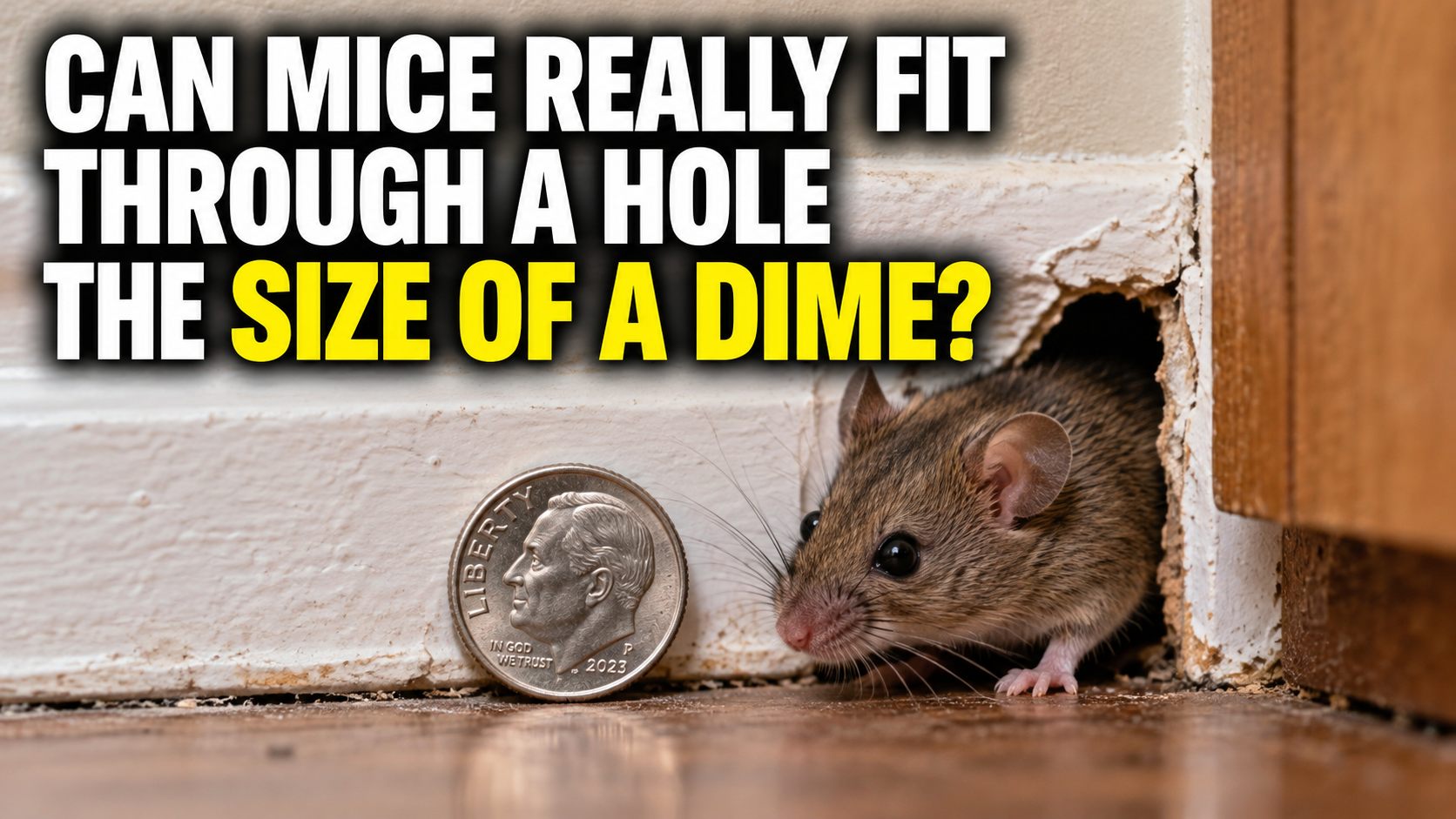
Can Mice Really Fit Through a Hole the Size of a Dime? Yes—and the part most people get wrong is that a mouse may not even need a hole that large. The dime comparison is common because it is easy to picture, but the CDC says mice can fit through an opening only about 1/4 inch, or 6 millimeters, wide. That is roughly the width of a pencil and smaller than most homeowners expect. It also helps explain why mice sometimes seem to appear out of nowhere in homes that look tightly sealed from the outside.
Why Can a Mouse Squeeze Through Such a Small Opening?
A mouse looks much bigger when it is running across a kitchen floor than the gap it can actually use to get inside. The key is not the furry width of the body but the structure underneath. If the skull can get through, the rest of the body can compress and follow. That is why tiny openings around plumbing lines, utility penetrations, weatherstripping, vents and foundations can become real entry points even when they look too small to matter.
This is not just a catchy pest-control saying. Penn State Extension specifically notes that a mouse can fit through a hole about the size of a dime or a pencil. That is a useful mental test because it gives homeowners an easy way to stop dismissing small gaps that feel insignificant but are actually large enough for rodent entry.
Is the Dime Comparison Literally Accurate?
Not exactly. A dime is larger than 1/4 inch, which means the famous “dime-sized hole” phrase can actually understate how small a usable mouse opening may be. In practical terms, though, the message is still correct: if a hole looks tiny to you, that does not mean it is too small for a mouse.
A better way to think about it is this: if a gap is approaching pencil-width, take it seriously. And if it is truly dime-sized, it is already more than big enough for trouble. Some openings can also get worse over time. A weak material around the edge of a pipe or vent may be gnawed, turning a marginal opening into a dependable mouse entrance.
Where Are the Most Common Mouse Entry Points?
Most people think first about the front or back door, but many mouse entry points are much less obvious. Common problem spots include gaps around pipes under sinks, spaces where cable or electrical lines enter the structure, dryer vent areas, garage-door edges, crawlspace and attic vents, cracks in the foundation and small openings hidden behind appliances. In kitchens and bathrooms, the cabinet can hide plumbing penetrations that are much larger than they appear from normal standing height.
The EPA recommends sealing holes inside and outside the home and combining exclusion with sanitation, food protection and removal of shelter. That matters because closing one hole helps, but a home that still offers easy food, water and nesting spots gives rodents every reason to keep looking for another way in.
What Should You Use to Seal the Openings?
Not every filler works. Soft materials alone often fail because mice can chew through them or tear them apart. For smaller gaps, rodent-resistant materials such as steel wool combined with caulk are often used. Larger openings may require hardware cloth, metal flashing, cement or other tougher repairs. Door sweeps deserve special attention because even a narrow gap under an exterior or garage door can be enough for a mouse, especially if the inside offers food or warmth.
The goal is not to make the hole look closed from six feet away. The goal is to make it physically difficult for a rodent to chew, widen or pass through.
Sealing Holes Is Only Half the Job
If mice are already inside, exclusion alone does not solve the whole problem. The rodents that entered before the repairs may still be in the walls, attic, cabinets or garage. Fresh droppings, gnaw marks, shredded paper, nesting material and nighttime scratching sounds can help show whether activity is still ongoing. Trapping, monitoring and sanitation matter just as much as sealing gaps.
PestMarket’s Rodent Control Guide covers common signs of mice and rats, prevention steps, exclusion basics and when it may make sense to bring in professional help.
The PestMarket Verdict
Can Mice Really Fit Through a Hole the Size of a Dime? Yes, mice really can fit through a hole the size of a dime—and in some cases they can squeeze through openings even smaller than that. CDC guidance says a gap of about 1/4 inch can be enough for a mouse, so the familiar dime comparison is actually a conservative rule of thumb.
Evidence Grade: STRONG EVIDENCE
The claim is well supported by public-health and university pest-management guidance. For homeowners, the practical takeaway is to treat pencil-width gaps around pipes, doors, utility lines and foundations as potential mouse entry points.