
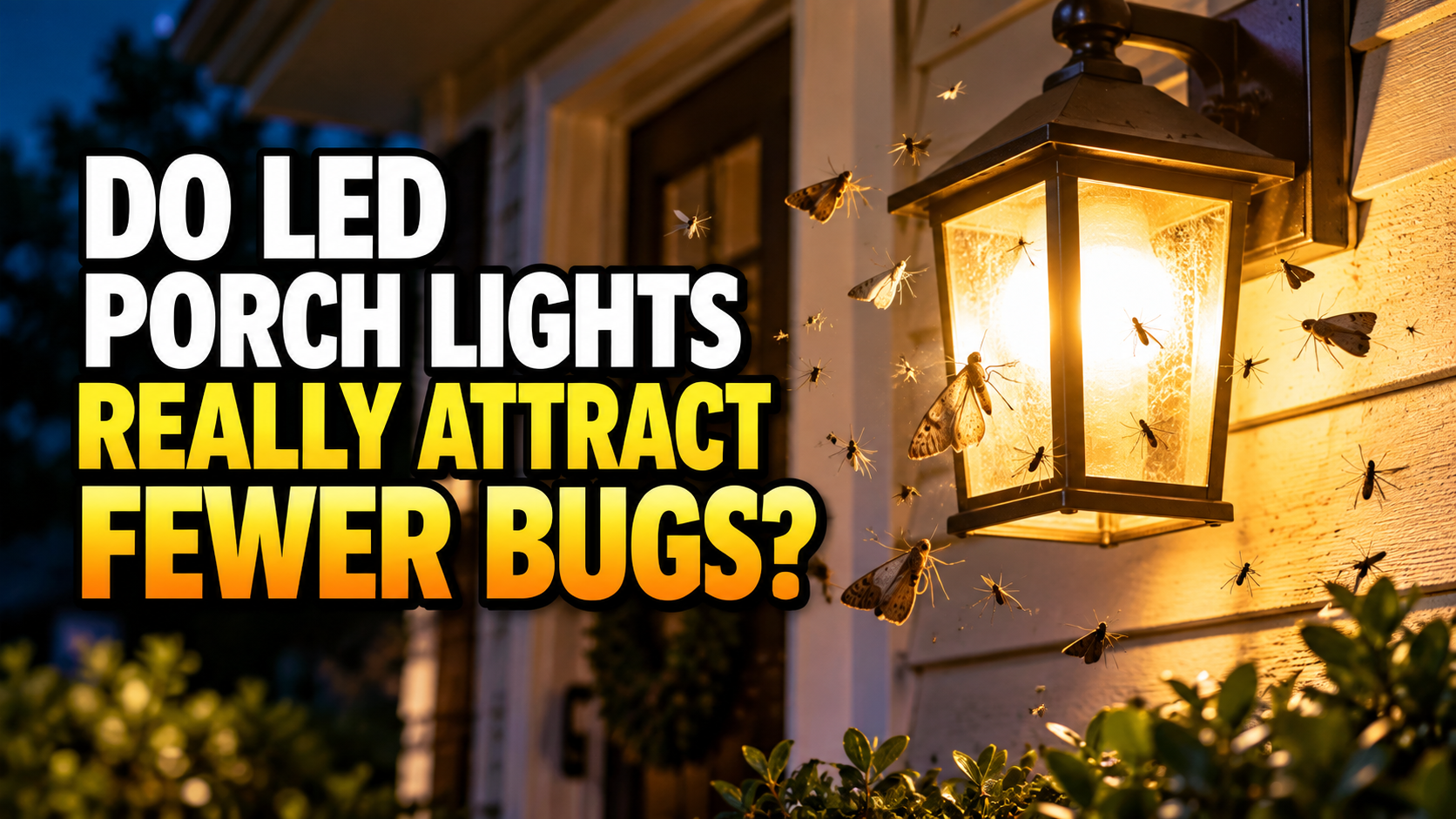
Do LED Porch Lights Really Attract Fewer Bugs? Usually, yes, but simply replacing an old bulb with any LED is not enough. If you have ever turned on your porch light at night and watched moths, mosquitoes and other flying insects gather around the front door, the type of light can make a noticeable difference. The key is not just whether the bulb is LED. Color temperature, wavelength and brightness all affect how attractive that light may be to insects. A warm yellow LED can be a much better choice than a bright blue-white LED, even though both use the same basic lighting technology.
Why Do Bugs Gather Around Lights?
Many nocturnal insects respond strongly to artificial light. Different species see different portions of the light spectrum, but ultraviolet, blue and shorter wavelengths tend to be especially attractive to many flying insects. That helps explain why bright white or blue-toned outdoor lights can become gathering points after dark. Researchers are still studying exactly why insects circle artificial lights, and different species do not respond identically. From a homeowner’s perspective, though, the practical pattern is well established: changing the color and intensity of exterior lighting can reduce the number of insects gathering around a doorway.
Not All LED Bulbs Are the Same
This is where the simple advice to “switch to LED” becomes misleading. UF/IFAS Extension explains that LEDs with wavelengths below about 550 nanometers and correlated color temperatures above 3600K are less effective at excluding insects. These are often the bulbs sold as natural light, daylight or cool white. Warmer LEDs with lower color temperatures produce less of the short-wavelength light that attracts many insects. So if you replace a traditional porch bulb with a very bright 5000K daylight LED, you may save electricity without solving your bug problem.
Yellow and Warm White Usually Perform Better
Yellow “bug lights” are designed around this same principle. UF/IFAS says yellow or yellow-coated LEDs typically produce peak wavelengths around 550 to 600 nanometers and can significantly reduce unwanted insects gathering around exterior lights. Penn State Extension also recommends considering yellow bug lights because they attract fewer insects. They are not insect repellents and they do not create an invisible barrier around your porch. They simply produce light that many insects find less attractive.
Does That Mean Yellow Lights Attract No Bugs?
No. This is an important distinction. A yellow LED can reduce insect activity around a fixture, but no normal porch light can guarantee zero insects. Species respond differently, nearby vegetation and standing water matter, and a very bright yellow light may still attract more insects than a dimmer light of the same color. The goal is reduction, not elimination. That also explains why homeowners sometimes report dramatically different experiences after buying bulbs that are all marketed as “bug lights.”
Brightness and Location Matter Too
Color is only one part of the equation. Leaving a powerful porch light on all night provides insects with a much stronger visual target than using a lower-output bulb for short periods. Motion-activated lighting can help because the fixture remains dark most of the time and switches on only when someone approaches. Fixture placement matters as well. University of Minnesota Extension recommends reducing exterior lighting and, where practical, positioning security lights away from the building and directing the light toward the doorway. That can draw insects away from the exact place where people are opening the door.
Why Porch Lights Can Lead to More Than Flying Bugs
A porch light full of insects can also create a second pest problem. Spiders often build webs near outdoor fixtures because the light provides a steady supply of prey. Other insect predators may gather there for the same reason. Reducing the number of insects around the fixture can therefore make the entryway less attractive to spiders as well. It will not eliminate a spider population around a property, but it can remove one concentrated feeding location right beside the front door.
What Should You Buy?
For most homes, a practical starting point is a warm white, ultra-warm white, yellow or amber LED, preferably below about 3600K. Avoid excessively bright daylight-style bulbs if reducing insects is a priority. A motion sensor or timer can reduce attraction even further by limiting how long the light stays on. For additional ways to reduce insects around doors, windows and outdoor living areas, PestMarket’s DIY Pest Control Guide covers prevention strategies that can be used alongside better outdoor lighting.
The PestMarket Verdict
Do LED Porch Lights Really Attract Fewer Bugs? Yes, but the type of LED matters. Warm white, yellow and amber LEDs generally attract fewer insects than cool white or blue-heavy outdoor lighting. Simply buying a bulb labeled LED does not guarantee better results.
Evidence Grade: STRONG EVIDENCE
University Extension guidance consistently supports reducing short-wavelength outdoor light and using warmer or yellow lighting when the goal is to attract fewer insects. For the best practical result, combine a warm-color LED with lower brightness, good fixture placement and a timer or motion sensor.