
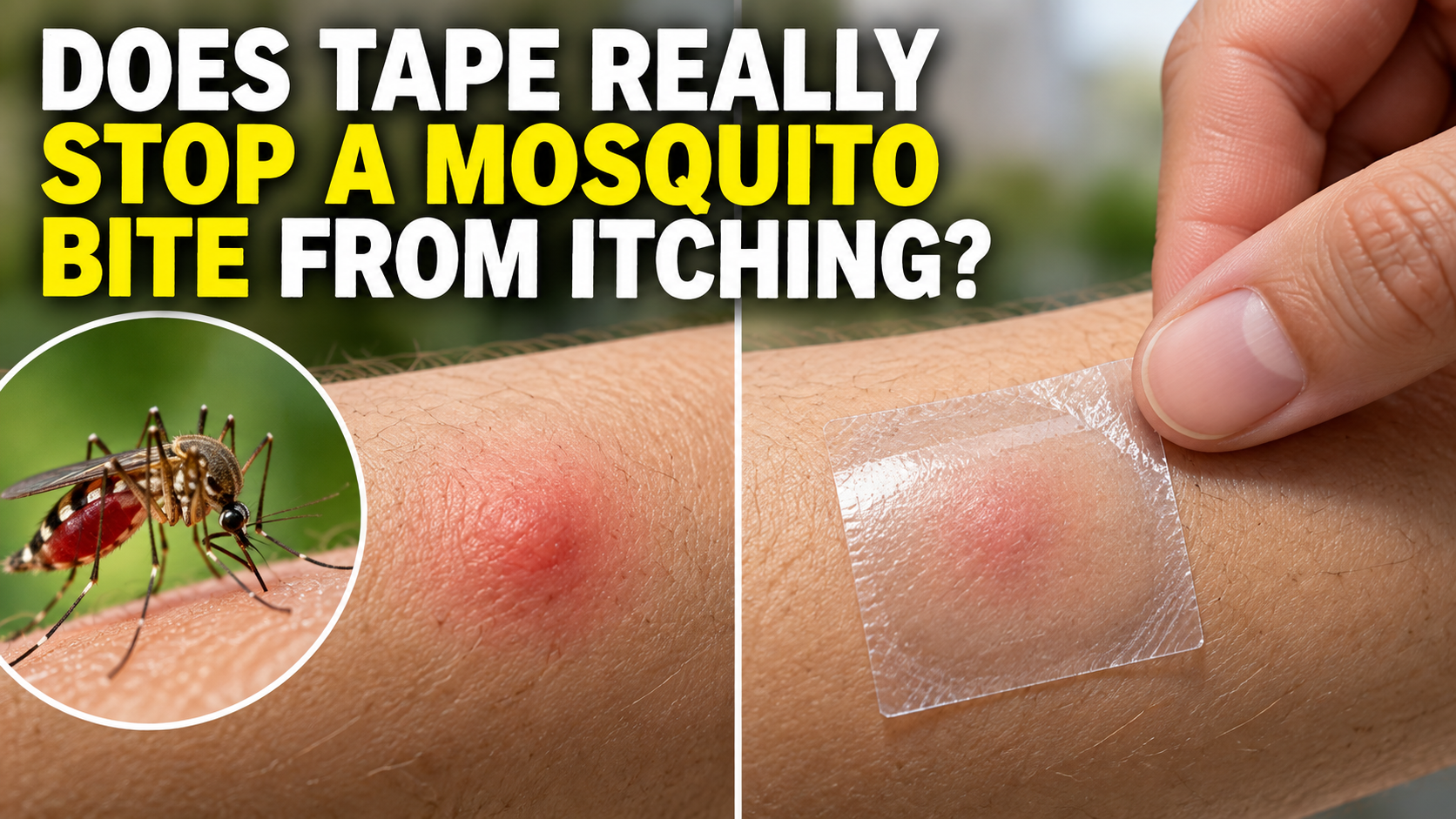
I’ve noticed something strange with mosquito bites over the years. If I completely cover an itchy bite with tape so that the skin underneath feels sealed off from the air, the itching seems to stop. Leave the tape on, and the bite can stay surprisingly quiet.
That raises an obvious question: does Mosquito Bite Tape really stop the itch, and if it does, is keeping air away from the bite really the reason? The answer turns out to be more interesting than a simple yes or no.
Why Does a Mosquito Bite Itch in the First Place?
The itch doesn’t appear because air reaches the bite. When a mosquito feeds, it deposits saliva into the skin. Proteins and other substances in that saliva trigger an immune response that can involve histamine, mast cells and several other itch-signaling pathways. A scientific review from the University of Miami describes mosquito-bite itch as a combination of histamine-dependent and non-histamine mechanisms. Frontiers in Immunology
That reaction happens below the surface of the skin. In other words, simply preventing oxygen or outside air from touching the bump shouldn’t switch off the underlying allergic reaction. That’s also why established treatments focus on calming inflammation and itch signaling rather than “airing out” or sealing a bite. You can find more information about mosquito biology and control in our Mosquito Control Guide.
Mosquito Bite Tape Could Still Change What You Feel
Here’s where the tape idea gets more interesting. Although researchers don’t appear to have conducted a controlled clinical trial specifically testing ordinary adhesive tape over mosquito bites, there is evidence that physical stimulation can alter how strongly we perceive itch. Mayo Clinic, for example, recommends applying pressure to an itchy mosquito bite for about 10 seconds as one way to soothe it. Mayo Clinic
Research on itch more broadly has also found that sensory “counter-stimulation” can temporarily inhibit itch signals. Reviews of neuropathic itch even describe tight occlusion of itchy areas as potentially increasing inhibitory signals in the spinal cord. That doesn’t prove tape works on mosquito bites, but it gives us a plausible neurological explanation for why covering a bite can feel dramatically different. Indian Journal of Dermatology, Venereology and Leprology
Is Blocking the Air Actually Doing Anything?
This is the part where personal experience and scientific evidence separate. I can absolutely believe the observation that a sealed mosquito bite may stop itching while it is covered. What I couldn’t find is evidence showing that removing air exposure itself is responsible.
An occlusive piece of tape changes several things at the same time. It applies light pressure, continually stimulates touch receptors, prevents direct scratching and changes the moisture and temperature at the skin surface. Any one of those effects, or a combination of them, could change the perception of itch. That makes “no air = no itch” an understandable conclusion from experience, but it isn’t something the research currently confirms.
Covering the Bite Also Stops the Itch-Scratch Cycle
There’s another very simple advantage: you can’t directly scratch skin that’s covered. Scratching can temporarily feel satisfying, but it can also intensify irritation and damage the skin. Repeated scratching can break the skin barrier and increase the risk of a secondary bacterial infection.
Clinical guidance consistently recommends avoiding scratching. Cold treatment, antihistamines and corticosteroid creams are among the more established ways to control mosquito-bite symptoms. The scientific review on mosquito-bite reactions notes that second-generation antihistamines have actually reduced both wheal size and itching in controlled trials.
Could Leaving Tape on Cause Problems?
Possibly. Adhesive tape isn’t completely harmless to skin, especially if it stays on for a long time. Medical adhesives can sometimes cause irritant or allergic contact dermatitis, and repeated removal can damage the superficial skin barrier. Moisture can also build up beneath highly occlusive materials.
So if someone wants to try covering an intact bite briefly, a skin-friendly medical tape or small adhesive bandage would make more sense than aggressive household tape. If the skin is already broken, infected-looking, blistered or producing drainage, treating it as a simple itchy mosquito bite is no longer appropriate.
So, Does Mosquito Bite Tape Really Stop the Itch?
For some people, it very well may make the itch feel much weaker or even disappear while the bite is covered. The personal observation is biologically plausible because pressure, touch, occlusion and simply blocking scratching can all influence itch perception.
But there’s an important distinction: there is currently no good evidence that mosquito bites itch because they are exposed to air, or that blocking air shuts down the mosquito-bite reaction. So the relief may be real even if the explanation isn’t. That’s exactly the kind of home remedy that deserves a proper controlled study.
Evidence Grade: LIMITED BUT PLAUSIBLE