
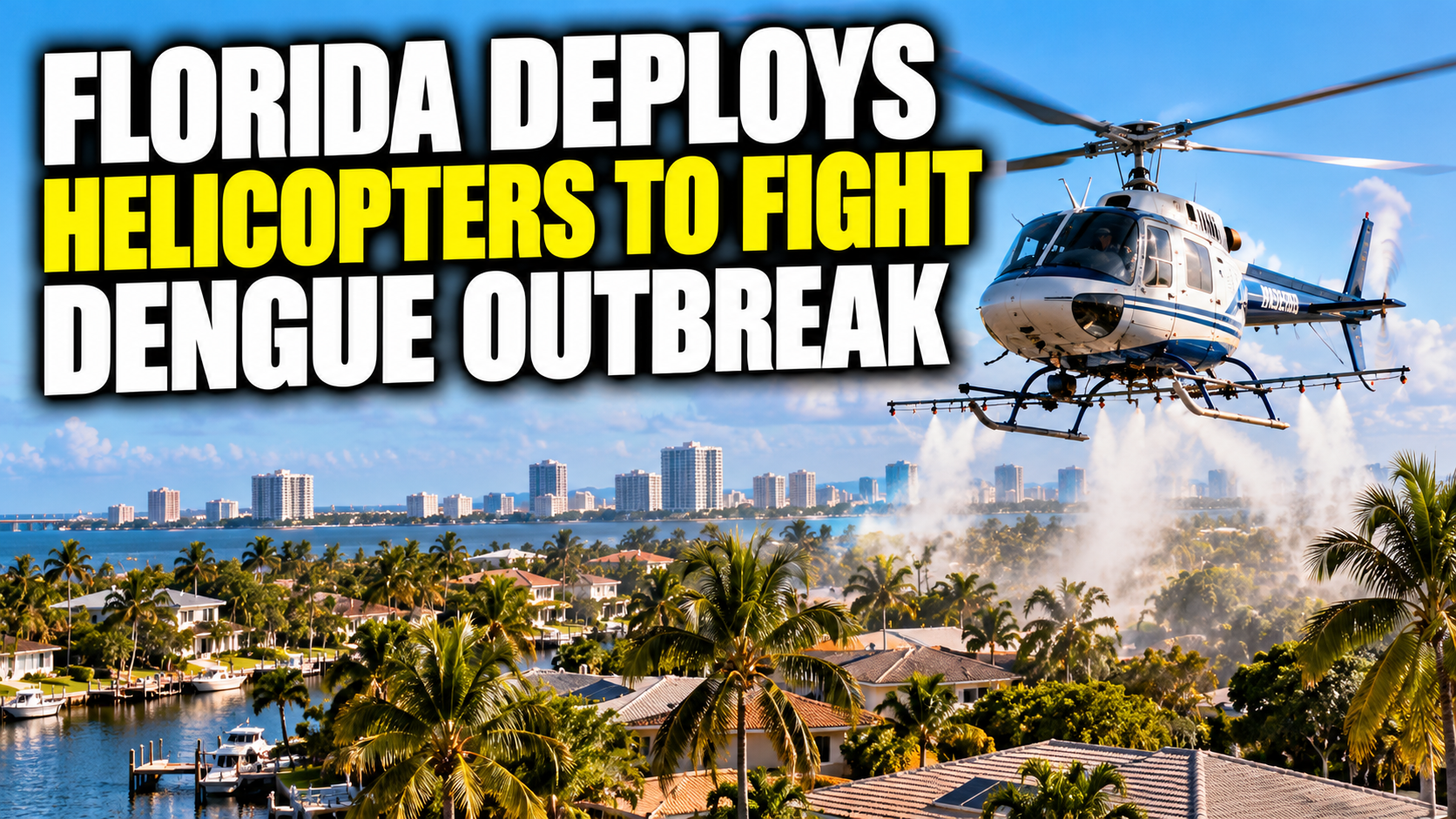
Florida launches helicopter mosquito treatments as Pinellas County steps up its response to a dengue outbreak affecting the Tampa Bay region. Officials have announced a partnership with Lee County Mosquito Control to deploy low-flying helicopters over designated parts of St. Petersburg and Clearwater, targeting mosquito larvae in standing water that ground crews cannot easily reach. According to the county’s October 15 update, Pinellas had recorded 37 confirmed dengue cases since August and extended its local emergency declaration through October 22. The operation marks an expansion of the county’s mosquito-control strategy, but officials have not finalized a neighborhood-by-neighborhood flight schedule.
Why Florida Launches Helicopter Mosquito Treatments
The new aerial campaign is focused on the earliest stages of mosquito development rather than directly spraying adult mosquitoes. In its October 19 announcement, Pinellas County said it was working with Lee County’s mosquito-control team to treat difficult-to-access breeding areas. Trucks and ground crews remain part of the response, but helicopters can cover larger sections of neighborhoods more efficiently and reach water hidden among vegetation, alleys and other inaccessible spots. The county described the aircraft as flying low enough to help the treatment reach standing water beneath tree cover. Officials say flights will take place during daylight hours, between 9 a.m. and 3 p.m., once specific treatment areas and dates are scheduled.
Dengue Cases Rise as Pinellas Extends Its Emergency
The aerial effort comes after a sharp rise in locally acquired dengue infections across Tampa Bay. In its October 15 emergency extension, Pinellas County reported 37 confirmed cases since August, up from 20 in the preceding weekly update. The county also cited 351 confirmed cases across Pinellas, Pasco and Hillsborough counties in that update. The local emergency was originally declared September 24 to speed spending and operational decisions needed for mosquito control, and the latest extension runs through October 22. These are reporting-period totals, not a count of people infected on the day of the helicopter announcement, and totals may change as surveillance reports are updated.
What Are the Helicopters Spraying?
The low-flying aircraft are scheduled to release a fine mist containing Bacillus thuringiensis israelensis, commonly called Bti. This naturally occurring bacterium is used as a larvicide: susceptible mosquito larvae ingest it in water and are killed before developing into biting adults. Unlike conventional adult mosquito fogging, the purpose here is to treat breeding sites. Pinellas County says Bti, when used as directed, does not pose the same hazard to humans, pets or pollinators that residents might associate with indiscriminate pesticide spraying. The low-altitude flights may be noisy and visually striking, but officials say they are necessary to deliver treatment through foliage and into small pools of water. The county’s dengue information page explains the treatment approach and provides updates for residents.
Why St. Petersburg and Clearwater Are in Focus
The county has identified designated sections of St. Petersburg and Clearwater for the Lee County-supported aerial treatments. That does not mean every neighborhood in either city will be sprayed. Local officials are still preparing the detailed schedule, and residents should check the county’s treatment map and notification options rather than relying on a generalized citywide alert. Additional mosquito-control work, including field inspections and ground-based treatments, remains underway across Pinellas. Aerial coverage is intended to supplement those measures where conventional larvicide delivery is too slow or cannot adequately reach standing water.
How Dengue-Spreading Mosquitoes Thrive Near Homes
Dengue is spread primarily by infected Aedes mosquitoes, especially Aedes aegypti. Unlike the familiar image of mosquitoes breeding in expansive marshes, these insects often lay eggs in small containers around houses and businesses. Flowerpot saucers, discarded tires, pet bowls, buckets and rain-filled toys can provide breeding sites. They can also bite during daylight hours, making morning and afternoon exposure important. Pinellas County’s public-health guidance stresses that even small amounts of water can sustain mosquito development. Reducing these sites remains essential even in areas receiving helicopter treatments, because new larvae can develop after a treatment if containers are left filled with water.
What Residents Should Do During the Response
Residents in affected areas should follow official notices for scheduled helicopter flights and continue everyday mosquito precautions. Empty and scrub water-holding containers at least weekly, maintain screens, and use an EPA-registered repellent according to its label. Long sleeves and other protective clothing can also reduce exposure. For household prevention steps, PestMarket’s Mosquito Control Guide covers breeding-site removal and practical treatment options. Residents looking for broader home pest-prevention information can also use PestMarket’s Pest Control Guides. Anyone with fever, severe headache or body aches following possible mosquito exposure should contact a healthcare professional, especially if symptoms worsen. Mosquito control reduces exposure risk but does not replace medical evaluation.
The Next Step in Tampa Bay’s Dengue Response
The central question now is whether expanded larval treatment, combined with inspections and source reduction, can bring mosquito populations down as the outbreak response continues. Pinellas County’s use of Lee County helicopters reflects the scale of the operational challenge, not proof that aerial spraying alone will stop dengue transmission. The exact timing and geographic coverage of flights remain subject to official updates, and health surveillance may identify additional cases after the latest published totals. For St. Petersburg and Clearwater residents, the practical message is to watch for localized treatment notices and keep eliminating standing water around their properties while public-health and mosquito-control crews work to reduce transmission risk.