
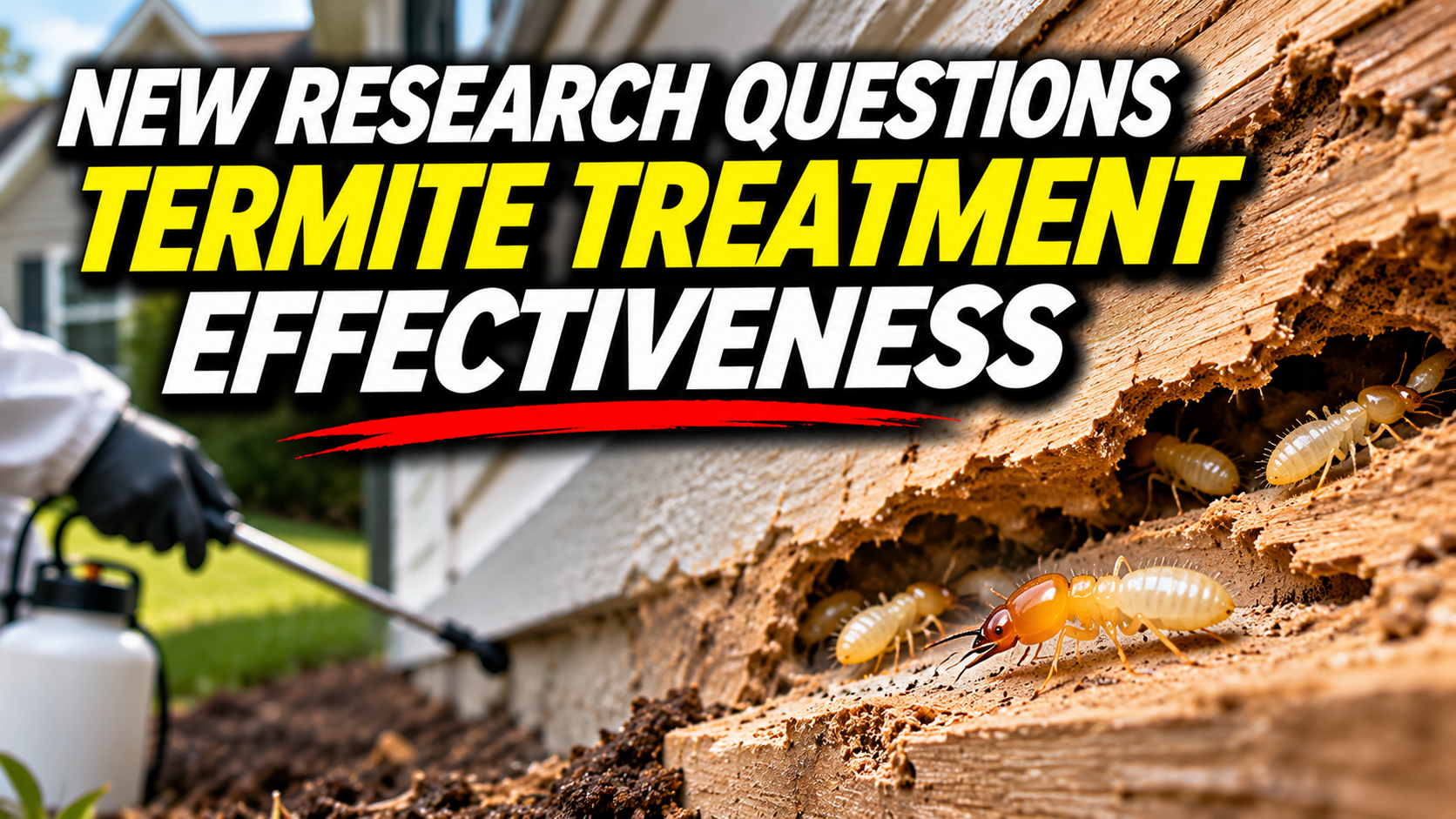
New Research Questions Termite Treatment Effectiveness, but not because scientists have proved that common termite pesticides have stopped working. Instead, studies are exposing a critical distinction: protecting a building from subterranean termites is not necessarily the same as eliminating the entire termite colony living in the surrounding soil. A November 4, 2026, EHSLeaders review of insecticide performance compared research that reached different conclusions about the colony-level effects of fipronil, a widely used active ingredient in termite treatments. Those findings matter for homeowners who assume that seeing fewer termites after treatment proves that every nearby termite has been eliminated. The science points to a more complicated picture, shaped by species, treatment placement, colony behavior and the way effectiveness is measured.
Why Termite Treatment Effectiveness Is Being Reexamined
A subterranean termite colony may forage through a network of tunnels extending away from the structure it is attacking. A termiticide placed around a foundation may prevent termites from crossing treated soil and damaging wood even when part of the colony remains active elsewhere. This creates two different goals that can be confused in advertising and everyday conversations: structural protection and complete colony elimination. Both can be meaningful outcomes, but they require different evidence. A protected home does not prove that every termite in the soil has died, just as a surviving colony does not automatically mean a properly treated structure remains unprotected. Researchers have investigated whether fipronil exposure spreads through colonies as effectively as once expected.
New Research Questions Termite Treatment Effectiveness
The phrase New Research Questions Termite Treatment Effectiveness reflects an active scientific debate rather than a confirmed nationwide treatment failure. Much of the debate examined in the November 2026 report comes from studies published in 2012 and 2024, not a newly released nationwide trial. The 2024 research proposed that dying termites may form a local “death zone” around treated soil; surviving nestmates then avoid that location, potentially limiting exposure beyond the treated area. A separate 2026 study using an experimental wooden-structure system also found that fipronil-treated wood reduced feeding locally without eliminating the entire colony. These outcomes are important, but each experiment needs to be interpreted within its own conditions.
What a 2012 Field Study Found
One influential 2012 field study published in the Journal of Economic Entomology examined eight homes in the Raleigh, North Carolina, area. Scientists used genetic markers to identify individual termite colonies and monitored them after fipronil treatment. Eleven colonies known to be attacking the buildings were no longer detected within 90 days, and the researchers did not detect them again during their remaining monitoring period of up to three years. They concluded the targeted colonies were probably eliminated. That is substantial evidence of strong colony-level effects under those field conditions. However, disappearance from monitoring is not the same as directly counting every dead termite, and the findings involved particular species, properties and treatment circumstances.
What a 2024 Laboratory Study Found Instead
A different 2024 University of Florida study tested whole laboratory colonies of Asian subterranean termites in long simulated foraging systems. Researchers applied fipronil-treated soil at varying distances from colony nesting areas. Termites near the treatment died quickly, but surviving individuals changed their movement patterns around the treated zone. The researchers reported that some colonies suffered very limited mortality over the longer observation period. In those experiments, rapid local killing could restrict the opportunity for exposed insects to spread the chemical to nestmates. That finding challenges the assumption that a nonrepellent soil treatment must always eliminate a large colony through widespread transfer. It does not establish that fipronil fails to protect houses in the field.
A Separate 2026 Experiment Examines Combined Treatments
The issue also appears in a 2026 BioResources paper examining termite management in simulated wooden cultural heritage structures. Researchers compared fipronil-treated wood, a bistrifluron bait, and a combined treatment against Reticulitermes speratus colonies. The fipronil-treated group showed sharply reduced feeding on treated wood, but the colony persisted and redirected feeding to untreated wood. In the tested setup, the combined approach suppressed feeding and ultimately eliminated the colony within 10 weeks. That result suggests possible value in pairing immediate wood protection with slower-acting colony control. Yet the authors stressed the need for further field validation: the experiment cannot be treated as proof that homeowners should combine products themselves or that the same outcome will occur in every building.
Does This Mean Termites Are Becoming Resistant?
No verified conclusion from these studies establishes widespread fipronil resistance among subterranean termites. Insecticide resistance refers to a heritable reduction in susceptibility that can spread across generations under selection pressure. By contrast, the “death zone” hypothesis concerns insects avoiding an area where others have died, limiting further exposure. Avoidance caused by conditions around a treatment is not the same as genetically inherited pesticide resistance. The November 2026 EHSLeaders article quotes entomologist Edward Vargo saying he knows of no evidence of subterranean termite resistance to fipronil. Claims that termite treatments are now broadly useless or that resistance has swept across the United States would therefore go beyond the published evidence.
What EPA Actually Requires of Termite Products
The U.S. Environmental Protection Agency’s termite-control guidance explains that registered termiticides intended to protect structures must demonstrate appropriate protective performance, and lists liquid soil treatments, termite baits and wood treatments among recognized approaches. A product’s registration and labeling should not be confused with a universal promise to wipe out every surrounding colony. The agency also emphasizes that effective application often requires trained professionals. Choosing between a liquid treatment, a bait system or another approach depends on infestation location, species, building construction and site conditions. Products should always be used according to their registered labels; homeowners should not improvise concentrations or treatment combinations based on a laboratory result.
What Homeowners Should Ask Before Paying for Treatment
Homeowners can use this research to ask more precise questions. Does the treatment proposal promise structural protection, control of termites currently inside the building, or colony elimination? What monitoring or follow-up inspection will verify success, and what does the warranty actually cover? Is the problem caused by subterranean termites or another type, such as drywood termites, requiring a different approach? Will the technician treat known entry points and inspect for moisture or soil conditions that could compromise protection? PestMarket’s termite identification and control guide explains practical warning signs, while its broader pest control reference guides help homeowners prepare for an inspection. These questions are more useful than simply asking which chemical is strongest.
Why Visible Termite Activity Can Be Misleading
A drop in swarmers, mud-tube activity or visible feeding can be encouraging, but it should not be treated as a complete diagnosis. Termites can live and forage beyond the areas a homeowner can inspect, and the absence of visible insects does not always show where a colony has gone. Conversely, research demonstrating survival of termites somewhere in an experimental tunnel system does not prove they can continue accessing a structure protected by a correctly installed treatment. That is why the location of monitoring stations, species identification and long-term inspections matter. The most practical response to suspected activity remains an informed inspection rather than a do-it-yourself experiment with additional insecticide.
The Bigger Lesson for the Pest Control Industry
The studies highlight a persistent challenge in pest-control evaluation: a product may perform one task well without automatically achieving every other desirable outcome. Evidence from controlled laboratory colonies can reveal mechanisms that field observers miss, while well-designed field studies can test whether those mechanisms change results in real buildings. Both are necessary. Regulators, manufacturers and treatment professionals should be precise about what has been tested and what can reasonably be promised. For consumers, a credible pest-control provider should explain treatment goals, monitoring and limitations without claiming that one application guarantees total elimination of all colonies in the neighborhood.