
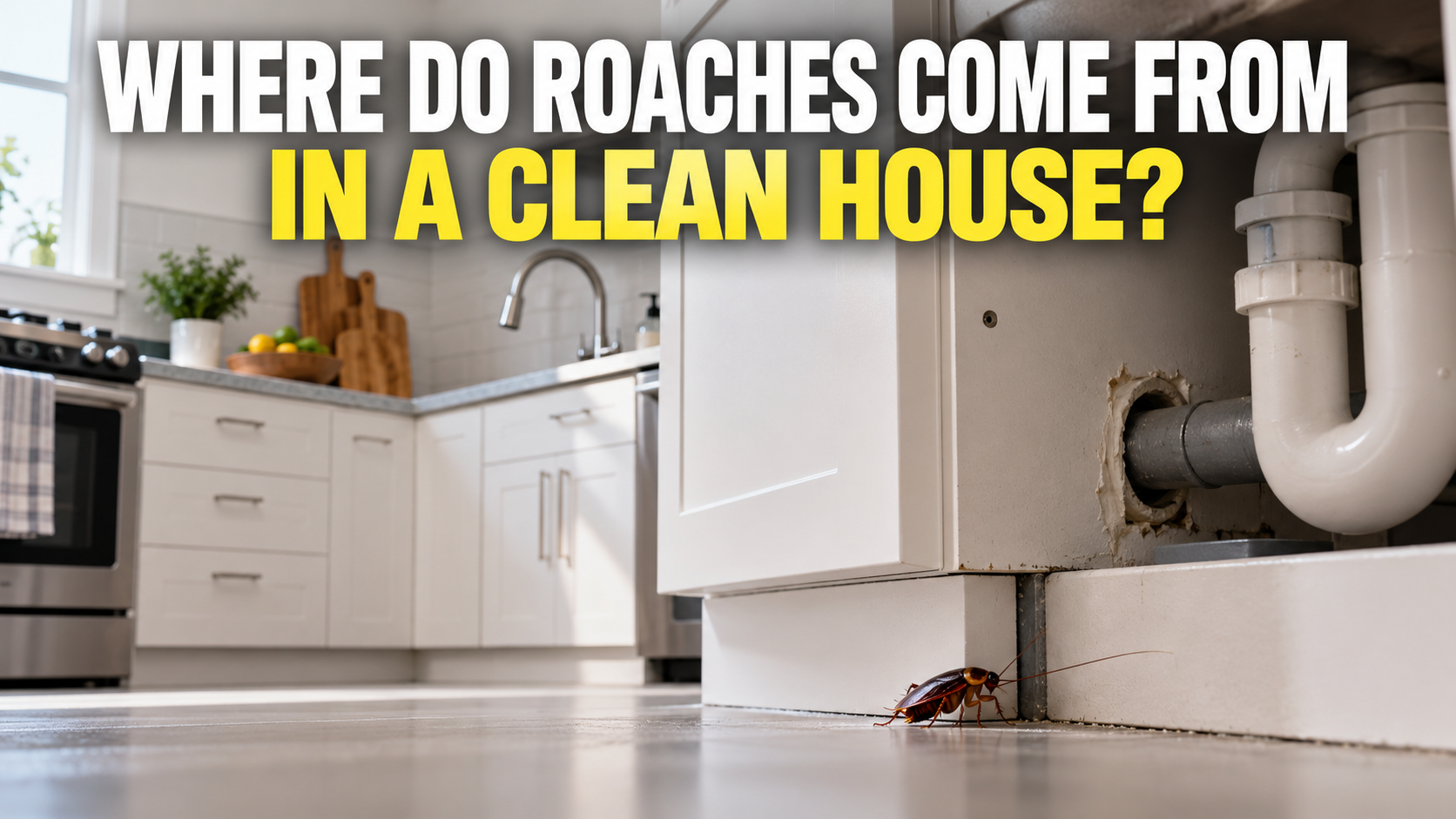
You keep the counters wiped down, take out the trash, don’t leave dishes in the sink and still spot a cockroach at night. That can feel confusing, especially because roaches are often associated with dirty homes. But Where Do Roaches Come From in a Clean House? The answer is that cleanliness is only one part of the equation. Cockroaches need food, water and shelter, but they can also enter through plumbing, gaps around pipes, exterior doors, drains, packages, cardboard boxes and shared walls in apartments or condos. Some species live and breed indoors, while others normally live outside and only wander in. UC IPM specifically separates German and brownbanded cockroaches, which reproduce indoors, from American, Oriental and Turkestan cockroaches, which commonly live outside and can temporarily invade buildings. UC IPM cockroach guidance
A Clean Kitchen Does Not Make a House Roach-Proof
Cleanliness absolutely matters because crumbs, grease, pet food and standing water can support cockroaches. But a spotless-looking kitchen can still offer what they need in places you rarely see. A few drops beneath a refrigerator, condensation around plumbing, grease under an appliance or moisture inside a cabinet can be enough to support activity. EPA guidance recommends removing food, water and shelter as part of integrated pest management, but also emphasizes keeping pests out in the first place. That means sanitation is important, but it does not replace exclusion. A home can be clean and still have cracks, pipe gaps, damaged weather stripping or neighboring infestations that give roaches a path inside.
German Cockroaches Usually Mean an Indoor Source
German cockroaches are the species most closely associated with kitchens, bathrooms and indoor infestations. Penn State Extension identifies them as the most common cockroach found in houses and other buildings, while UC IPM describes them as persistent indoor pests that live and breed around food-preparation areas. If German roaches show up in a clean home, the source may be hidden behind appliances, inside cabinets, around plumbing or in another unit of the same building. They can also be carried in on boxes, grocery items, used appliances or other belongings. UC IPM’s current IPM guidance specifically advises inspecting packages for cockroaches before bringing them indoors.
American Roaches Can Simply Wander Inside
A large American cockroach is a different situation. UC IPM notes that American cockroaches can live outdoors and commonly inhabit sewers, water meter boxes, storm drains and other warm, humid areas. They may enter ground-floor buildings if pipes are damaged, drain traps are faulty, screens are missing or other openings allow access. UC IPM American cockroach information That means seeing one large roach in a clean bathroom, garage or laundry area does not necessarily mean there is a kitchen infestation. It may have come from a sewer, drain system, crawlspace or exterior environment. The same general principle can apply to Oriental and Turkestan cockroaches, which also commonly live outdoors and move inside when conditions favor it.
Gaps Around Pipes Are a Major Entry Route
One of the most overlooked entry points is not the drain opening itself but the space around plumbing where pipes pass through walls, floors or cabinets. Those gaps can connect kitchens and bathrooms to wall voids, crawlspaces, neighboring units or utility chases. If a vanity has a large opening around supply or drain pipes, a roach does not need to come through the actual water-filled pipe to get into the room. It can simply move through the unsealed space beside it. UC IPM recommends sealing cracks and other openings, using door sweeps and weather stripping and reducing hiding places in walls and cupboards. UC IPM cockroach exclusion guidance This is why inspection under sinks, behind vanities and around tubs can matter just as much as cleaning the countertop.
Apartments and Condos Can Be a Different Problem
In multifamily housing, your own housekeeping may not be the deciding factor. Cockroaches can move through shared walls, utility lines, pipe chases and neighboring units. EPA specifically identifies cockroaches as a persistent problem in multifamily housing and says effective integrated pest management often requires cooperation between residents, maintenance staff, property managers and pest professionals. EPA multifamily pest guidance If one apartment is heavily infested, adjoining units may continue seeing roaches even when those residents keep their homes very clean. That is one reason treating only the unit where a roach is seen may fail if the broader source is somewhere else in the building.
Cardboard Boxes and Packages Can Bring Roaches In
Not every cockroach enters through a crack in the building. Some are transported. Grocery boxes, shipping cartons, used electronics, secondhand appliances and other items can carry roaches or egg cases into a home. This matters especially for German cockroaches because they are well adapted to indoor environments and can hide in tight spaces. UC IPM’s updated 2026 IPM guidance advises people to inspect packages for cockroaches and other pests before bringing them indoors. UC IPM IPM guidance A home can therefore develop a roach problem even if there was no existing infestation in the structure beforehand.
Water May Matter More Than Food
Many homeowners focus almost entirely on crumbs, but moisture can be just as important. Leaky faucets, dripping supply lines, condensation, pet water bowls and damp areas beneath appliances can all create favorable conditions. EPA specifically recommends repairing leaky plumbing and removing water sources as part of pest prevention. EPA smart pest control guidance Kitchens and bathrooms remain common roach locations not because they are automatically dirty, but because they combine warmth, moisture, food and hiding places. A very clean bathroom with a slow plumbing leak can still provide exactly what cockroaches need.
The PestMarket Verdict
Where Do Roaches Come From in a Clean House? They can come from more places than most homeowners realize. German cockroaches may arrive in packages or spread from neighboring indoor infestations, while American and other outdoor species may enter from sewers, drains, crawlspaces, garages or exterior gaps. Cleanliness lowers the amount of food and shelter available, but it cannot seal a pipe penetration, repair a faulty drain trap or stop a roach hidden inside a cardboard box. The best response is to identify the species first, inspect plumbing and structural openings, eliminate moisture, use sticky traps to monitor activity and seal likely entry points. If repeated sightings continue, especially with German cockroaches or nymphs, the problem is more likely to involve an established indoor source. For a step-by-step approach, see the PestMarket Cockroach Control Guide
Evidence Grade: STRONG EVIDENCE