
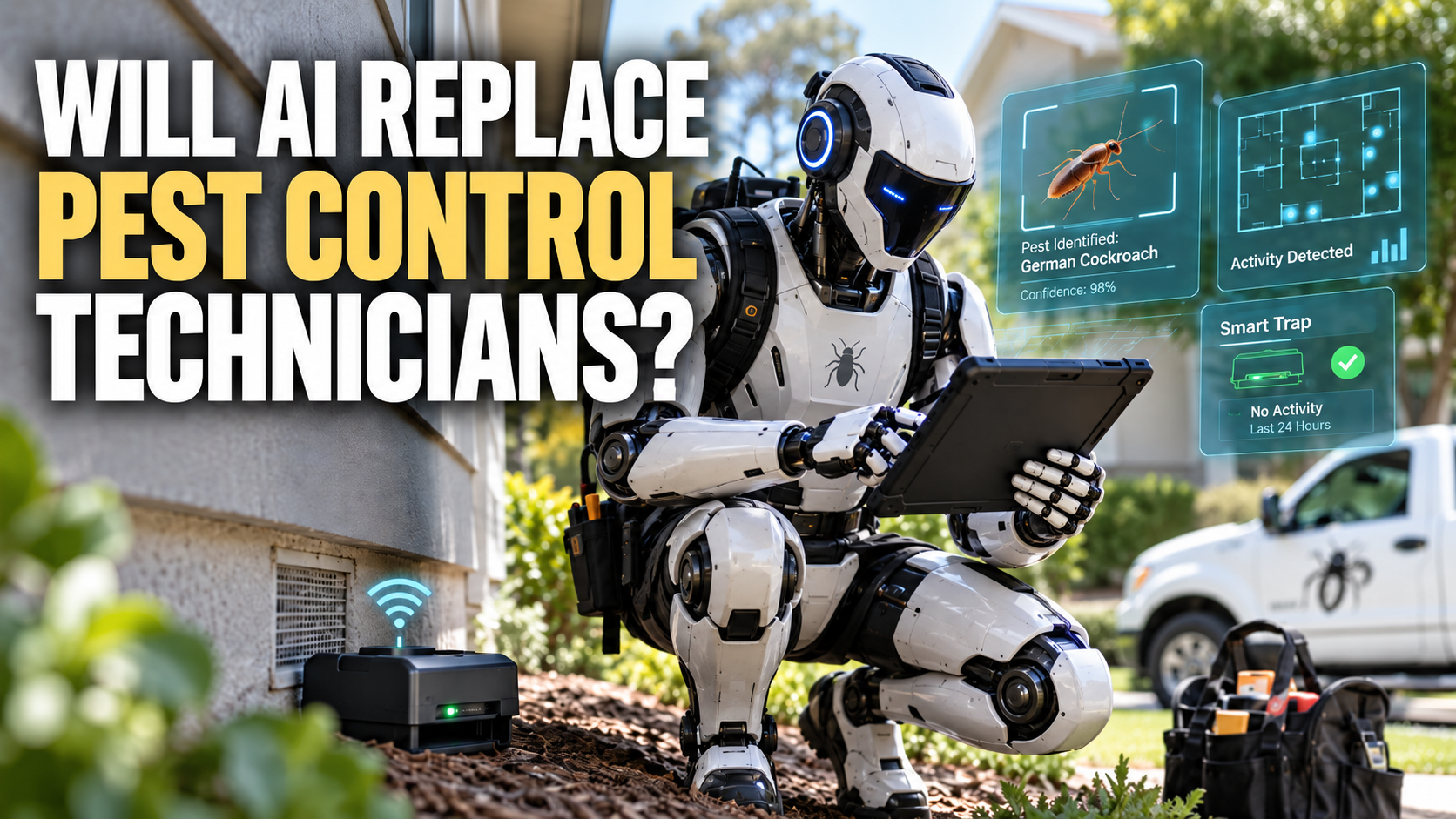
AI is already inside the pest control industry. It is answering phones, summarizing customer calls, optimizing routes, monitoring traps and analyzing service data. That makes the obvious question harder to ignore: Will AI Replace Pest Control Technicians? Based on what the industry is actually using in 2026, the more likely answer is that AI will replace some tasks long before it replaces the technician. The U.S. Bureau of Labor Statistics still projects employment for pest control workers to grow 6% from 2025 to 2035, faster than the average for all occupations, with about 13,700 openings expected each year.
AI Is Already Taking Over Office Work
The fastest automation is happening away from the crawlspace and attic. The National Pest Management Association reports that pest companies are already using AI for route optimization, scheduling decisions, call transcription, customer-service analysis, internal training and back-office workflows. At Adam’s Pest Control, AI is being used to optimize routes and reduce manual office work, while Truly Nolen has used AI for communication summaries, sentiment analysis and operational forecasting. NPMA’s broader conclusion is that the practical use of AI in pest control is not futuristic robotics but faster decisions, fewer manual steps and better use of existing data. Read the full NPMA analysis of AI in pest control.
Smart Traps Can Reduce Routine Site Visits
Remote monitoring is another area where technology is changing technician workflows. Connected traps can send alerts when activity occurs, allowing companies to respond to actual pest events instead of physically checking every device on a fixed schedule. Current systems can monitor rodent traps, electronic fly killers and other devices, while some camera-enabled systems can analyze glue boards remotely. BPCA’s 2026 digital-monitoring coverage describes smart traps that notify technicians immediately and AI tools that review historical site data for missed actions or trends. Vendors such as Trapmate similarly market remote monitoring around reducing unnecessary inspections and responding only when activity is detected. That can reduce labor per account, but someone still has to install devices, investigate the cause and take corrective action. (BPCA digital monitoring) (Trapmate remote monitoring)
The Technician’s Core Work Is Still Physical
The hardest part of the job to automate is the part pest control workers actually perform on site. According to the U.S. Bureau of Labor Statistics, technicians inspect buildings for evidence of infestation, determine treatment strategies, set traps and baits, apply pesticides, create barriers and work in locations that may require crawling, bending, kneeling or accessing tight spaces. Those jobs involve changing environments rather than predictable factory floors. An AI system may identify a likely cockroach from a photo, but it cannot yet crawl under a customer’s home, discover a leaking pipe behind a wall, determine how rodents are entering an attic and physically seal the opening with the reliability expected from a trained technician.
AI May Change How Many People a Company Needs
That does not mean jobs will be unaffected. Automation can allow a pest company to handle more customers with the same number of office employees and potentially increase the number of accounts each field technician can manage. FieldRoutes’ 2026 industry survey found AI was the technology pest operators expected to provide the greatest business value over the next one to three years. Planned software investment also more than doubled year over year, while 40% of operators identified AI as their top anticipated technology. Routing, scheduling and communication systems are increasingly designed around doing more with less administrative labor. That points toward a change in job composition even if the technician headcount does not collapse. (FieldRoutes 2026 industry report)
Customer Service May Feel AI First
Customers may notice AI before field technicians do. NPMA reports that pest companies are already using AI receptionists and automated systems for routine scheduling, billing questions, appointment confirmations and account notes. But the same industry reporting emphasizes the need for human handoffs when a customer is upset, when pricing becomes complicated or when a pest problem requires reassurance and judgment. Companies are finding that repetitive communication can be automated effectively, while trust-heavy conversations are harder to hand completely to software. That balance may become the model for field work as well: AI handles standardized information and repetitive decisions, while people handle uncertainty, physical work and customer confidence. (NPMA on AI and client service)
Even Pest Identification Is Becoming More Automated
AI-assisted pest identification and prediction are also moving forward. NPMA highlighted 2026 research involving AI-powered surveillance and IoT sensor data for predicting cockroach activity in sewer systems, showing how pest management may shift from reacting to visible infestations toward predicting where activity is likely to occur. Camera systems can also make remote identification easier, and future models will likely become better at distinguishing species from images and sensor patterns. But identification is only one step in pest control. A correct species ID still has to be translated into a safe treatment plan that fits the structure, occupants, pets, environmental conditions and applicable pesticide regulations. (NPMA Pestology on AI-powered pest tools)
The Job May Become More Technical, Not Disappear
The strongest evidence against near-term replacement may be the labor outlook itself. BLS counted about 108,700 pest control workers in 2025 and projects approximately 114,700 by 2035. It specifically cites the growing number of invasive insect species as one factor expected to support demand. At the same time, technicians increasingly need to work with digital inspection tools, remote-monitoring systems, software platforms and data generated by connected devices. The technician of the future may spend less time checking empty traps and more time responding to verified activity, interpreting sensor data and solving complicated structural problems. In other words, AI may change what a good technician does rather than eliminate the need for one.
The PestMarket Verdict
Will AI Replace Pest Control Technicians? Probably not in the way people usually imagine. AI is already replacing repetitive pieces of the job around the technician: scheduling, routing, reporting, monitoring, customer-service tasks and some forms of pest identification. Those changes can make each employee more productive and may reduce the need for certain administrative roles. But the core field job still requires physical access, inspection, judgment, pesticide safety, exclusion work and direct interaction with customers. For now, the more realistic future is technicians working with AI, not AI replacing technicians. Anyone interested in how pest management is evolving can explore PestMarket’s Pest Control Guides for the practical side of what technicians still have to solve in real homes.
Evidence Grade: STRONG EVIDENCE