
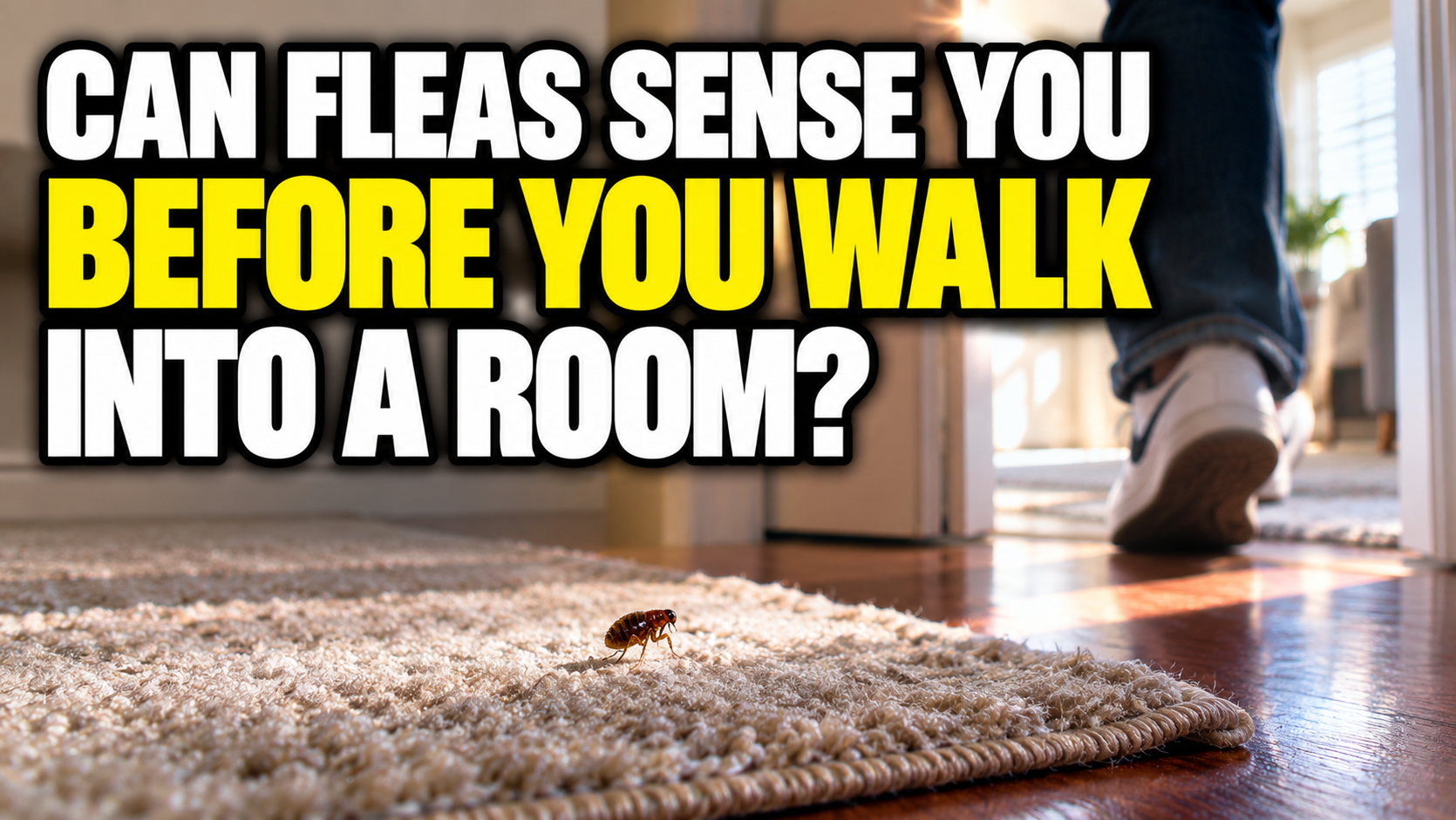
Can Fleas Sense You Before You Walk Into a Room? A person approaching a carpeted room may unknowingly create the very signals that bring hidden fleas into view. Footsteps transmit vibrations through floors, warm bodies alter nearby conditions, and breathing releases carbon dioxide. These cues can help newly developed fleas recognize that a potential blood meal is nearby. But an insect responding to environmental signals is not the same thing as possessing an uncanny ability to know that someone is about to enter. The real explanation begins inside a nearly invisible cocoon.
Can Fleas Sense You Before You Walk Into a Room? What the Evidence Shows
The strongest evidence concerns fleas that have already developed into adults but have not yet emerged from their protective cocoons. According to the Centers for Disease Control and Prevention, adult fleas may remain within the cocoon until movement or body heat suggests a host is present. The Merck Veterinary Manual identifies additional emergence triggers, including pressure, substrate movement, exhaled carbon dioxide and heat. These mechanisms explain how a flea can react before a person has noticed it, but they do not establish a universal distance at which every flea detects someone through a closed doorway.
Footsteps Are More Than Just Noise
A footstep is a physical disturbance as well as a sound. Vibrations can travel across floors and through carpeting, reaching flea cocoons in places where pets previously rested. For a flea that has completed development inside its cocoon, such disturbances may indicate that a living host has returned. University of Florida entomology guidance describes fleas emerging when vibrations from people or pets indicate a nearby host, helping explain why a long-vacant home can suddenly appear full of jumping fleas when someone walks through it. The important distinction is timing: the flea may detect vibrations before direct contact with a host, but the available guidance does not show that it predicts a person’s arrival from far away.
The Role of Carbon Dioxide and Body Heat
Human beings and other mammals continuously produce biological signals. We exhale carbon dioxide, give off heat and create air movement as we pass. Fleas can use some of these cues in host-related behavior, particularly when adult insects are ready to leave cocoons. The Companion Animal Parasite Council specifically lists mechanical pressure, carbon dioxide and increased temperature as stimuli for emergence. Signals may work together rather than acting like a long-range tracking system. It would be misleading to conclude that a flea can identify a particular individual through a wall or detect an approaching person at a precise number of feet without controlled evidence for that claim.
Why Fleas Seem to Appear in an Empty House
A vacant property can provide an unexpectedly effective setting for delayed flea emergence. Eggs laid on an animal fall into floor cracks, carpets and bedding. Larvae develop in sheltered areas, then form cocoons. Once development is complete, an adult may remain inside until environmental cues suggest a host is available. This delay is one reason a home that appeared pest-free during an absence can produce a flurry of flea activity when a family returns or new residents move in. Those insects did not materialize overnight: many may already have been present in protected life stages. Our related report, Can Fleas Live in a House With No Pets?, explores how this scenario can unfold even without a current dog or cat.
Do Adult Fleas Hunt People From Across the Room?
The phrase ‘sense you coming’ can give the wrong impression about adult flea behavior. Fleas are not miniature radar systems, and their ability to respond depends on the species, life stage and surroundings. The European Centre for Disease Prevention and Control notes that adult fleas generally tend to wait for an approaching host, responding to changes such as temperature, humidity and vibration rather than constantly searching over long distances. Newly emerged fleas may climb upward through carpet fibers or vegetation and jump when a potential host comes close. A person walking in may therefore experience bites around the ankles even though the insects were initially hidden nearby. That does not prove the insects recognized a specific human before that person crossed the threshold.
Why One Vacuuming Session May Not End the Problem
Households sometimes interpret a new burst of flea activity after vacuuming as proof that cleaning made the infestation worse. A more careful interpretation is that vacuuming can both remove flea material and create the same vibrations that stimulate some waiting adults to emerge. The process can expose previously concealed activity without creating new fleas. Because eggs, larvae, cocoons and adult fleas are found in different locations and respond differently to treatment, one pass over the carpet rarely resolves a substantial infestation. Effective management usually requires repeated cleaning, treating household pets with suitable veterinary products when appropriate, and addressing the areas where animals rest. For a practical plan, see PestMarket’s flea control guide.
Can Fleas Sense You Through a Closed Door?
A door is a useful boundary for people, but it is not necessarily a barrier to floor vibrations or every change in the surrounding environment. In principle, movement on a connected floor could transmit a detectable disturbance into an adjacent space. Whether a flea actually responds would depend on the intensity of that disturbance, the floor construction, the insect’s developmental stage and other conditions. The scientific and extension sources reviewed here support sensitivity to host-associated cues; they do not establish reliable detection across a closed door, through a wall or at any particular advance warning distance. Claims that fleas ‘know you’re coming’ before you enter should therefore be treated as an informal description of sensory biology, not a demonstrated supernatural or predictive ability.
What Homeowners Should Watch For
If fleas appear after entering a room, pay attention to where animals sleep, where carpeting meets walls and where upholstered furniture or pet bedding creates sheltered habitat. Look for persistent scratching in pets, flea dirt in fur and small jumping insects near floors. Bites alone cannot definitively identify fleas because several pests and skin conditions can cause similar irritation. Check for possible wildlife or rodent sources if there are no pets, and consult a veterinarian for appropriate animal treatment. Avoid using products intended for dogs on cats, or applying household pesticides in ways their labels do not permit. Persistent infestations may need coordinated treatment of the animal, indoor environment and any contributing outdoor shelter rather than a single spray.
The PestMarket Verdict
So, can fleas sense you before you walk into a room? Sometimes they can respond to cues from an approaching host before a person comes into direct contact with them. This is particularly well supported for developed adults waiting inside cocoons: vibrations, warmth, pressure and carbon dioxide can trigger emergence. However, the dramatic suggestion that fleas reliably perceive someone at a distance, identify that person or predict entry into a room goes beyond the evidence reviewed. The more accurate conclusion is that fleas detect nearby environmental signals associated with potential hosts. That biological response is striking enough without turning it into a supernatural sixth sense.
Evidence Grade: STRONG FOR HOST-CUE DETECTION; LIMITED FOR BEFORE-ENTRY CLAIMS
The role of movement, heat, carbon dioxide and mechanical disturbance in flea emergence is supported by major veterinary, public-health and entomology references. The narrower claim that fleas detect a person before the doorway is crossed is plausible in some physical situations but not established as a general rule or quantified detection distance. The distinction matters because compelling pest stories should describe what is observed and tested, not assign abilities the research has not demonstrated.