
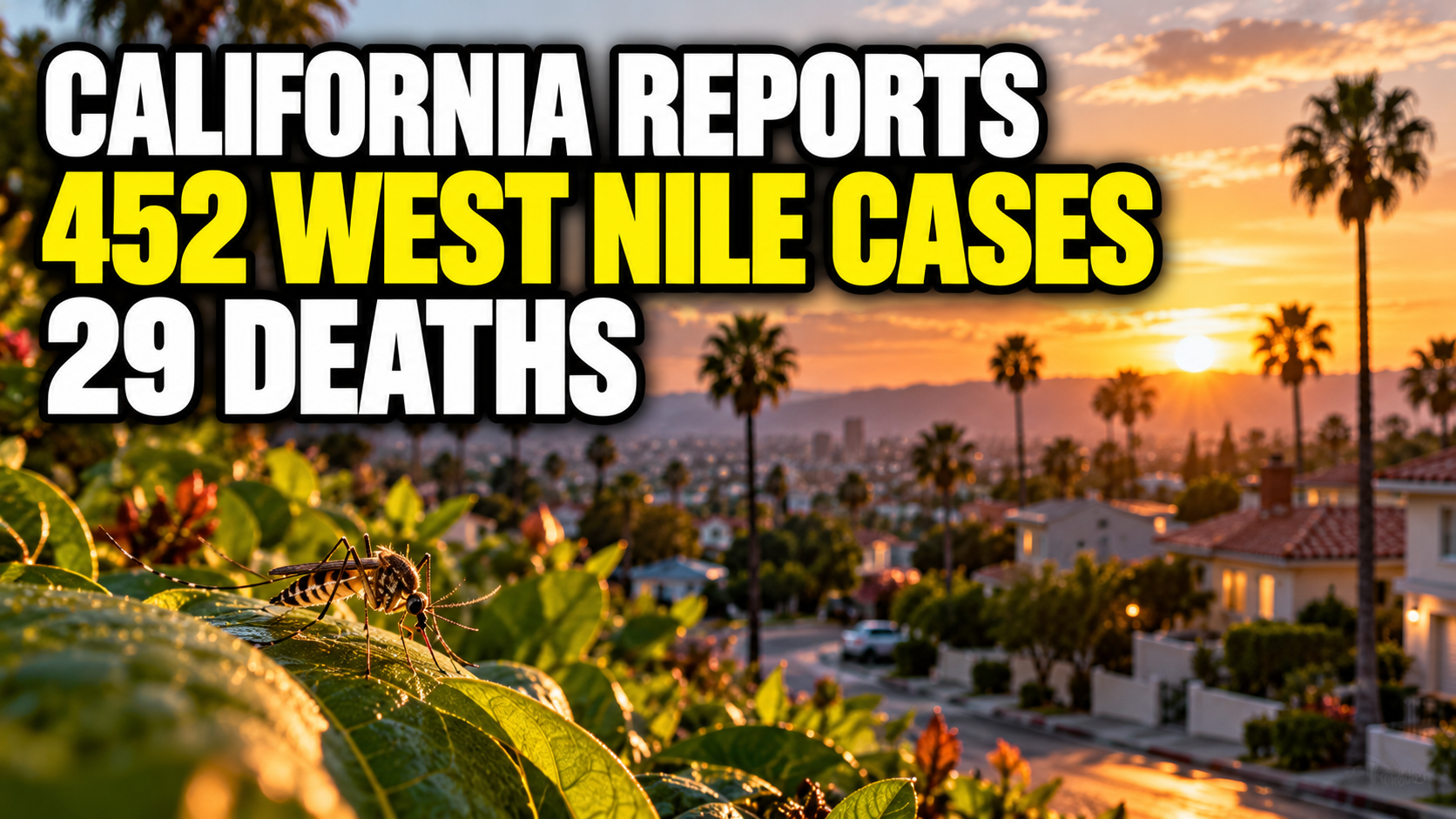
California West Nile Cases Reach 452 as Death Toll Hits 29 as the latest state surveillance report documents a late-season increase in reported infections. California has reported 452 human West Nile virus cases and 29 related deaths in 2026, according to the latest statewide surveillance figures available on October 28. The California West Nile Virus surveillance dashboard was last updated October 23 and shows 74 additional human cases reported during the previous week. Los Angeles County accounted for 59 of those newly reported cases, while Orange County accounted for another 10. The numbers arrive late in the traditional mosquito season and underscore why public-health officials continue to urge caution even as temperatures begin to cool. Crucially, these are newly reported cases, not proof that all 74 infections occurred during the same seven days.
California West Nile Cases Reach 452 as Death Toll Hits 29: LA and OC Lead Recent Reports
Los Angeles County has 251 cases in the state surveillance tally, representing more than half of California’s 452 reported infections. Orange County has 57. Of the 29 West Nile-related deaths reported statewide, 10 are attributed to Los Angeles County and seven to Orange County. The state also lists cases in 24 counties, showing that the infection is not confined to Southern California. Weekly reports can differ from county health-department dashboards because agencies receive, investigate, classify and publish cases on different schedules. Readers comparing local and state numbers should always check each dashboard’s reporting date rather than assume one figure is necessarily incorrect.
Seventy-Four New Reports in a Week, Not Seventy-Four Infections That Week
The weekly increase of 74 is striking, but its meaning requires care. A person may become infected, develop symptoms, seek medical care, undergo testing and only then be entered into a surveillance database. Those steps can span days or longer. Consequently, a surge in reports may include infections acquired earlier in the season and does not independently establish that mosquito transmission accelerated during the exact reporting week. The new reports were assigned to Fresno County (2), Los Angeles County (59), Orange County (10), San Joaquin County (1), Stanislaus County (1) and Tulare County (1). For homeowners, the practical message is not to assume that a weekly reporting spike pinpoints a particular date or neighborhood where mosquitoes suddenly became more dangerous.
Surveillance Finds Virus in Mosquitoes and Birds Across the State
Human illness is only one measure of West Nile activity. The state surveillance dashboard lists 4,075 West Nile-positive mosquito samples and 753 positive dead birds so far this year, along with 149 sentinel chickens and 17 horses that tested positive. The latest week added 70 positive mosquito samples and 19 positive dead birds. Orange County has recorded 902 positive mosquito samples, compared with 781 in Los Angeles County, although different surveillance and collection practices make raw sample totals an imperfect measure of relative exposure. A positive mosquito sample can contain multiple mosquitoes and should never be interpreted as a count of infected people. These findings show that the virus remains detectable in the environment beyond the locations where human cases have been reported.
Could Late-October Rain Extend Mosquito Activity?
Recent rain in portions of California adds a reason for residents to inspect yards, but it does not by itself prove that West Nile infections will rise. Rainwater left in flowerpot saucers, buckets, clogged gutters, tarps or neglected water features can create mosquito breeding habitat. Whether enough mosquitoes survive and reproduce depends on temperature, species and local conditions. Cooler nights may suppress activity even when water is available. No official forecast tied the latest storm to a specific number of future West Nile infections as of this report. Residents should respond to the known opportunity for breeding by removing standing water, rather than assuming that every rainstorm will trigger a new outbreak.
Why Severe West Nile Illness Remains a Concern
Most people infected with West Nile virus develop no symptoms. Others experience fever, headache, body aches, fatigue or a rash, while a small minority develop potentially life-threatening neurological disease. According to the CDC guidance on West Nile symptoms, older adults and people with certain underlying medical conditions are at greater risk for serious illness. Warning signs include severe headache, neck stiffness, confusion, muscle weakness and other new neurological symptoms. Anyone with those symptoms should seek urgent medical assessment. Reported surveillance cases tend to overrepresent more serious illness because infections with no symptoms are often never diagnosed. The 29 reported deaths deserve attention, but they do not indicate that 29 out of every 452 people infected statewide would necessarily die.
How Residents Can Lower Risk Before Mosquito Season Ends
The CDC’s West Nile prevention recommendations emphasize EPA-registered insect repellents, long and loose-fitting clothing, intact window screens and reducing exposure when virus-carrying mosquitoes are most active, often around dusk and dawn. Around the property, empty and scrub water-holding containers regularly, address drainage problems and maintain pools. PestMarket’s Mosquito Control Guide describes common breeding sites and practical household prevention steps, while its broader Pest Control Guides explain how to manage other unwanted pests without relying on indiscriminate treatments. Community mosquito-control programs and individual precautions work best as complementary measures. No licensed human vaccine is available for West Nile virus, making bite prevention especially important for higher-risk households.
The Season Is Not Over, but the Next Count May Change
California West Nile Cases Reach 452 as Death Toll Hits 29 is the statewide picture as of the October 23 surveillance update, not a count of infections occurring on October 28. California’s latest published figures describe a serious 2026 West Nile season: 452 reported human cases across 24 counties and 29 deaths as of the October 23 update. The 74 cases added in the latest weekly report are a clear surveillance development, particularly in Los Angeles and Orange counties, but they should not be portrayed as 74 infections all acquired in one week. Reporting delays, weather conditions and the pace of local mosquito activity will shape what appears in future updates. Residents should continue basic mosquito precautions into the fall and consult updated state or local health-department data for changes after October 23. For PestMarket readers, the immediate lesson is straightforward: the calendar may say late October, but it is too early to ignore mosquito exposure.