
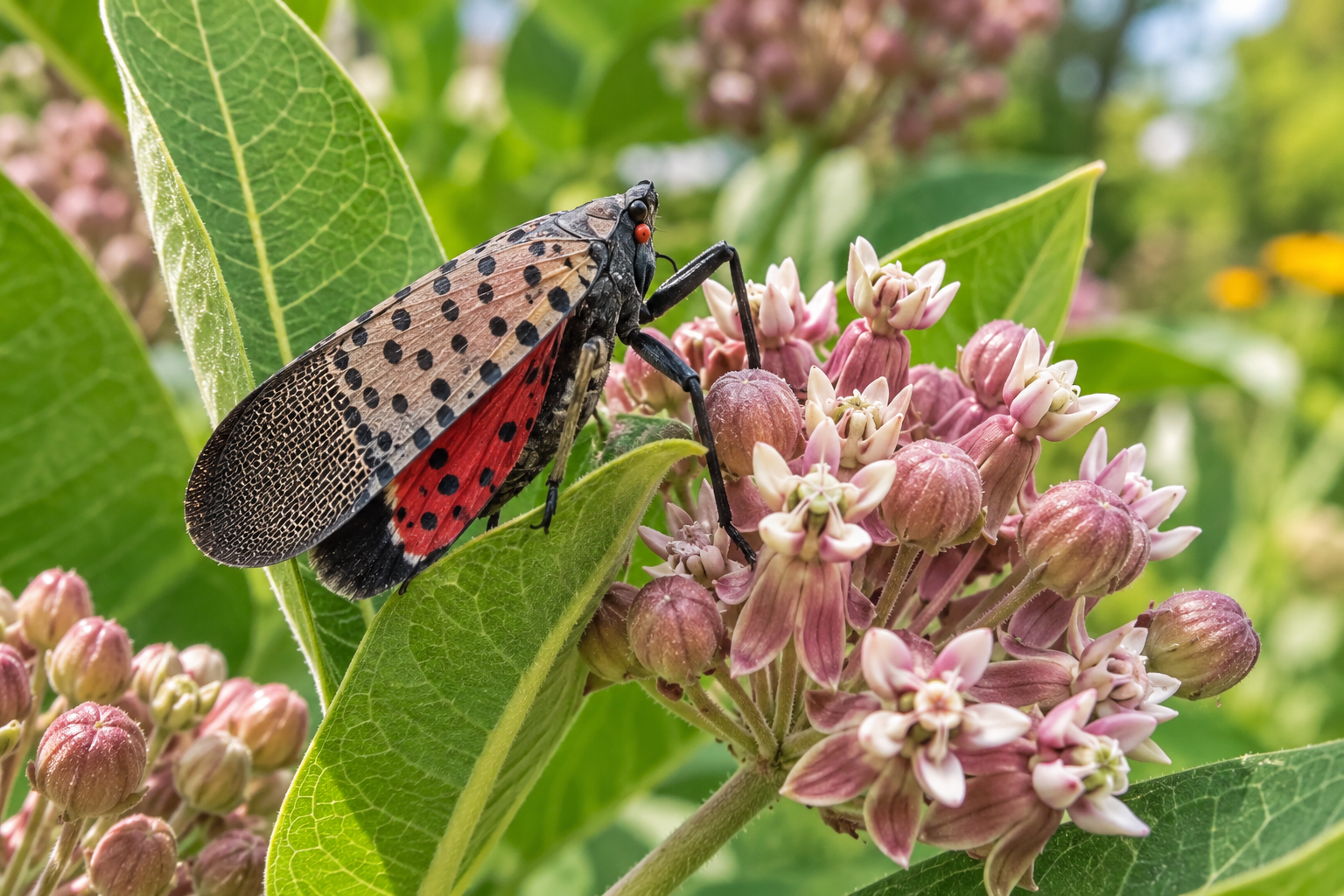
Can milkweed kill spotted lanternflies? Early research suggests it might, after scientists investigating an unusual backyard observation found surprisingly high death rates among lanternflies exposed to the plant.
The research began after people reported finding dead spotted lanternflies around milkweed. Scientists decided to test whether the plant might have something to do with it.
What they saw was striking. Lanternflies exposed to milkweed died at much higher rates than insects given grapevine, one of their preferred foods.
But there’s an important catch. The research has not yet been published in a peer-reviewed scientific paper, and nobody has shown that planting milkweed will control spotted lanternflies in the real world.
Some Lanternflies Died Within 24 Hours
According to National Geographic’s report on the research, scientists tested different milkweed species and several stages of the spotted lanternfly life cycle.
In some experiments, mortality ranged from roughly 10% to 90% within 24 hours, depending on the type of milkweed and the lanternfly’s life stage. Common milkweed appeared more lethal than swamp milkweed.
Researchers were also surprised that some lanternflies chose milkweed even when grapevine was available.
Exactly why the plant appears to kill them isn’t known yet.
Milkweed contains defensive chemicals that many animals can’t tolerate. Monarch caterpillars famously feed on the plant and are adapted to those chemicals, but spotted lanternflies don’t share that relationship.
Researchers are now trying to determine which part of the plant may be responsible for the effect.
Don’t Plant Milkweed as Lanternfly Control Just Yet
As interesting as the early results are, milkweed isn’t a proven spotted lanternfly treatment.
Scientists still need to determine whether lanternflies feed on milkweed frequently enough in nature for the effect to matter, which milkweed species are most effective and whether the laboratory mortality translates into meaningful population control.
Current Penn State Extension guidance does not recommend milkweed as an established control method for spotted lanternflies.
That doesn’t mean milkweed isn’t worth planting.
Native milkweed already provides important habitat for monarch butterflies and other pollinators. If further research eventually shows that it can also hurt an invasive pest, that would be an unusual bonus.
For now, the finding is better viewed as a promising scientific clue rather than a new backyard pest-control trick.
Sometimes, though, an interesting discovery starts with something as simple as people noticing dead bugs underneath a plant.