
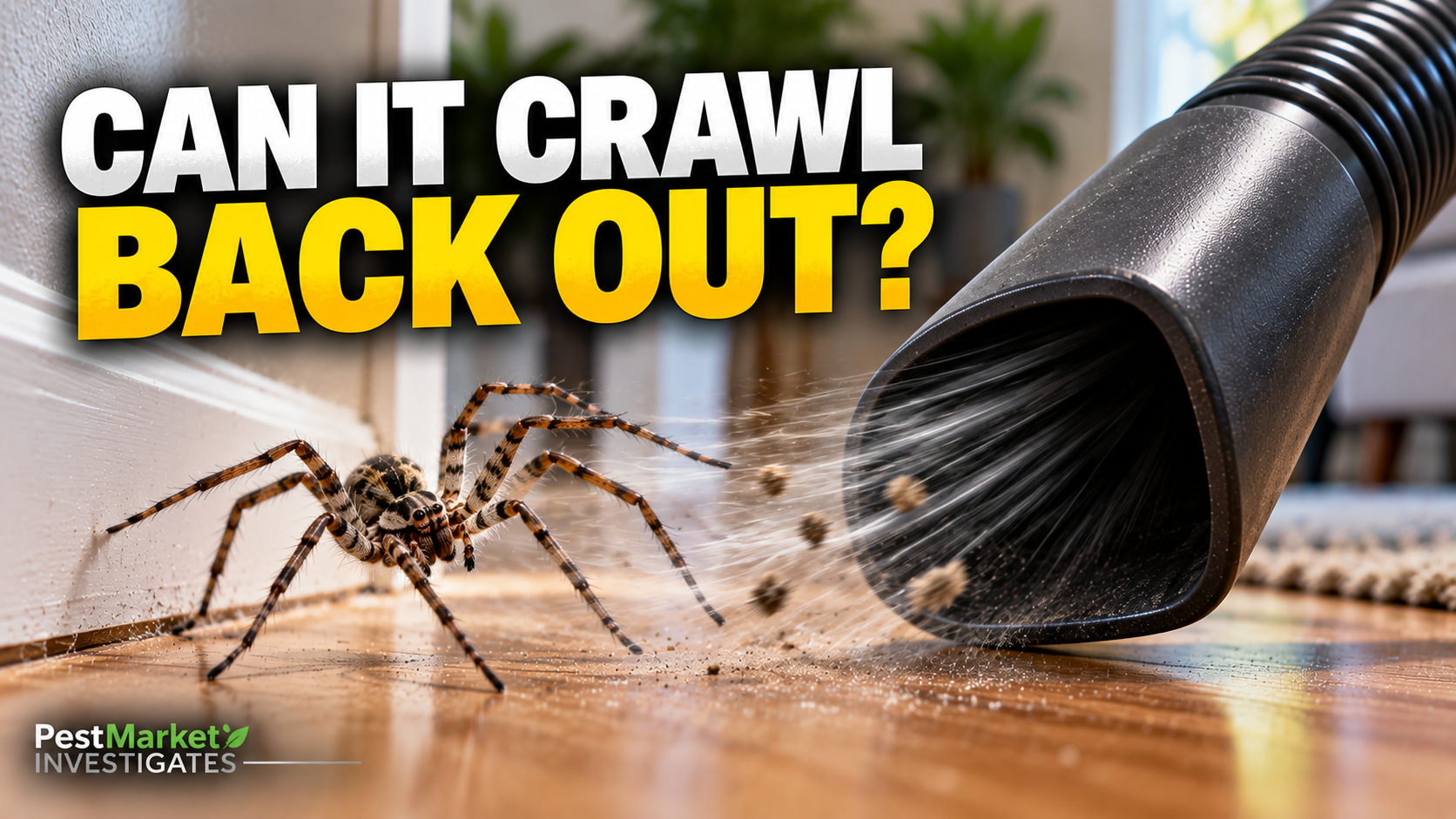
Can a spider crawl back out of your vacuum after you’ve sucked it up? If you’ve ever watched one disappear down the hose and then stared at the vacuum cleaner wondering whether you really solved the problem, you’re not alone.
The reassuring answer is that most spiders probably won’t make the return trip. But research and expert opinion suggest something more interesting: survival depends partly on what happens inside the vacuum, and not every machine treats its eight-legged passenger the same way.
What Actually Happens to a Spider Inside a Vacuum?
A spider doesn’t simply travel gently from the floor into a dust bin. Airflow can send it rapidly through a narrow hose, around bends and into hard internal surfaces before it ever reaches the bag or collection chamber.
The University of California Statewide Integrated Pest Management Program recommends vacuuming as an effective way to remove indoor spiders and their webs. UC IPM says spiders’ soft bodies usually don’t survive the tumbling process through the vacuum hose.
An arachnologist at the Smithsonian’s National Museum of Natural History reached a similar conclusion. In a Smithsonian explanation of what happens to vacuumed spiders, Jonathan Coddington said almost every spider sucked into a household vacuum would eventually die, either from the physical trauma or later from dehydration.
There is also experimental evidence.
Researchers tested vacuum cleaners against Loxosceles intermedia, a recluse spider found in South America. In the study published in the Journal of Venomous Animals and Toxins including Tropical Diseases, researchers vacuumed adult females, adult males, young spiders and newly hatched spiders.
Using the vacuum’s normal configuration, all of the tested spiders died. The researchers also found that vacuuming destroyed the egg sacs used in the experiment.
But then they changed the machine.
Can a Spider Crawl Back Out of Your Vacuum If It Survives?
The researchers removed a plastic plate inside the vacuum that spiders normally struck after traveling through the suction tube. Once that obstacle was removed, some spiders survived the trip.
That detail changes the answer.
A spider’s fate can depend not only on suction but on the design of the vacuum and what it collides with on the way to the collection chamber. The study involved one vacuum design and one spider species, so it cannot tell us what happens to every spider in every modern vacuum cleaner. It does show that being sucked into a vacuum is not automatically fatal under every possible configuration.
Then there is the question of escape.
Vacuum design expert Simon Lockrey and spider expert Lizzy Lowe explained to ABC Education that a surviving spider could potentially escape if there is a clear route back out. Some vacuum cleaners have one-way internal doors or other barriers that make that difficult or impossible. Others may leave a more accessible path once the motor stops.
A bagged vacuum adds another barrier between a surviving spider and your living room. With a bagless machine, the collection chamber and airway design become more important.
Interestingly, the laboratory research also showed just how much the details matter. When adult female spiders were placed directly into a vacuum bag containing dust and debris, some remained alive for days. That is very different from surviving the violent trip through the operating machine, but it demonstrates that simply being inside a vacuum bag does not necessarily kill a spider immediately.
Should You Worry About a Vacuumed Spider Coming Back?
Probably not.
The available evidence suggests that a spider traveling through a normally operating household vacuum has a good chance of being killed by the physical forces involved. UC IPM specifically recommends vacuuming as a practical method for managing indoor spiders and their webs.
Still, if the thought of a survivor bothers you, the simplest precaution is to empty a bagless collection bin outdoors after vacuuming a spider. With a bagged machine, disposing of or securely containing the bag removes the remaining uncertainty.
There is another option if the spider isn’t posing a threat. Most spiders are predators of insects and other arthropods, and UC IPM considers them beneficial. A cup or jar and a piece of stiff paper can be used to capture an individual spider and release it outside without putting either the spider or your vacuum cleaner through the ordeal.
The PestMarket Verdict
Evidence Grade: STRONG EVIDENCE
Most spiders sucked through a normally operating household vacuum are unlikely to survive and crawl back out.
Both pest-management guidance and experimental evidence support vacuuming as an effective spider-control method. One controlled experiment killed every spider sent through the tested vacuum in its standard configuration.
But “a spider can never crawl back out” goes further than the evidence allows. Some spiders survived when the researchers altered the vacuum’s internal pathway, and experts note that a surviving spider could potentially escape from certain vacuum designs.
So if you vacuumed up a spider and are now watching the end of the hose, you can probably stop worrying. If you want to remove even that small uncertainty, empty the vacuum outside.