
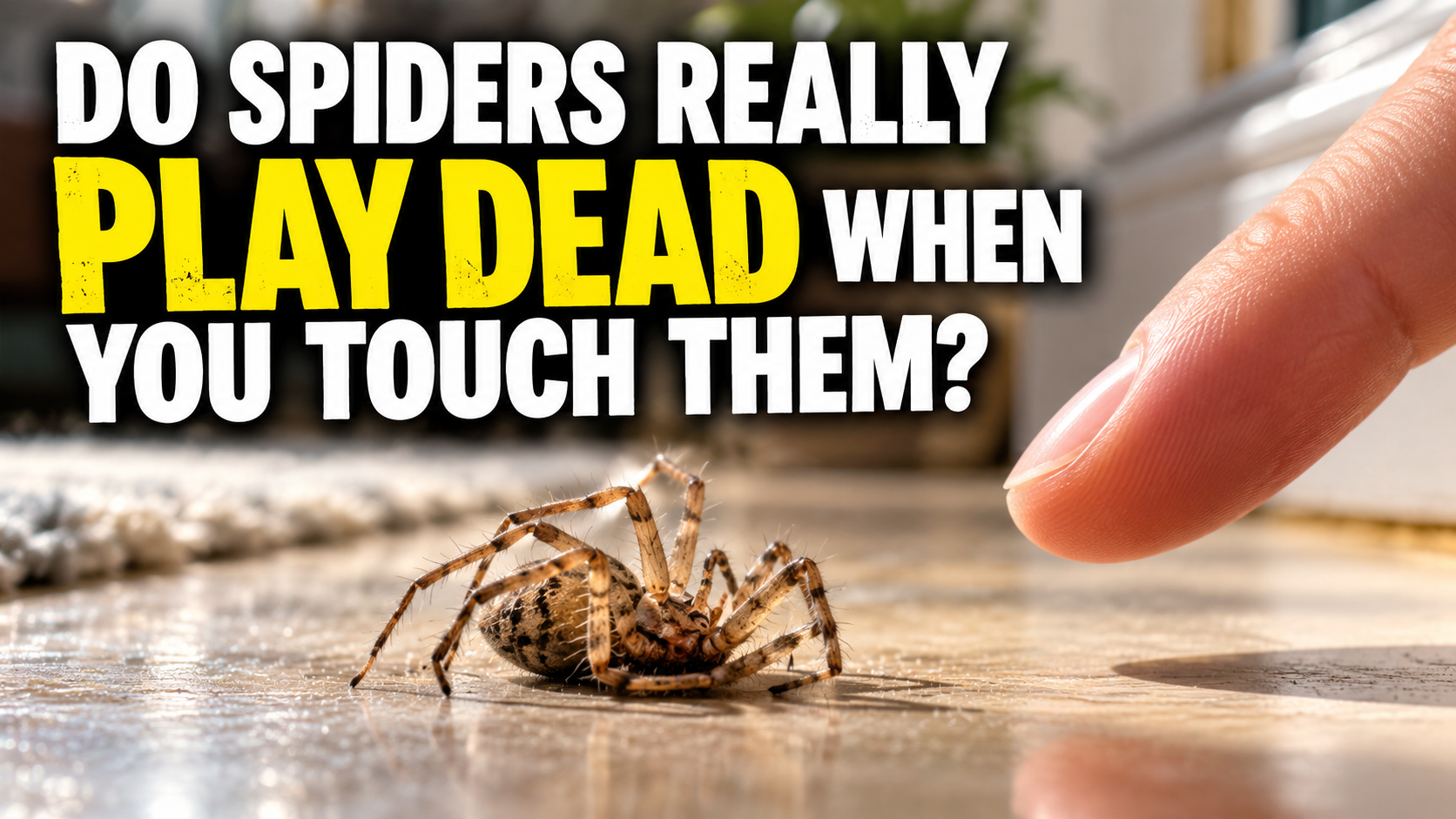
Do Spiders Really Play Dead When You Touch Them? Some spiders really can become almost completely motionless after threatening physical contact, but it is not as simple as touching any spider and watching it pretend to die. Scientists generally call the behavior tonic immobility, although it is also commonly described as thanatosis or death-feigning. It usually occurs during a close threatening encounter, particularly after an animal has been restrained, grabbed or strongly disturbed. The spider may remain motionless after the immediate contact ends and then suddenly resume normal movement when the danger appears to have passed.
Some Spiders Really Do Enter Tonic Immobility
A major scientific review of tonic immobility describes the behavior across many animal groups, including spiders. Researchers define tonic immobility as a temporary motionless state generally triggered by close contact with a predator or other threat. One spider examined in this research is Larinoides cornutus, an orb-weaving species in which scientists have studied factors affecting how long the immobility lasts. That makes this more than a spider simply deciding to sit still. It is a measurable defensive response influenced by the spider’s biology.
Does Repeated Touching Make a Spider Play Dead?
It can trigger immobility in some species, but repeatedly poking a spider is not a reliable experiment and is not something homeowners need to try. A light touch might make one spider run, another drop from its web and another freeze. True tonic immobility is more commonly associated with stronger threatening contact or restraint that resembles being caught by a predator. Even among spiders capable of the behavior, individuals may respond differently. So if a spider suddenly stops moving after being disturbed, it could be a defensive response, but simply remaining still does not prove it is playing dead.
Why Would Playing Dead Help a Spider?
Movement can help predators locate and continue attacking prey. Becoming suddenly motionless after being caught may therefore reduce the cues that encourage another strike. A broader review of death-feigning and tonic immobility describes the behavior as a last-resort defense seen across a wide range of animals. That does not mean the spider consciously thinks about pretending to be dead. “Playing dead” is a useful human description, while the actual behavior is likely an evolved automatic response that improved survival over many generations.
Some Spiders Use Playing Dead for a Completely Different Reason
Spider behavior gets even stranger with the nursery web spider, Pisaura mirabilis. Males of this species often approach females carrying a wrapped prey item as a courtship gift. Females can be dangerous, so some males suddenly become motionless while still holding the gift. When the female begins feeding, the male may become active again and attempt to mate. In a study of death-feigning in nursery web spiders, males using this strategy achieved mating more successfully than males that did not. That makes this one of the strangest documented uses of death-feigning because it is connected to reproduction rather than escaping a predator.
Does a Motionless Spider Mean It Is Dead?
No. A living spider may freeze defensively, remain motionless while resting or stay still because it senses danger nearby. A dead spider often curls its legs inward because spiders rely partly on hydraulic pressure to extend their legs, but posture alone is not a perfect test. An injured or frightened spider may also hold its legs differently. If a spider looks motionless, repeatedly touching it to see whether it reacts is unnecessary. Give it space and observe it from a distance instead.
Do All House Spiders Play Dead?
No. This is the most important limitation behind the claim. Death-feigning and tonic immobility have been documented in spiders, but there is no evidence that every common house spider behaves this way. One species may freeze while another immediately runs. Individual spiders within the same species can also differ in how easily the response is triggered and how long it lasts. Temperature, physical condition, intensity of the threat and other factors may influence the response.
Why a Spider Might Freeze Instead of Run
Spiders have several possible defensive strategies. Some run rapidly, some retreat into cracks, some drop from webs and others remain still. Which strategy works best depends on the predator, the environment and the spider species. A spider sitting against bark or a dark surface may become difficult to see once it stops moving. In that situation, freezing could provide an advantage even before full tonic immobility develops. The same basic principle explains why motionless behavior has evolved in many unrelated animals.
Should You Test a Spider to See if It Plays Dead?
Probably not. There is little practical benefit to repeatedly disturbing a spider simply to trigger the response. Most spiders found around homes are trying to avoid people, and repeated handling can injure the animal or increase the chance of a defensive bite. If a harmless spider is in an unwanted location, it can usually be moved with a container rather than repeatedly touched. PestMarket’s Pest Control Guide covers common household pest concerns and when removal or professional help may make sense.
The PestMarket Verdict
Do Spiders Really Play Dead When You Touch Them? Yes, some spiders can enter a motionless state known as tonic immobility after threatening physical contact or restraint. But a simple touch does not automatically make a spider play dead, and not every spider species is known to use the behavior. Even more surprisingly, some spiders use death-feigning during courtship rather than predator defense.
Evidence Grade: STRONG EVIDENCE
Scientific research clearly documents tonic immobility and death-feigning in spiders. What should not be exaggerated is the idea that every house spider will collapse whenever someone touches it. The behavior is real, but when it happens and why depends heavily on the species and situation.