
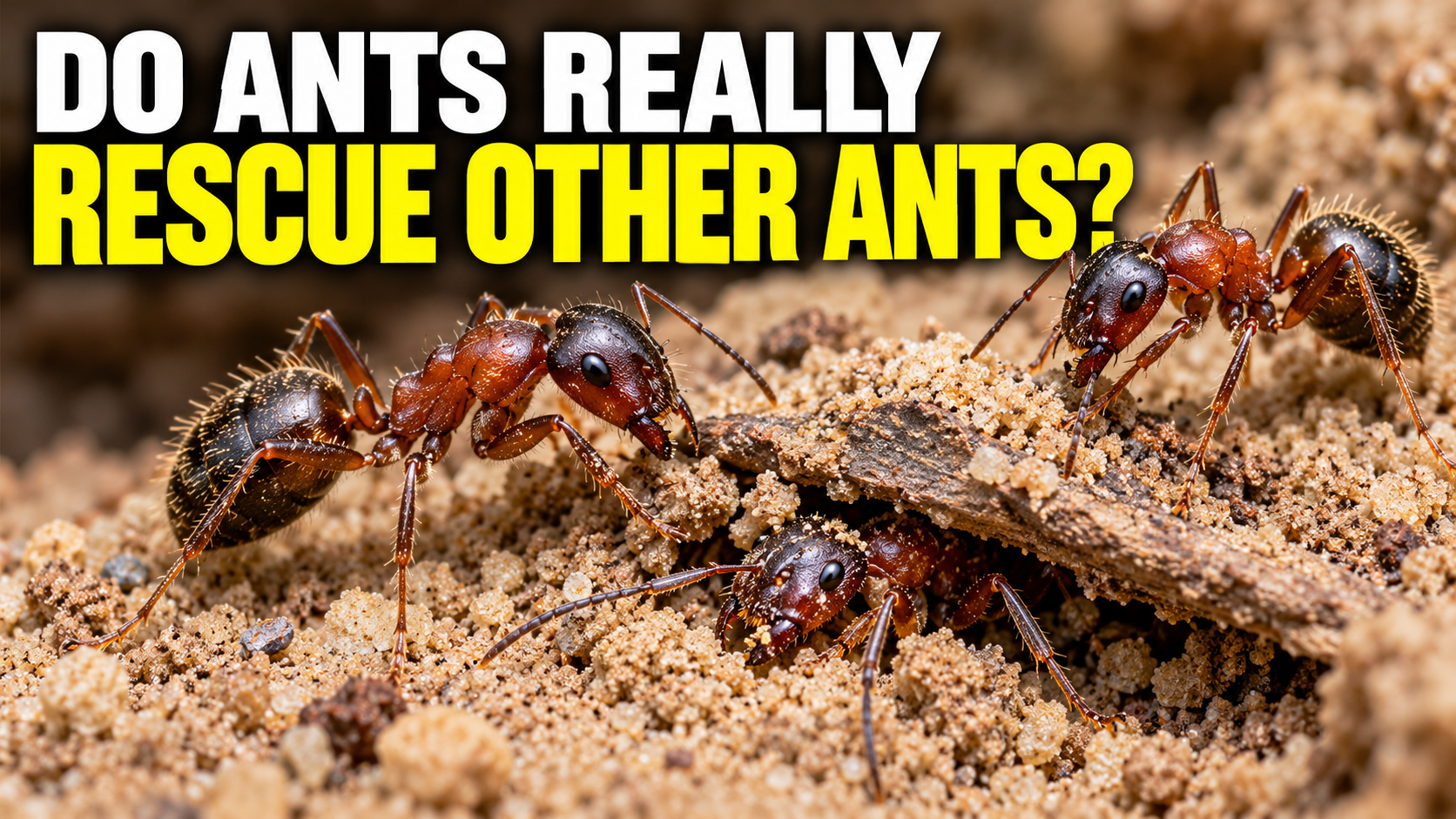
Do Ants Really Rescue Other Ants? Yes, some species do. In controlled experiments, researchers have watched ants respond to trapped nestmates with a surprisingly organized sequence of actions. They dig away sand, pull on the victim’s legs, carry loose material away and even bite directly at the object holding the other ant in place. The behavior is not random agitation. In some species, the rescuers appear to target the exact source of the problem and adjust what they do as the situation changes.
Researchers Have Watched Ants Free Trapped Nestmates
One of the clearest demonstrations involved the desert ant Cataglyphis cursor. In a PLOS ONE study, researchers partially buried ants in sand and restrained them with nylon thread. Nestmates responded by digging around the trapped ant, pulling on its limbs and biting at the restraint itself. The researchers also tested unrelated ants, ants from other colonies, prey items and chilled nestmates. Rescue was directed specifically toward active nestmates, showing that the behavior was not simply a response to any moving object.
The Rescue Can Be Surprisingly Precise
Later work found that the behavior can be highly targeted. Rescuers do not just dig randomly around the victim. They may first remove sand covering the trapped ant, then pull at exposed body parts and finally focus on whatever is physically holding the nestmate in place. A study of rescue sequences found that ants change their actions based on what they have already tried, suggesting that short-term memory helps make the rescue more efficient.
Not Every Ant Becomes a Rescuer
One of the more interesting findings is that rescue appears to be a specialized role in some colonies. Some workers repeatedly perform the behavior while others rarely or never do. Research on Cataglyphis ants found that this difference can be partly heritable, with certain workers functioning almost like colony “first responders.” That does not mean they understand rescue the way humans do, but it does suggest that colonies may benefit from having individuals especially good at responding to emergencies.
Do Ants Know Their Nestmate Is in Trouble?
Scientists are careful about assigning human emotions or intentions to ants. The safer interpretation is that trapped ants produce chemical or behavioral signals that trigger a rescue response in nestmates. Active struggling seems important. In the original experiments, chilled and motionless nestmates did not trigger the same rescue behavior. That suggests the rescuers respond to a combination of identity cues and signs of distress rather than simply recognizing that an object is physically stuck.
Rescue Can Happen in Nature Too
This behavior is not limited to laboratory setups. Researchers studying sand-dwelling ants have linked rescue behavior to natural threats such as nest cave-ins and antlion traps. Some ants attempt to pull nestmates away from antlion larvae after they become trapped. A broader study comparing ant species found that rescue behavior was more common in species whose natural environments make entrapment or predation a realistic threat.
But Rescue Does Not Always Work
Helping behavior can be costly, and success is not guaranteed. In experiments involving ants captured by antlions, workers sometimes attempted rescue but failed to free the victim. That is important because it shows rescue is not a magical or perfectly efficient system. The rescuer can spend time and energy on the effort and may even expose itself to danger.
What Happens When Food Is Nearby?
A 2026 Animal Behaviour study tested what ants do when rescue competes with another important task. Workers were presented with trapped nestmates and food at different distances. The researchers found that ants often prioritized nearby food over rescue, showing that even social help is affected by opportunity cost. In other words, ants may rescue a nestmate, but they still respond to competing environmental cues.
Is This Really Altruism?
Behaviorally, rescue fits many definitions of helping because the rescuer spends time and energy to benefit another individual. Whether it should be called altruism in the human sense is more complicated. Ant workers live in highly related colonies, so helping nestmates can indirectly support the survival and reproduction of shared genes. The behavior can therefore evolve even if it carries a short-term cost to the individual rescuer.
Does This Mean All Ants Rescue Each Other?
No. Rescue behavior has been documented in several species, but it is not universal. Ecology appears to matter. Species that frequently face nest collapse, sand entrapment or antlion predation may be more likely to evolve rescue responses than ants living in environments where those threats are rare. So seeing one ant species perform rescue does not mean every household ant will do the same thing.
Why This Behavior Is So Interesting
Ant colonies are already known for cooperation, but rescue adds another layer. Workers are not just feeding larvae or following trails. Some can respond dynamically to a nestmate in danger, identify what is trapping it and alter their actions until the problem is solved. PestMarket’s Ant Control Guide covers the more familiar side of ant behavior around homes, but rescue studies show how complex their social systems can be.
The PestMarket Verdict
Do Ants Really Rescue Other Ants? Yes. Some ant species have been experimentally shown to dig out, pull and even bite restraints to free trapped nestmates. The behavior can be precise, situation-dependent and specialized among certain workers.
Evidence Grade: STRONG EVIDENCE
Rescue behavior has been demonstrated repeatedly in controlled experiments and observed across multiple ant species. What scientists avoid assuming is that ants experience human-like empathy or consciously decide to be heroic. The behavior is real. The emotional interpretation is not established.