
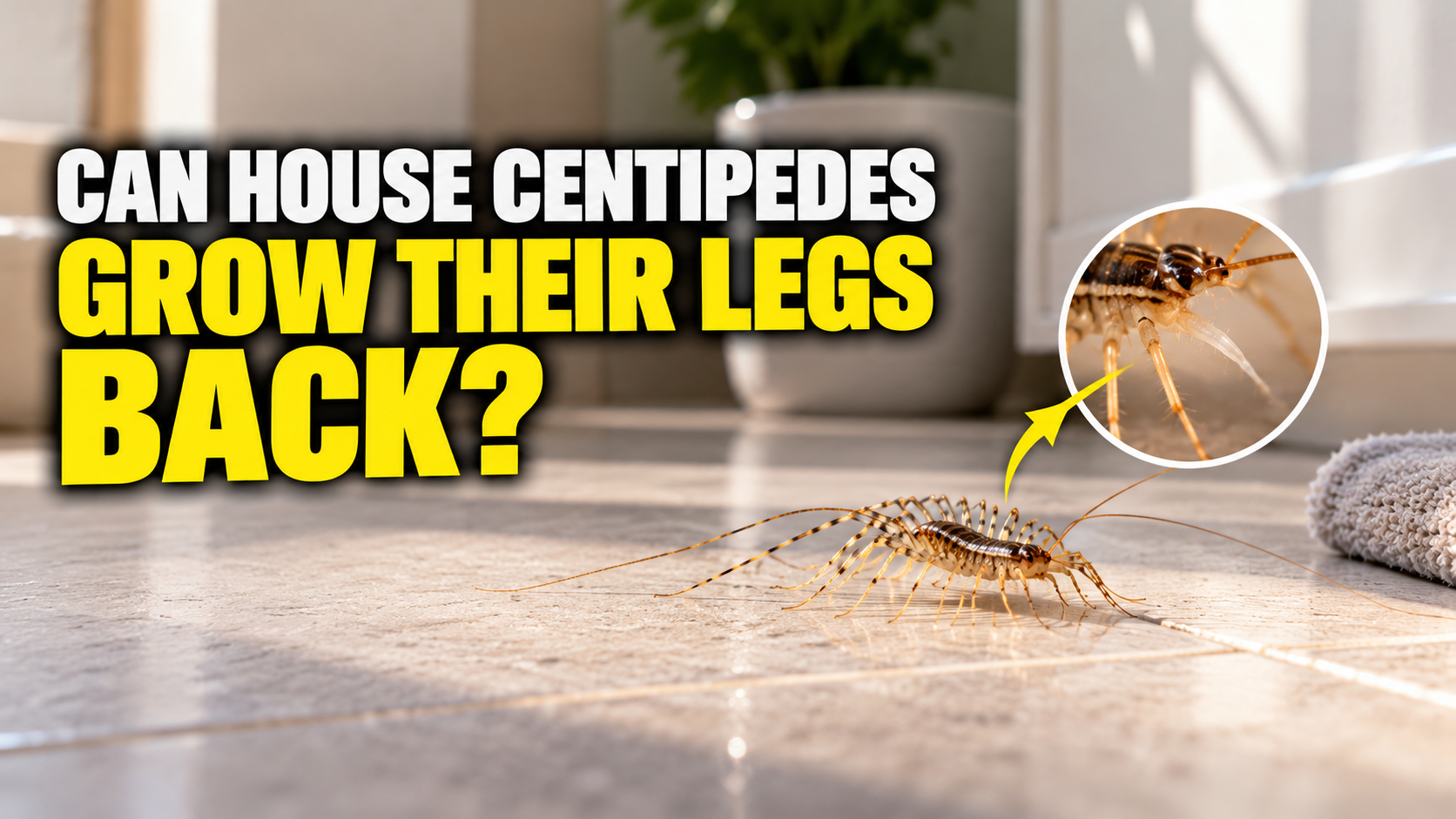
Can House Centipedes Grow Their Legs Back? Yes. House centipedes are capable of regenerating lost legs, and they can do it with surprising speed. Unlike many arthropods that regrow appendages gradually over multiple molts, house centipedes can sometimes replace a missing leg within a single molting cycle. Researchers call this “explosive regeneration.” The ability is especially useful because house centipedes have extremely long, fragile legs that can break or detach during attacks, escapes or physical contact.
House Centipedes Have a Built-In Break Point
The 2024 Frontiers in Zoology study found that Scutigera coleoptrata has a preferred breakage point near the base of the leg. When a leg is grabbed or injured at this location, it can detach relatively easily. Internally, the joint contains a specialized diaphragm that helps seal the opening after the leg is lost. This reduces fluid loss and creates the conditions needed for healing and regeneration.
The Wound Starts Healing Almost Immediately
After a leg breaks off, hemolymph, the arthropod equivalent of blood, quickly covers the wound and dries into a hardened seal. Researchers observed that the tissue beneath the wound begins reorganizing within hours. A mass of regenerative cells called a blastema forms inside the remaining leg base, and this becomes the foundation for the new appendage. The process is remarkably organized, especially considering how suddenly the original leg may have been lost.
The New Leg Grows Curled Up Inside
One of the strangest parts of the regeneration process is that the replacement leg grows in a tightly coiled form inside the remaining leg base. As development continues, nerves and muscle tissue form inside the new limb. The leg stays folded under the old cuticle until the centipede molts. When the old outer layer is shed, the regenerated leg unfolds and becomes functional.
One Molt Can Be Enough
This is what makes house centipedes especially unusual. The study found that if the leg is lost early enough before the next molt, the animal can complete the replacement within that same molting cycle. Researchers describe this as explosive regeneration because the appendage appears essentially complete after just one molt. Other centipedes and arthropods often require several molts before a regenerated appendage reaches normal size.
Timing Makes a Big Difference
Leg regeneration is not equally fast at every point in the molting cycle. If a house centipede loses a leg early in the intermolt period, regeneration begins slowly. If the loss happens closer to the next molt, the process can accelerate dramatically. There is also a critical point late in the molting cycle. If the injury happens after that point, full regeneration may have to wait until a later molt.
They Can Regenerate and Grow New Legs at the Same Time
Young house centipedes already add new leg-bearing body segments as they mature. That means an immature centipede can actually be developing new legs normally while simultaneously regenerating a leg that was lost earlier. The researchers found that these two processes happen in different parts of the body but can occur at the same time. That makes house centipedes unusually useful for studying how normal development and regeneration are related.
Adults Can Regenerate Too
The ability is not limited to juveniles. Adult house centipedes continue to molt throughout their lives, even after they have reached their full complement of 15 pairs of legs. Because molting continues, adults can also replace legs they lose. That is unusual among many terrestrial arthropods, where regenerative ability often becomes more limited after maturity.
Why Losing a Leg May Not Be a Disaster
House centipedes are fast predators that rely heavily on their legs for movement and prey capture, but losing one leg does not necessarily prevent them from functioning. Their ability to detach a leg may actually help them escape predators. The missing limb can later be replaced during a molt, turning what might otherwise be a serious injury into a temporary disadvantage.
House Centipedes Already Have a Lot of Legs
Adult house centipedes have 15 pairs of legs, for a total of 30. The Penn State Extension notes that newly hatched individuals begin with only four pairs and gradually add more through successive molts before reaching adulthood. Their unusually long legs make the animal look much larger than its body really is, but they also make limb loss more likely during encounters with predators or people.
Are House Centipedes Dangerous?
Despite their intimidating appearance, house centipedes are generally considered nuisance pests rather than dangerous household animals. The University of Minnesota Extension describes them as beneficial predators that feed on insects, spiders and other arthropods. They prefer damp environments and are often found in basements, bathrooms or other humid areas. Seeing many of them can sometimes indicate that other insects are also present in the home.
Should You Try to Pull Off a Centipede’s Leg?
No. The fact that house centipedes can regenerate legs does not mean intentionally injuring one is harmless. Regeneration requires energy, and losing multiple appendages can affect movement and survival. The research simply shows that house centipedes have evolved an unusually effective recovery system for injuries that naturally occur in the wild.
The PestMarket Verdict
Can House Centipedes Grow Their Legs Back? Yes. House centipedes can regenerate missing legs, and under the right conditions they can replace an entire lost limb within a single molting cycle. Their specialized breakage point, rapid wound sealing and continued molting make them unusually effective at recovering from leg loss.
Evidence Grade: STRONG EVIDENCE
The regeneration process has been directly documented using histology, imaging and controlled observations. Researchers have shown how the wound closes, how the replacement leg develops and how it unfolds after molting. House centipedes are not indestructible, but when it comes to replacing a missing leg, they are remarkably well equipped.