
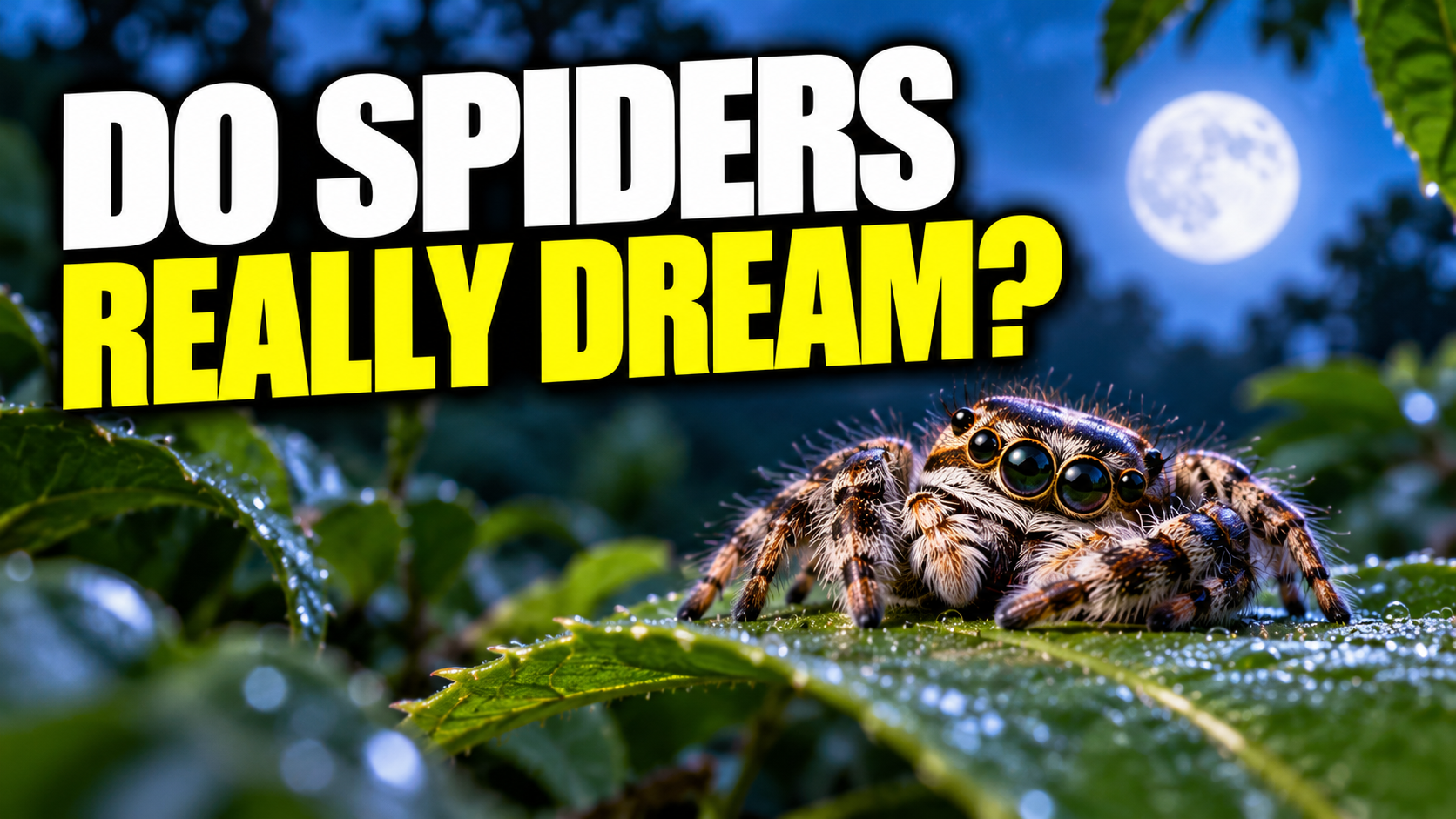
Do Spiders Really Dream? The idea of a tiny spider experiencing dreams might sound like science fiction, but researchers have discovered something remarkable happening while certain spiders rest at night. In carefully recorded experiments, jumping spiders displayed rapid movements inside their eyes, twitching limbs and repeated periods of activity that resemble features of rapid eye movement (REM) sleep in humans. The findings have raised an intriguing question: could the processes associated with dreaming exist in animals far removed from mammals? Scientists have evidence of REM-like behavior in spiders, but determining whether those animals actually experience dreams is a much more difficult challenge. PestMarket Investigates examines what researchers observed, what those movements might mean and why the answer is not as simple as it appears.
Scientists Filmed Jumping Spiders Resting at Night
In 2022, a research team led by behavioral ecologist Daniela Rößler published a study in Proceedings of the National Academy of Sciences examining the nocturnal behavior of a jumping spider species called Evarcha arcuata. The scientists used infrared cameras to observe 34 newly emerged spiderlings overnight. Young spiders were particularly useful because their temporarily translucent exoskeletons allowed researchers to observe movements of internal retinal tubes, structures that help the spiders direct their gaze. During periods of nighttime rest, the team recorded recurring bursts of retinal movement accompanied by twitching legs and characteristic curling motions. These findings were reported in the peer-reviewed study on REM sleep-like behavior in jumping spiders. The movements occurred in recognizable patterns, offering evidence that something more structured than ordinary stillness was taking place. Rather than simply assuming the spiders were dreaming, the researchers described what they observed as a REM sleep-like state.
Why Their Eye Movements Surprised Scientists
Most spiders cannot move their eyes the way humans do. Jumping spiders, however, have specialized retinal tubes that move behind their fixed eye lenses, allowing them to redirect their gaze without moving their entire bodies. That unusual anatomy gave scientists a rare opportunity to examine a potential REM-like phenomenon in an arthropod. During the nighttime observations, the spiderlings exhibited bursts of retinal movement that followed relatively regular intervals. Some movements coincided with twitches of the legs or other body parts, resembling features associated with active sleep in vertebrates. The researchers also found that the duration and spacing of these bouts changed as the night progressed. The patterns were noteworthy because REM sleep is traditionally studied using brain activity, muscle changes and eye movements in animals such as mammals and birds. The spiders showed behavioral similarities, but those observations did not establish that their nervous systems were experiencing exactly the same physiological state as a sleeping human.
Some Jumping Spiders Sleep Hanging From Silk Threads
The nighttime behavior becomes even more unusual when considering how these spiders rest. Earlier research on Evarcha arcuata documented individuals suspending themselves from a single silk thread attached to vegetation, sometimes hanging motionless for extended periods after dark. This behavior was described in a 2021 study of nocturnal resting in jumping spiders. During later observations, scientists noticed that resting spiders could curl their legs or twitch while suspended. Hanging from silk may offer practical advantages for a visually oriented hunter that becomes less active at night, although the precise protective benefits require further study. It also provides researchers with a striking view of movements that might otherwise be difficult to notice. What looks like a motionless spider dangling from a thread may involve repeated changes in activity that are invisible to a casual observer.
Does REM Sleep Mean an Animal Is Dreaming?
In humans, vivid dreaming is frequently associated with REM sleep, although dreams can also occur during other sleep stages. That relationship makes REM-like activity in spiders fascinating, but it does not provide direct proof of dream experiences. A spider cannot describe what it perceived during rest, and similar movements across species do not necessarily indicate identical mental states. Even the identification of true sleep in an unfamiliar animal requires more than observing a stationary posture or twitching limbs. Scientists commonly investigate whether an animal becomes less responsive during rest, can be awakened and compensates after sleep deprivation. In a scientific commentary on the jumping spider findings, researchers emphasized the importance of distinguishing apparent sleep from rigorously established sleep and REM-like behavior from the subjective experience of dreaming. The evidence raises the possibility of dreaming, but does not answer what, if anything, a spider experiences.
Do All Spiders Sleep the Same Way?
The findings should not be applied automatically to every spider species. Jumping spiders are especially visual hunters, equipped with sophisticated eyes and visually guided behaviors. Other spiders depend more heavily on webs, vibrations or chemical cues, and their resting patterns may differ considerably. The 2022 research focused on a particular jumping spider species rather than surveying the thousands of spider species found worldwide. Some spiders are primarily active during the day, while others hunt at night or remain relatively stationary in webs. Differences in sensory systems, habitat and daily activity make it unlikely that all spiders express identical sleep-related movements. Scientists are continuing to investigate how broadly sleep-like states occur across arachnids and whether different spider lifestyles produce different patterns of rest. The discovery in jumping spiders opens a field of research rather than settling the question for every species.
Could Spiders Dream About Hunting?
Jumping spiders possess sophisticated visual abilities and use them to locate prey, judge distances and navigate complicated environments. That makes it tempting to imagine a sleeping spider replaying a hunt or following an insect in a dream. However, no experiment has established that spiders mentally replay daytime events during rest or experience dream images resembling human dreams. Such suggestions remain hypotheses rather than demonstrated facts. Researchers would need additional evidence connecting particular brain or nervous-system activity to earlier waking experiences before making stronger claims. The distinction matters because describing a spider as dreaming about flies may be memorable, but it implies knowledge of an animal’s internal experience that scientists do not currently possess. The most compelling aspect of the discovery is not that spiders have been proven to dream, but that their resting behavior resembles processes previously investigated mainly in very different animal groups.
What Does This Mean for Spiders Around Your Home?
The research changes how scientists think about spider behavior, but it does not mean homeowners need to change their approach to ordinary spider encounters. Many household spiders are beneficial predators that help control insects, and seeing one resting motionless in a corner or near a window does not automatically indicate unusual behavior. PestMarket’s Spider Control Guide explains how to identify spider activity, reduce hiding places and manage recurring indoor sightings without unnecessary pesticide use. People who prefer to discourage spiders can remove accessible webs, reduce clutter, seal entry points and limit the insects attracting spiders indoors. The broader DIY Pest Control Guides provide additional prevention information. Whether spiders dream or not, they remain part of a much more complex natural world than their reputation as household pests suggests.
The PestMarket Verdict
Do Spiders Really Dream? Scientists have not established that spiders experience dreams, but there is meaningful evidence that at least one jumping spider species enters a REM sleep-like resting state. Researchers observed periodic retinal movements, limb twitches and leg curling that share important behavioral characteristics with REM sleep in other animals. These observations suggest that active sleep-like states may exist across a wider range of species than previously recognized. However, confirming dream experiences would require evidence that goes beyond visible movement, and scientists cannot yet determine whether sleeping spiders mentally experience images, memories or other subjective events. The research supports the possibility of dreaming, not a definitive yes or no. For now, the most accurate conclusion is that spiders show intriguing signs of sleep-related processes, while the question of whether they actually dream remains open.
Evidence Grade: MODERATE EVIDENCE
Strong evidence supports recurring REM-like behavior in the jumping spider species studied, but direct evidence of subjective dreaming is lacking. The findings come from peer-reviewed behavioral research, and the observations are sufficiently detailed to establish meaningful similarities with REM sleep. However, matching behaviors do not necessarily establish the same brain state or a conscious dream experience. The evidence is therefore strong for the observed behavior but insufficient to confirm that spiders truly dream.