
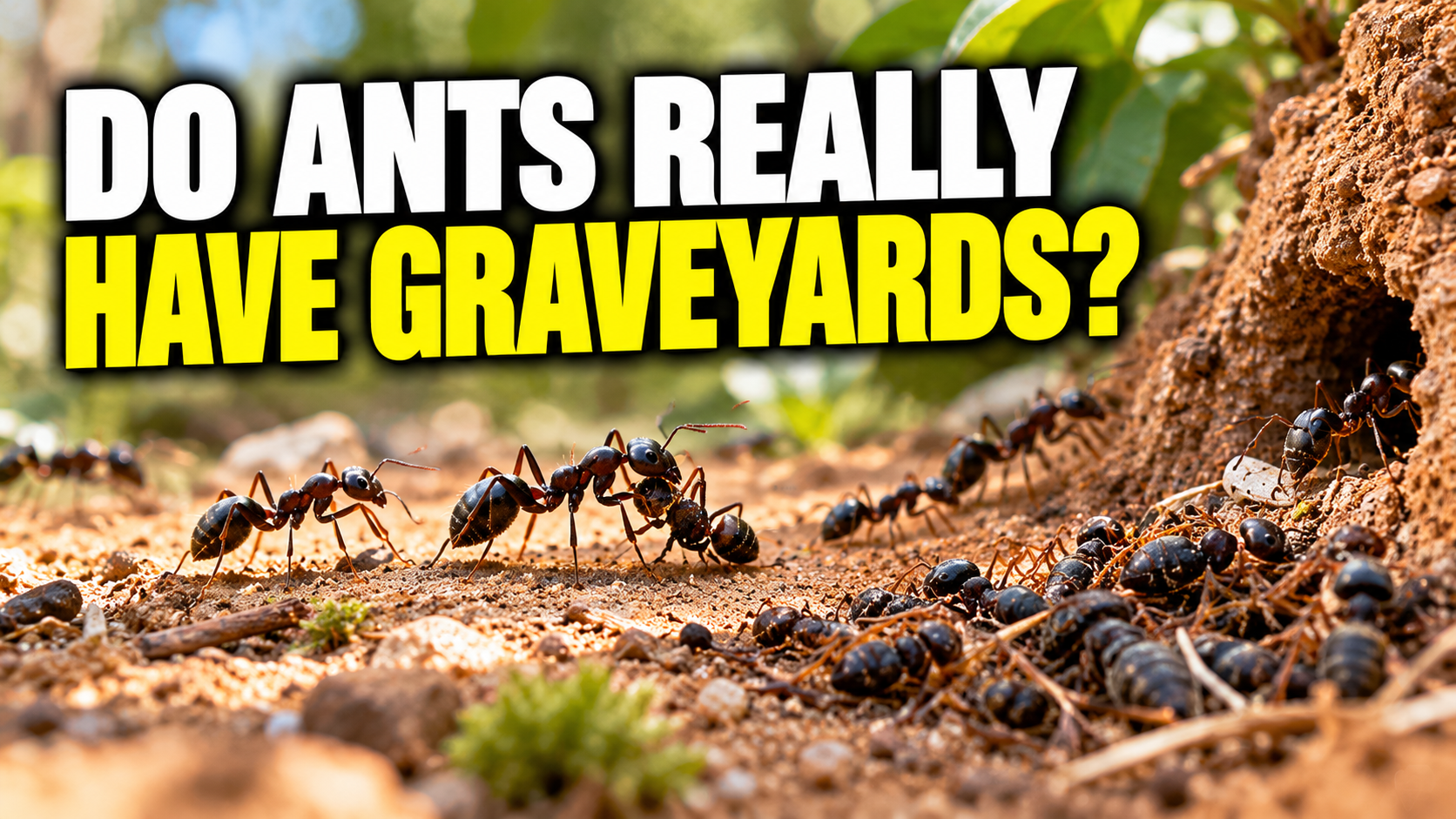
Do Ants Really Have Graveyards? If you have ever watched ants carrying a dead nestmate away from their colony, you may have witnessed one of the most fascinating behaviors in the insect world. Some ants move dead colony members to designated disposal areas, sometimes creating piles of bodies that look remarkably like miniature cemeteries. But are these insects actually burying their dead, or is something entirely different happening? Scientists have spent decades investigating the behavior, including experiments showing that ants can identify dead nestmates through chemical signals. The findings reveal a sophisticated form of colony sanitation that can easily be mistaken for something resembling a human funeral.
Why Do Ants Carry Away Their Dead?
Ant colonies are densely populated environments where thousands of individuals may live in close contact. A dead insect left inside a nest can become a potential source of microorganisms, including pathogens that threaten surviving colony members. Removing corpses helps reduce that exposure. Scientists call this behavior necrophoresis, the transportation of dead individuals away from the nest or into designated disposal areas. In their classic 1958 study, Chemical Releaser of Necrophoric Behavior in Ants, researchers documented worker ants carrying dead colony members toward refuse piles. The behavior appears organized because workers often transport corpses to particular locations rather than abandoning them wherever they are found. However, its primary biological function is sanitation, not a demonstrated understanding of death or mourning.
How Do Ants Know Another Ant Is Dead?
One of the most remarkable findings is that ants can recognize death through changes in another ant’s chemical signature. Researchers have identified fatty acids associated with decomposition, including oleic acid and linoleic acid, as important signals in certain species. As the body changes after death, these compounds can influence how surviving workers respond. Scientists studying red ants found that freshly killed individuals were removed much less frequently than corpses that had been dead for several days. Their research on post-mortem chemical changes reported that only 15% of freshly killed nestmates were removed, compared with approximately 80% of corpses aged one to six days. When researchers applied particular fatty acids to fresh corpses, removal increased. This demonstrates how ants can use chemical information to distinguish between living colony members and bodies requiring disposal. The exact process varies among species, and chemical recognition is more complicated than a single universal death odor.
Scientists Discovered That Living Ants Have Chemical Life Signals
For decades, researchers often explained corpse removal by suggesting that ants respond to chemicals that accumulate after death. But further experiments revealed another fascinating possibility: ants may also recognize death when chemical signals associated with living colony members disappear. In a 2009 study published in Proceedings of the National Academy of Sciences, scientists investigated Argentine ants and found that two compounds normally present on living individuals, dolichodial and iridomyrmecin, declined rapidly after death. The study on chemical signals associated with life demonstrated that the disappearance of these substances helped trigger corpse-removal behavior. Rather than simply waiting for a body to smell dead, workers could respond when signals identifying an individual as alive were no longer present. This finding also explains why some ants remove freshly killed nestmates before obvious decomposition begins. Different ant species use different combinations of chemical cues, making their responses more complex than early experiments initially suggested.
Are Ant Graveyards Really Cemeteries?
Ant refuse piles can resemble miniature graveyards, especially when workers repeatedly carry dead nestmates to the same area. But calling these places cemeteries is a human comparison rather than a scientific description of their purpose. Ants are not known to conduct funerals, create memorials, or intentionally honor deceased colony members in the way people do. The disposal sites are often better described as refuse piles or middens, and depending on the species and colony conditions they may contain other unwanted material as well as dead ants. The location of a pile can reflect practical factors such as nest layout, access, and how workers organize their tasks. Not every species handles corpses in the same way, and a visible heap of dead ants does not mean the insects have a fixed, human-like burial tradition.
Can Ants Mistake a Living Ant for a Dead One?
Experiments using chemicals associated with corpse removal have sometimes led ants to transport treated objects, and early studies even reported living ants being carried away after exposure to particular substances. That does not mean every living ant exposed to oleic acid will automatically be treated as dead. Subsequent research showed that a worker’s behavior depends on the species, the surrounding colony activity, and the balance of chemical signals present on the insect. An ant normally carries a complex chemical profile that can inhibit inappropriate removal. The famous image of a living ant being dragged toward a refuse pile illustrates how influential chemical communication can be, but it should not be mistaken for a universal or automatic reaction.
What Happens When Dead Ants Are Left Near a Home?
A small concentration of dead ants on a patio, windowsill, or near a foundation does not necessarily mean there is a graveyard beneath the house. Ants may collect dead nestmates near a nest entrance, but a pile may also reflect recent treatment, an environmental disturbance, predation, or other causes of mortality. Homeowners should pay attention to repeated trails, new piles, and ants moving in and out of cracks rather than treating every dead insect as evidence of a serious infestation. PestMarket’s Ant Control Guide explains how to recognize common ant activity and identify conditions that attract colonies indoors. If you find dead ants clustered in one spot, observe the surrounding activity before sweeping everything away, because the location and movement of live ants can help identify the source.
How Can You Prevent Ant Colonies Around Your Home?
Ant prevention generally starts with reducing food, moisture, and access points. Clean crumbs and spills promptly, keep pantry food sealed, address leaking pipes, and avoid leaving pet food accessible for long periods. Seal gaps around doors, windows, pipes, and foundations, and trim vegetation that touches the building. If trails persist, identification matters because different ant species may respond differently to baits, sanitation, and other targeted methods. The broader PestMarket DIY Pest Control Guides offer practical information about monitoring and prevention. Finding a few dead ants is not a reason to spray widely, particularly if there is no evidence of an active colony inside the house.
The PestMarket Verdict
Do Ants Really Have Graveyards? Partly true, but the word graveyard can be misleading. Researchers have documented ants removing dead nestmates and carrying them to particular refuse areas, sometimes producing piles of bodies that resemble miniature cemeteries. The behavior is known as necrophoresis and is strongly supported by decades of experimental research. Chemical cues associated with decomposition, as well as the disappearance of signals associated with living ants, can help workers recognize corpses. What the evidence does not establish is that ants bury their dead out of grief or create cemeteries for the symbolic reasons humans do. The remarkable truth is a carefully coordinated form of colony hygiene rather than an insect funeral.
Evidence Grade: STRONG EVIDENCE
Corpse-removal behavior and chemical recognition mechanisms have been demonstrated in controlled experiments across multiple ant species. Evidence strongly supports necrophoresis and the formation of refuse piles, but not human-like mourning, ritual burial, or a universal cemetery-building behavior in all ants. The apparent graveyard is real as a disposal site; the human interpretation of its purpose is the misleading part.