
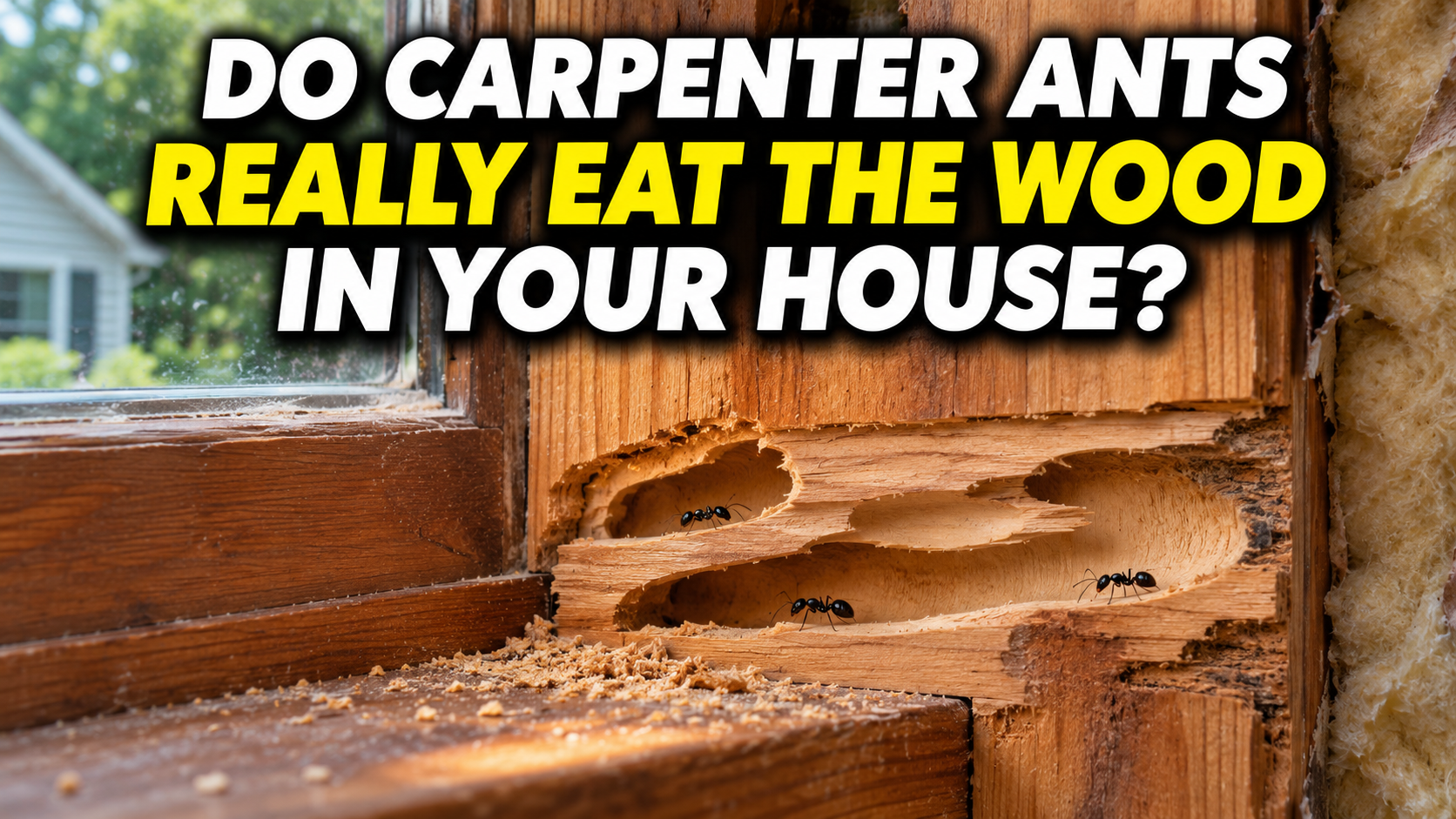
Do Carpenter Ants Really Eat the Wood in Your House? Despite the misleading impression created by damaged boards and piles of sawdust, the answer is no: carpenter ants do not eat wood. They excavate it to build protected galleries where their colony can live and raise young. That distinction matters because it explains both why ants may leave wood fragments outside a nest and why a house can still suffer damage even when no insect is consuming its lumber. An isolated ant walking across a kitchen counter is not proof that hidden structural damage exists, but repeated sightings near damp wood deserve closer investigation.
Why Carpenter Ants Dig Into Wood Instead of Eating It
Carpenter ants belong to the genus Camponotus. Their mandibles cut and carry away pieces of wood to open nesting chambers and passages; the discarded material does not supply the colony’s calories. According to the University of California Integrated Pest Management program, carpenter ants excavate timber to build nests and can extend their galleries into sound wood after beginning in a damp or decayed area. Workers maintain the passages, protect developing ants and travel through the resulting network. This is construction activity rather than feeding. The distinction is easy to miss when a damaged joist looks hollowed out, but knowing what creates the damage changes the clues a homeowner should look for.
What Do Carpenter Ants Actually Eat?
Carpenter ants seek sugars and proteins rather than cellulose. Outdoors they feed on honeydew produced by aphids and other plant-feeding insects, and they capture or scavenge other insects. Indoors, some will forage for sweets, pet food and other accessible foods. The University of Minnesota Extension specifically notes that carpenter ants remove wood while nesting but do not eat it. A sugar spill may attract workers even when the colony is outside; seeing ants at food therefore does not automatically mean the wall behind the kitchen contains a nest. Track the direction workers travel rather than assuming the location of a food source is the location of structural activity.
How Carpenter Ant Damage Differs From Termite Damage
Both pests can damage wooden components, but their biology is different. Termites obtain nutrition from cellulose in wood, while carpenter ants carve nesting spaces and discard the material they remove. Carpenter ant galleries tend to look relatively clean and smooth, whereas termite signs depend on the species and may include mud tubes, soil-lined galleries, or drywood termite fecal pellets. The difference helps guide identification, but no single visual clue settles every case. A homeowner who sees damaged timber should compare the evidence with PestMarket’s termite identification and control guide and consider an inspection before purchasing treatment for the wrong insect.
Why Wet or Decaying Wood Attracts Carpenter Ants
Leaking plumbing, failed window seals, roof leaks, condensation and poorly drained exterior surfaces can all create attractive nesting conditions. Moisture-softened material is easier to excavate, and cavities may provide shelter. That does not mean carpenter ants are incapable of affecting dry wood: a growing colony can extend from a decayed section into nearby sound material. The Texas A&M Urban and Structural Entomology program describes how ants remove wood to enlarge a nest and how that process may create structural damage. Repairing a leak without locating an established colony may leave ants behind; killing foraging ants without correcting the leak can leave the original attraction in place.
What Sawdust-Like Piles May Reveal
One of the more useful warning signs is a recurring pile of coarse, sawdust-like material emerging from a crack, window frame, baseboard or other opening. This material is often called frass, although carpenter ant debris can include shredded wood, insect remains and other fragments carried out of the nest. A pile by itself is not definitive evidence, because renovation dust, other insects and ordinary wear can produce similar debris. Reappearing material in the same location alongside carpenter ant activity is more meaningful than a one-time dust pile. Photograph the debris, note where it emerges and avoid sweeping away all traces before someone can inspect the site.
Can Carpenter Ants Damage a House Without Being Seen?
Yes, colonies can operate in concealed wall voids, ceiling spaces, insulation, hollow doors and wooden framing. But absence of visible workers does not prove ants are present, and occasional indoor workers may have arrived from an outdoor nest. Colonies can also have a parent nest outdoors and one or more satellite nests in a structure. Activity may increase at night, when many workers forage. If you notice repeated traffic near a damp window frame, a bathroom wall or a roof leak, investigate the source of the moisture and the path the ants take. Do not cut into a wall solely on suspicion or confuse a small number of visiting foragers with a confirmed indoor colony.
Does Every Carpenter Ant Infestation Mean Major Structural Damage?
No. The level of damage depends on the species, size and age of the colony, where it is nesting, existing moisture damage and the wood members affected. Some species nest in insulation or pre-existing voids and cause relatively little excavation. Others may expand galleries through timber over time. A sighting of one large black ant is therefore not a reliable indicator of repair costs or structural danger. Assessing serious damage may require both a licensed pest professional who can identify the ants and a qualified building professional who can evaluate compromised framing. Avoid assuming that an old, hollowed board must have been destroyed recently or by carpenter ants alone.
Do Carpenter Ants Really Eat the Wood in Your House? What the Evidence Shows
The evidence points to a crucial distinction between eating wood and damaging it. Carpenter ants do not digest wooden building materials as food, but workers can make extensive cavities while establishing and enlarging nests. They generally begin in damp or softened wood and may eventually affect adjoining sound wood. This explains why simply asking whether they eat wood can produce a reassuring answer that misses the practical risk. For a homeowner, the better question is whether ants have established a nest in or near the structure, and whether moisture or existing decay has made timber vulnerable. Both a precise identification and an inspection of the affected area matter more than the name of the pest.
What Homeowners Should Check Before Treating
Start with observable conditions rather than guessing about the colony’s location. Look for recurring coarse debris, repeated trails, damaged window or door frames, water stains, plumbing leaks and ants entering gaps around exterior trim. Correct moisture problems and keep vegetation and stored wood from providing convenient bridges to the structure. Reduce accessible food and seal entry points once active nesting areas are understood. PestMarket’s ant identification and prevention guide explains general steps, but a suspected concealed carpenter ant nest is a more specialized problem. Spraying visible workers alone may miss the colony, while treating the wrong void can create needless damage and pesticide exposure.
When a Professional Inspection Makes Sense
Professional evaluation is especially reasonable when large ants repeatedly appear indoors during cool seasons, sawdust-like debris returns from the same opening, winged ants emerge inside, or water-damaged structural wood is involved. Ask the inspector to identify the insect, explain evidence of a nest, evaluate likely parent and satellite nesting areas, and specify what can be confirmed without opening walls. If wood appears weakened, a building professional should assess whether repairs are needed. An insect treatment plan and a repair plan address different problems; success in one does not automatically resolve the other. Follow pesticide labels and avoid pouring chemicals into electrical outlets or opening energized equipment to look for ants.
The PestMarket Verdict
Carpenter ants do not eat the wood in your house. They cut it away to create galleries, which means the familiar claim that they are “eating your home” is biologically inaccurate. Yet the opposite conclusion, that they cannot harm a home because they do not eat wood, is also wrong. A persistent nest can damage timber, especially around leaks or decay, and some colonies expand into adjoining sound wood. The practical response is to identify the ants, locate the actual nest, correct moisture problems and determine whether any structural components need repair. A passing ant is not a diagnosis, and a lack of visible ants is not a guarantee that hidden damage is absent.
Evidence Grade
STRONG EVIDENCE supports the conclusion that carpenter ants do not consume wood for nutrition and instead excavate galleries to nest. STRONG EVIDENCE also supports their association with moisture-damaged wood and their ability to cause structural damage in some circumstances. CONTEXT-DEPENDENT EVIDENCE applies to the severity of damage in any particular home, because species, colony size, nesting site, moisture history and the condition of individual wood members vary. Finding carpenter ants, frass or a hollow-sounding board alone is insufficient to determine the extent of structural harm without inspection.