
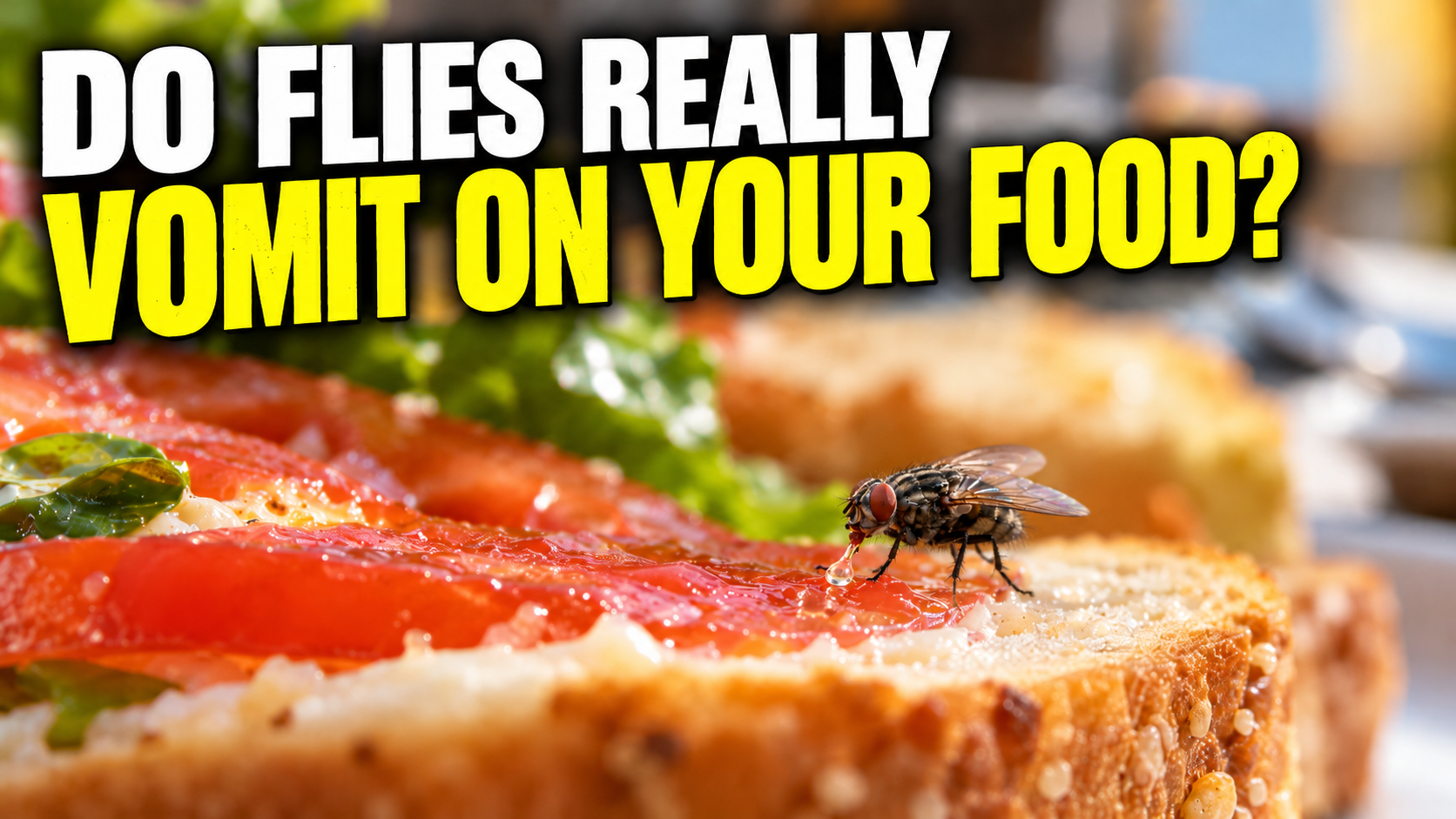
Do Flies Really Vomit on Your Food? In a loose sense, yes, but “regurgitate” is the scientifically accurate word. House flies cannot chew solid food the way humans do. Instead, they feed mainly on liquids and use their sponge-like mouthparts to draw food in. When a fly encounters something dry or solid, it can bring liquid back up from a storage organ called the crop and deposit it onto the food. That liquid helps dissolve the surface so the fly can suck it back up. Researchers studying the fly digestive system specifically distinguish this process from mammalian vomiting, but the result from a human perspective is not especially appetizing.
What Actually Comes Out of the Fly?
A fly’s crop is part of its foregut and acts as a temporary storage chamber for liquids it has already consumed. A detailed scientific review of the fly foregut and microbial transmission explains that flies can expel crop contents through regurgitation. Those droplets may contain previously ingested nutrients, water, digestive secretions and microorganisms. The same review notes that adult house flies may regurgitate crop fluid onto dry food to help liquefy it before feeding. So when people say a fly “throws up” on food, they are describing a real behavior, even though it is not vomiting in the mammalian sense.
Why Flies Need to Liquefy Their Food
House flies have specialized mouthparts built for sponging up liquids. They do not have chewing mouthparts capable of biting pieces off a sandwich, steak or piece of fruit. If the food is already moist, the fly can feed directly. If it is relatively dry, adding liquid makes the surface easier to ingest. This is one reason flies repeatedly extend their proboscis onto food and may appear to be tasting different areas before feeding.
Do They Regurgitate Every Time They Land?
No. This is where the viral version of the claim becomes exaggerated. A fly does not automatically regurgitate the instant its feet touch every surface. Landing, tasting and feeding are different behaviors. If the fly finds something suitable to eat, regurgitation may occur, particularly when it needs to liquefy dry material. So “every fly vomits every time it lands on your food” is too strong. The underlying feeding behavior, however, is real.
Why the Regurgitation Matters
The problem is not simply that the behavior sounds disgusting. House flies routinely visit garbage, feces, animal waste and decomposing organic material. A national agricultural pest-management resource notes that house flies often regurgitate and defecate while resting, allowing them to contaminate feed and other surfaces. The National IPM Database lists organisms such as E. coli, Salmonella, Streptococcus and Staphylococcus among pathogens that house flies can potentially carry.
Bacteria Can Travel Inside the Fly Too
Microorganisms are not found only on a fly’s feet. Scientists have examined the bacterial communities living inside house flies as well. A large Scientific Reports study found hundreds of bacterial species associated with house flies and blowflies and concluded that the insects can act as reservoirs for bacterial transmission. Research has also found that the house fly’s crop can support certain microbes, meaning pathogens may survive inside the fly before later being released through regurgitation.
Can Fly Regurgitation Really Contaminate Food?
Yes. Experimental research summarized in the fly-foregut review found that house flies exposed to E. coli O157:H7 could deposit the bacteria onto spinach through regurgitated droplets. Other studies have recovered bacteria from fly regurgitant hours after the insects originally consumed contaminated material. That means the oral route is one genuine pathway by which house flies can transfer microbes onto food, alongside contamination from their feet and feces.
Should You Throw Away Food After a Fly Lands on It?
A single brief landing does not mean someone will automatically become sick. Risk depends on where the fly has been, how long it remains on the food, whether it feeds or defecates and the type of microorganism involved. Still, uncovered food that attracts multiple flies or sits exposed for long periods creates more opportunities for contamination. Covering food, cleaning spills and controlling garbage are simple ways to reduce that risk. PestMarket’s Pest Control Guide covers broader strategies for preventing household pest activity.
Why Flies Seem Obsessed With Your Meal
House flies are attracted to a huge range of organic odors. Sugars, proteins, fermenting foods, garbage and animal waste can all draw their attention. Their ability to move rapidly between filthy material and human food is exactly what makes them such effective mechanical vectors. The disturbing part is not just what happens after they land. It is what they may have visited before arriving.
The PestMarket Verdict
Do Flies Really Vomit on Your Food? Yes, in everyday language, but scientifically the process is regurgitation rather than true vomiting. House flies can bring liquid back up from their crop and deposit it onto solid food to help liquefy the surface before feeding. That regurgitated material can also carry microorganisms acquired from earlier meals or contaminated environments.
Evidence Grade: STRONG EVIDENCE
House fly regurgitation has been directly observed and extensively described in entomological research, including studies of how microbes can be carried in the crop and deposited onto food. The only myth is the claim that every fly automatically “vomits” the instant it lands.