
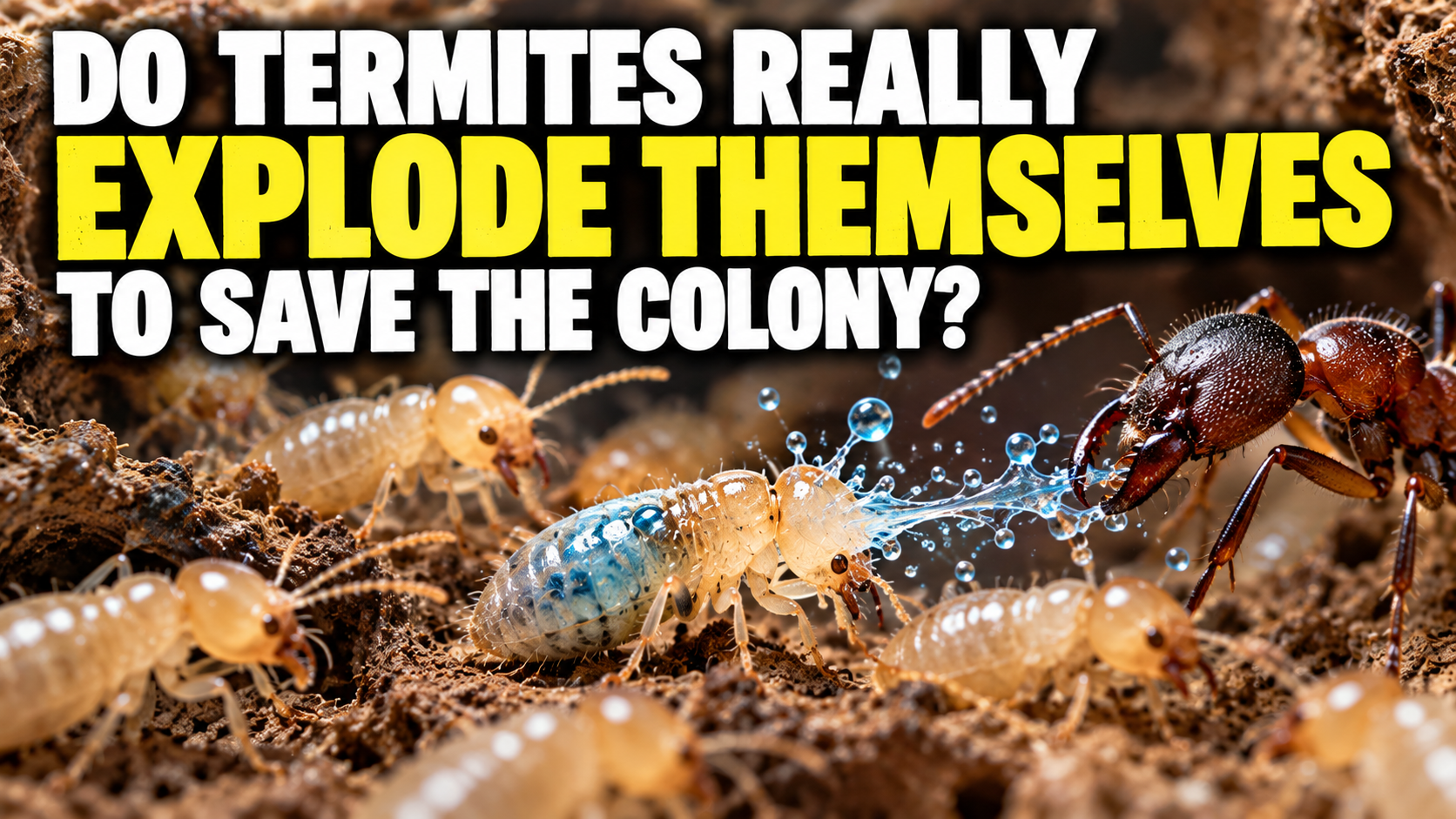
Do Termites Really Explode Themselves to Save the Colony? In one remarkable species, yes. Workers of the termite Neocapritermes taracua can rupture their own bodies during an attack and release a toxic chemical mixture that helps defend the colony. Scientists call this behavior autothysis, a form of self-destructive defense found in some social insects. The worker does not survive the event, but the released chemicals can immobilize or poison an attacker, potentially protecting nestmates and blocking access to the colony.
The Termites Carry a Chemical Defense on Their Backs
Researchers studying Neocapritermes taracua discovered that older workers develop distinctive blue crystal-filled structures on their backs. A molecular study of the termite’s defense system found that those crystals contain a protein called BP76. When the worker’s body ruptures during an attack, the protein mixes with compounds produced by the termite’s labial glands. The combination creates a highly toxic defensive mixture. In effect, the termite carries two harmless components separately and combines them only when the body breaks open.
Why Do They Have to Die?
The defense depends on rupturing the body, so the worker cannot survive it. That sounds like a terrible strategy for an individual insect, but termite colonies operate as highly cooperative societies. A worker that sacrifices itself may prevent an attacker from reaching many other colony members, including reproductives and younger workers. From the colony’s perspective, losing one older worker can be worthwhile if the action protects the nest.
Older Workers Are the Ones Most Likely to Explode
One of the strangest parts of the system is that the defensive ability changes with age. Older Neocapritermes taracua workers accumulate more of the blue crystal material and become increasingly specialized for this suicidal defense. A study of the defensive glands found age-related changes in the structures that produce and store these crystals. As older workers become less efficient at ordinary colony jobs, their value may shift toward defense instead.
What Actually Happens During an Attack?
When a predator or rival termite attacks, the worker can rupture its body and release the stored chemicals. The resulting sticky toxic mixture can immobilize or poison the attacker. This is not an explosion like a firecracker. There is no flame or blast wave. “Explode” is shorthand for the rapid rupture of the termite’s body and release of its chemical contents.
Is This Unique to One Termite Species?
Neocapritermes taracua is one of the best studied examples, but self-destructive defense is known in several social insects. Ants and other termites have evolved different forms of autothysis in which workers rupture glands or body tissues to release defensive chemicals. What makes this species especially unusual is its two-part chemical system involving stored blue crystals and gland secretions.
Why Are the Crystals Blue?
The color comes from the protein-rich crystal structures stored in the termite’s dorsal pouches. Researchers later showed that BP76 is a laccase enzyme with unusual structural stability. The blue crystals essentially function as a durable chemical reserve that can remain stored until the moment of attack. That helps explain how older workers can carry the defensive material for long periods without harming themselves.
Do They Choose When to Explode?
Scientists generally describe autothysis as a defensive response triggered during intense physical conflict rather than as a conscious decision in the human sense. The termite does not need to understand sacrifice or colony survival. Natural selection can favor behaviors that improve the reproductive success of closely related colony members, even when the individual worker dies.
Why Would Evolution Favor a Suicidal Worker?
Termite workers are usually sterile and share close genetic relationships with the reproductive members of the colony. If sacrificing one worker allows many relatives to survive, the genes supporting that behavior can still spread. This is one of the clearest examples of how social insect colonies can function almost like a single larger organism, with individual workers performing specialized roles for the survival of the group.
Are Termites in Your House Going to Explode?
No. Homeowners should not expect ordinary structural termites to start bursting when disturbed. The behavior discussed here belongs to specialized species and is not a normal feature of the common subterranean or drywood termites that damage homes in the United States. PestMarket’s Termite Control Guide covers the species and signs homeowners are more likely to encounter around buildings.
The PestMarket Verdict
Do Termites Really Explode Themselves to Save the Colony? Yes. Some termite workers can rupture their bodies and release a toxic chemical mixture that helps defend the colony from attackers. The behavior is real, but “explode” should not be interpreted as a fiery blast. It is a rapid body rupture that activates a powerful chemical defense.
Evidence Grade: STRONG EVIDENCE
Researchers have documented the behavior directly and identified the molecular system behind it. The blue crystal protein BP76 and gland secretions combine during autothysis to create the toxic defensive mixture, making this one of the most dramatic examples of self-sacrifice in social insects.