
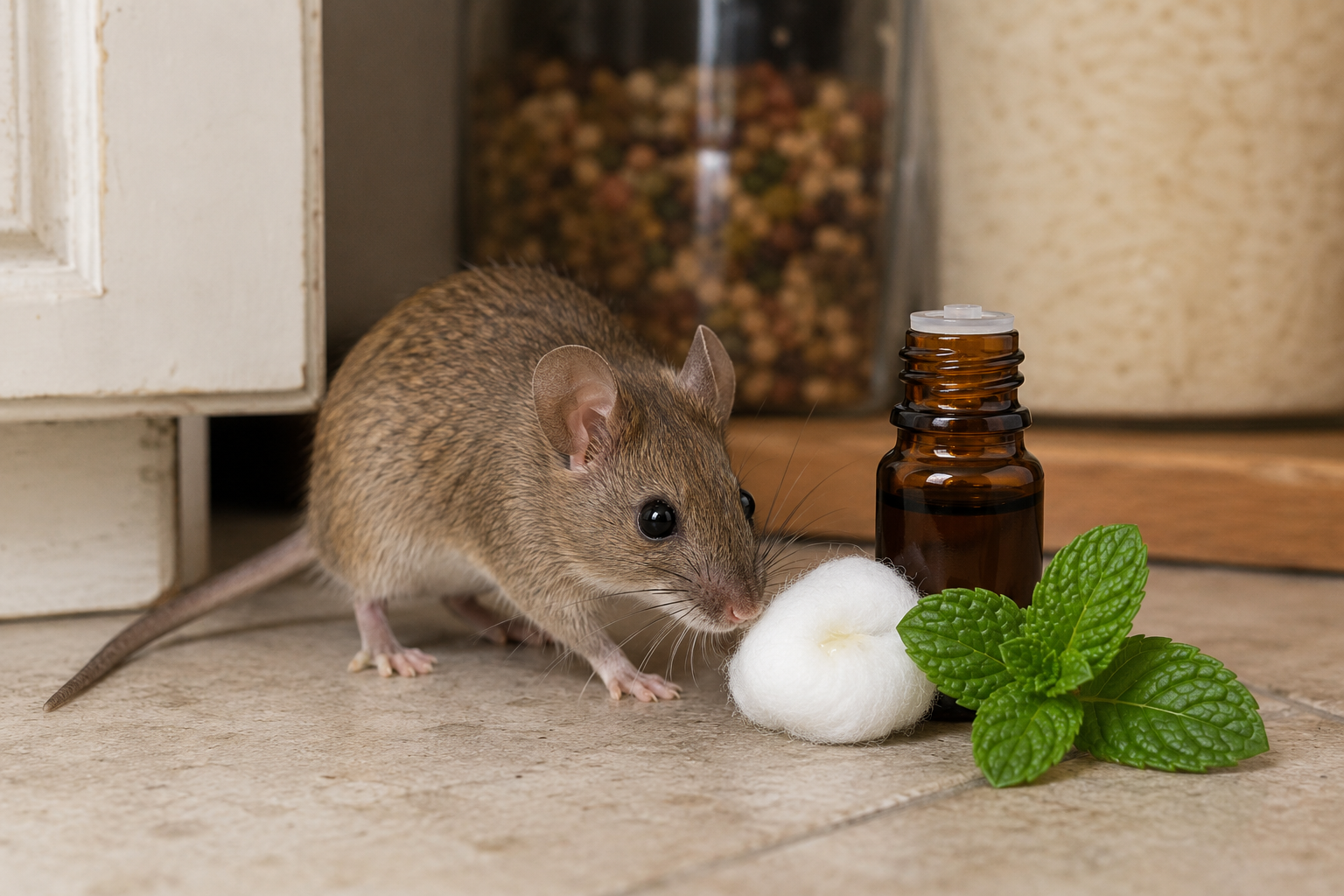
Search for a natural way to keep mice out of your house and one remedy appears almost everywhere: peppermint oil.
The instructions are usually simple. Put a few drops on cotton balls, leave them near doors, cabinets or other places where mice travel, and supposedly the strong mint smell will make them stay away.
It sounds plausible. Mice rely heavily on their sense of smell, and peppermint oil has an odor strong enough for us to notice from across a room.
But does peppermint oil really repel mice, or does your house just end up smelling like peppermint while the mice continue doing what they were doing?
There is actually some experimental evidence behind the idea.
The problem is what happens after the initial reaction.
Peppermint Oil Can Affect Mouse Behavior
Peppermint oil isn’t something scientists have completely ignored.
A 2022 study published in Natural and Life Sciences Communications tested several plant oils as possible mouse repellents, including peppermint, orange, lemongrass and ginger oils.
Researchers used laboratory mice in two different behavioral tests. One measured whether mice avoided areas containing the oils. Another examined how much time mice spent in a dark chamber when a potential repellent was present.
Initially, peppermint oil worked.
Mice exposed to peppermint oil showed avoidance behavior compared with the control condition. In other words, there is experimental support for the basic idea behind all those peppermint-oil mouse tips online.
The mice didn’t simply act as though the smell wasn’t there.
But the researchers didn’t stop after the first test.
Then the Researchers Waited Seven Days
This is where the peppermint-oil story gets more interesting.
When researchers evaluated longer-term effects one week later, peppermint oil no longer produced a significant repellent effect.
Menthol showed the same problem.
Some of the other oils tested retained repellent activity at the one-week measurement, but peppermint and menthol did not. The researchers suggested that the loss of peppermint’s effect could be related to changes in the active repellent properties over time.
That’s an important distinction.
Peppermint oil causing a mouse to avoid an area shortly after exposure is one thing. Peppermint oil reliably keeping mice out of a house is another.
The study provides evidence for the first claim.
It doesn’t establish the second.
Why the Famous Cotton-Ball Trick Is a Bigger Claim
Think about what you’re asking peppermint oil to accomplish inside a real house.
A mouse may already have access to warmth, nesting material, hidden spaces and food. It may know routes through walls and cabinets and have an established nest nearby.
Now put a peppermint-soaked cotton ball somewhere along one of those routes.
Even if the odor initially bothers the mouse, that doesn’t necessarily mean the animal will leave the building. It could avoid that particular spot, use another route or eventually stop responding strongly enough for the peppermint to matter.
That’s one reason laboratory avoidance shouldn’t automatically be translated into real-world pest control.
The 2022 experiment measured mouse behavior under controlled conditions. It was not a trial showing that homeowners could eliminate or prevent household mouse infestations with peppermint-soaked cotton balls.
What Do Pest Experts Recommend Instead?
University Extension guidance is much less enthusiastic about peppermint as a solution to mice inside homes.
When someone specifically asked Oregon’s Ask Extension whether peppermint oil was an effective mouse deterrent, the response was straightforward: peppermint wasn’t considered a reliable way to prevent mice from entering a home.
Instead, the recommendation focused on finding and blocking entry points, removing accessible food sources and using snap traps to manage mice already inside.
The University of California’s Integrated Pest Management program takes a similar approach. Its house-mouse guidance emphasizes sanitation, exclusion and population reduction through trapping or, where appropriate, rodenticide baits.
UC IPM describes exclusion as the most successful and permanent form of house mouse control. Mice can enter through openings about 1/4 inch wide, making structural gaps far more important than many homeowners realize.
The Problem Isn’t Just Whether Mice Hate the Smell
This gets to the biggest weakness in the peppermint-oil argument.
A repellent doesn’t merely need to smell unpleasant. To solve a household mouse problem, it needs to change the animal’s behavior enough to keep it away from the places you’re trying to protect.
And if the mouse can simply go around the smell, the problem hasn’t been solved.
A gap beneath a cabinet still exists. Food behind the stove is still food. A hole leading into a wall is still an entrance.
EPA guidance for preventing rodent infestations therefore focuses on eliminating the things rodents need and blocking the ways they enter: seal holes, remove food and water sources, and eliminate potential nesting areas.
That addresses why the mice are there rather than trying to make one part of the house smell unpleasant.
What About Peppermint Mouse Repellents Sold in Stores?
There’s another detail worth knowing.
Peppermint oil can appear in pest-repellent products marketed as more natural alternatives to conventional pesticides. But seeing peppermint oil on a product label isn’t proof that every peppermint-oil remedy has been demonstrated to work.
EPA explains that peppermint and peppermint oil are among ingredients that can appear in certain minimum-risk pesticide products exempt from federal registration requirements. For products that are not EPA-registered, EPA notes that it has not evaluated their effectiveness simply because their ingredients qualify for that exemption.
So “natural,” “minimum risk” and “proven effective” aren’t interchangeable terms.
And a bottle of peppermint essential oil intended for another purpose shouldn’t automatically be assumed to be a tested mouse-control product.
So, Does Peppermint Oil Really Repel Mice?
Under some conditions, apparently yes.
The laboratory evidence makes it difficult to dismiss the idea completely. Mice in the 2022 study initially avoided peppermint oil, which suggests the odor can produce a real behavioral response.
But that’s very different from saying peppermint oil will keep mice out of your home.
The effect didn’t remain significant after one week in that study, and established pest-management guidance continues to emphasize exclusion, sanitation and trapping rather than peppermint oil as a dependable solution.
If you already have mice inside, the important questions are still the boring ones:
Where are they getting in?
What are they eating?
Where are they nesting?
And how are you going to remove the mice that are already there?
For a broader approach to identifying mouse activity, sealing entry points, trapping and prevention, see PestMarket’s Mouse Control Guide.
The PestMarket Verdict
Peppermint oil isn’t completely imaginary as a mouse repellent.
There is experimental evidence that its odor can cause mice to avoid an area in the short term. That’s enough evidence that calling the entire idea a myth would go too far.
What isn’t supported nearly as well is the claim homeowners actually care about: that putting peppermint oil around a house will reliably keep mice away or eliminate an existing mouse problem.
Evidence Grade: LIMITED EVIDENCE
What the evidence supports: Peppermint oil can produce short-term avoidance behavior in laboratory mice.
What isn’t well established: That peppermint oil provides durable, real-world protection against mice in homes or can control an established infestation.
So if you like the smell of peppermint, there’s nothing surprising about using it around your home for that reason.
But if you hear scratching behind the wall at night, don’t reach for the essential oil and assume the problem is handled.
Find the hole. Remove the food source. Deal with the mice already inside.