
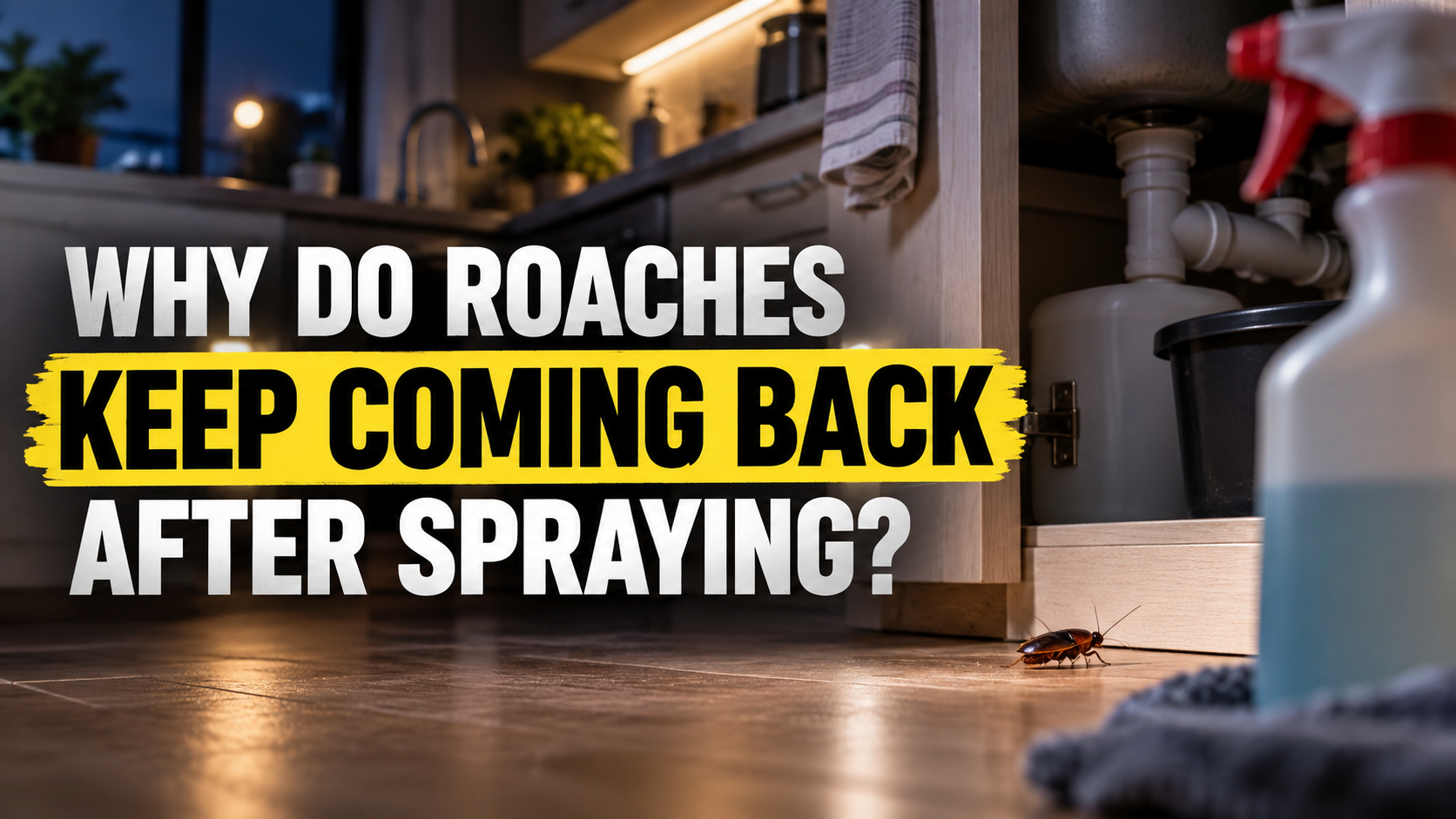
Why Do Roaches Keep Coming Back After Spraying? Usually because the spray killed some of the cockroaches you could see without eliminating the conditions that allowed the infestation to survive. Roaches spend most of their time hidden inside cracks, cabinets, wall voids, appliances and other protected spaces, and a quick spray across exposed surfaces may never reach much of the population. Eggs can remain behind, surviving roaches can continue breeding, and new insects may keep entering from neighboring units or gaps around plumbing. If the same pattern happens again and again, the real problem is often bigger than the roaches walking across the kitchen floor.
Spraying the Roaches You See Is Only Part of the Job
Seeing dead roaches after treatment can make it look like the problem has been solved, but visible adults may represent only part of an infestation. Cockroaches prefer tight, protected spaces close to food and moisture. They may hide behind refrigerators, underneath sinks, inside cabinet gaps, around plumbing penetrations or deep inside wall voids. The U.S. Environmental Protection Agency recommends an Integrated Pest Management approach that combines pest treatment with removing food, water and shelter. If those conditions remain unchanged, killing the roaches that happen to cross a treated surface may provide temporary relief without stopping the infestation.
Food and Water Can Keep the Population Going
Roaches do not need much to survive. Crumbs under appliances, grease around a stove, pet food, garbage residue and even small amounts of water can support them. A leaking pipe beneath a sink or condensation around an appliance may be more important than a homeowner realizes. Cleaning does not mean a house must be spotless, but reducing accessible food and moisture makes other control methods more effective. EPA guidance specifically recommends fixing plumbing leaks, sealing food, removing garbage and closing cracks and crevices that provide hiding places. If those basic conditions are ignored, repeated spraying can become a cycle rather than a solution.
Sprays and Baits Can Work Against Each Other
One common mistake is spraying insecticide directly where gel bait or bait stations have been placed. Some sprays can contaminate or repel roaches from baited areas, making them less likely to feed on the product. Mississippi State University Extension advises against applying insecticide sprays in areas where cockroach baits are being used and notes that gel baits work best when placed in multiple small locations near roach hiding areas. A bait is designed to be eaten, so covering the area with a product that encourages cockroaches to avoid it can defeat the purpose. More pesticide does not automatically mean better control.
Roaches Can Develop Resistance or Avoid Certain Baits
Cockroach populations are not all equally vulnerable to the same products. Over time, some populations can become less sensitive to particular insecticides, while others may avoid certain bait formulations. Penn State Extension notes that cockroaches have developed resistance to pesticides, including some baits and gels, and recommends switching products if a bait has failed to eliminate an infestation after an appropriate treatment period. This is one reason repeatedly using the exact same product in the exact same way may produce disappointing results.
The Problem May Be Coming From Somewhere Else
In apartments, condominiums and other attached housing, a clean unit can still experience roaches if they are moving through shared walls, plumbing chases or utility openings from another unit. Houses can have similar problems when roaches enter around pipes, doors, garages or exterior gaps. Boxes, bags and used appliances can also introduce roaches indoors. This is why sealing gaps matters. Openings around kitchen and bathroom plumbing, gaps beneath sinks and penetrations where pipes disappear into walls are especially worth checking. If roaches continue entering from another source, spraying inside one room will never fully address the problem.
Eggs Can Make It Look Like Roaches Suddenly Returned
Another reason roaches seem to “come back” is that eggs were already present during the original treatment. Cockroach egg cases can contain multiple developing young, and depending on the species and treatment used, the egg case may be less exposed than active adults. Newly emerged nymphs can appear after the original adult population has been reduced, making it seem as though the treatment completely failed. That is why monitoring and follow-up are important. Sticky traps placed near suspected harborages can help show whether activity is actually declining and where surviving roaches remain concentrated.
What Works Better Than Just Spraying Again?
The better approach is usually to find out why the roaches are surviving before automatically applying another layer of spray. Remove food and water sources, vacuum crumbs and debris from hard-to-reach areas, seal cracks and plumbing gaps, use monitoring traps and place baits where roaches actually travel and hide. The EPA’s pest-control guidance recommends baits as a first line of chemical defense in many situations and says pesticides outside baits or traps should generally be directed at targeted locations rather than sprayed throughout an entire room. PestMarket’s Cockroach Control Guide also covers identification, prevention and treatment options for different types of roach problems.
The biggest mistake is assuming that seeing fewer roaches for a few days means the infestation is gone. If they keep returning, something is allowing them to survive, reproduce or re-enter. Finding that source usually matters more than spraying one more time.