
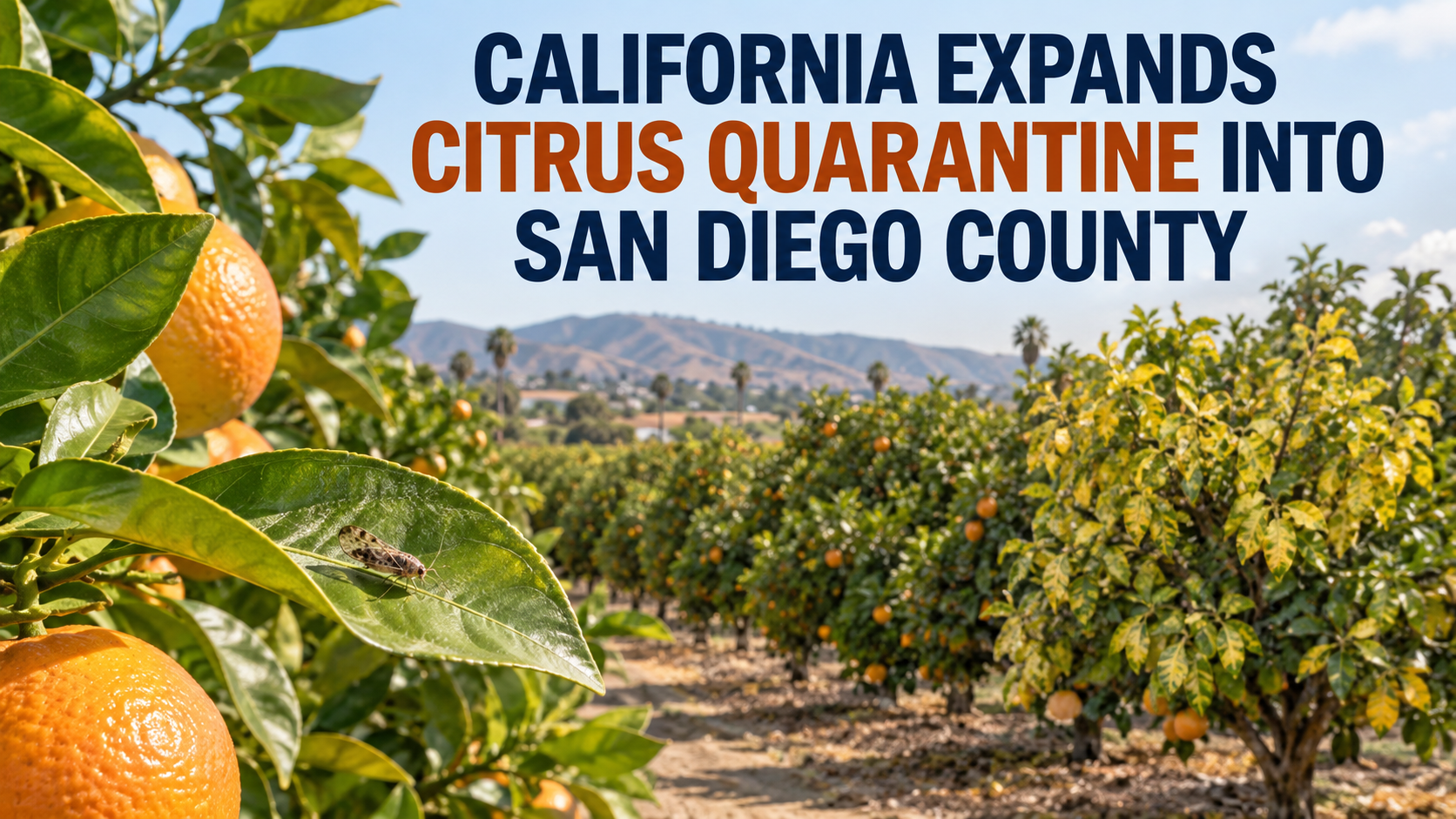
California has expanded a citrus disease quarantine south from Riverside County into San Diego County after confirming Huanglongbing, or HLB, in a residential citrus tree near Murrieta. California Expands Citrus Quarantine Into San Diego County as the new boundary runs south through the De Luz area and connects northern San Diego County’s existing quarantine with quarantined areas across Riverside, Orange, Los Angeles and San Bernardino counties. The expansion became effective Sept. 11, while a new Sept. 17 update from UC Agriculture and Natural Resources brought renewed attention to the change. San Diego County says the newly affected area includes more than 70 businesses, including more than 40 growers and 10 commercial nurseries. Residents and citrus businesses inside the affected area now face additional restrictions designed to slow the spread of one of the most destructive citrus diseases in the world. The latest boundaries can be viewed on the CDFA HLB quarantine map.
One Infected Residential Tree Triggered the Expansion
The latest expansion followed CDFA confirmation of HLB in a single residential citrus tree in the Murrieta area of Riverside County. Because California establishes quarantine areas around confirmed HLB detections, the discovery pushed the existing boundary farther south through De Luz and into northern San Diego County. According to San Diego County Agriculture, Weights and Measures, HLB quarantines were already active in areas including Fallbrook, Oceanside, Rancho Bernardo, Valley Center and Ramona. The new boundary effectively links parts of the northern San Diego quarantine area with a much larger Southern California quarantine network. CDFA has also expanded the corresponding Asian citrus psyllid regional quarantine to match the new HLB boundary, because the insect is the primary vector responsible for spreading the disease from infected citrus to healthy trees.
HLB Has No Cure Once a Citrus Tree Is Infected
Huanglongbing, also known as citrus greening, is caused by a bacterium that lives in the vascular tissue of citrus trees and is spread primarily by the Asian citrus psyllid. According to CDFA’s HLB pest profile, there is currently no cure once a tree becomes infected. The disease disrupts the tree’s ability to move nutrients, eventually causing declining health, blotchy or asymmetrical yellow leaves, yellow shoots, premature fruit drop and small or misshapen fruit with poor flavor. Infected trees eventually die and can serve as sources from which psyllids pick up the bacterium and carry it to other trees. CDFA describes HLB as the most devastating citrus disease in the world, which is why even a single residential detection can trigger a large quarantine response. The disease affects citrus plants, not people, and is not considered a human-health threat.
More Than 70 Businesses Fall Inside the Expanded Area
The quarantine is more than a line on a map. San Diego County says the latest expansion affects more than 70 businesses, including over 40 commercial citrus growers and 10 commercial nurseries. Growers, packers, transporters and fruit sellers must follow quarantine requirements before moving citrus, and commercial growers may need HLB quarantine compliance agreements to continue harvesting, processing, shipping or selling crops. The county advises residents within affected areas not to move citrus plants, leaves or other host material out of the quarantine area. Backyard fruit also needs to be handled carefully because moving citrus material can unintentionally transport Asian citrus psyllids to new locations. Businesses and residents can check the county’s Citrus Quarantine Program to determine whether a property falls inside the regulated area and what movement rules apply.
California Has Removed Thousands of Infected Trees
The new Murrieta-area detection is part of a much larger California battle against HLB. San Diego County reports that more than 10,000 HLB-positive trees have tested positive and been removed statewide since 2012. When an infected tree is identified, agricultural officials remove it and survey surrounding properties in an effort to find additional infected trees or Asian citrus psyllids before the disease spreads farther. The state’s current quarantine map, updated Sept. 17, shows a growing patchwork of regulated areas across Southern California. CDFA’s strategy relies heavily on early detection because an infected tree cannot be cured and may continue serving as a source of bacteria for feeding psyllids. The agency also operates biological-control and monitoring programs aimed at reducing Asian citrus psyllid populations and slowing transmission.
What San Diego County Residents Should Do
Residents with citrus trees should avoid moving citrus plants, branches, leaves or other host material out of quarantine areas and should inspect trees for unusual symptoms. CDFA advises Californians to watch for blotchy yellow leaves, yellow shoots and misshapen or poorly colored fruit and to report suspicious symptoms or Asian citrus psyllids through the state Pest Hotline at 1-800-491-1899. San Diego County also recommends cooperating with agricultural inspectors who may need access to trees for surveying and sampling. People should not move suspicious insects or plant material themselves because that can help spread the very pest officials are trying to contain. Homeowners who harvest backyard citrus should check the current county guidance before transporting fruit away from the property where it was grown.
Why This Expansion Matters
The significance of this latest expansion is not that California has suddenly discovered HLB for the first time. The state has been fighting the disease for years. What matters is that every new detection can extend movement restrictions into additional neighborhoods, farms, nurseries and businesses, making containment more complicated and expensive. This latest boundary now pushes the regulated area through another part of Riverside County and farther into San Diego County, where commercial growers and backyard citrus are both common. California officials are trying to prevent the type of widespread citrus losses seen elsewhere by finding infected trees early, removing them and limiting movement of potentially infested plant material. For more information about common pests and prevention around the home, visit the PestMarket Pest Control Guides.